Accused!

Accused! – The Importance and Transformative Power of Eating Meat

I heard a sermon recently on Mark 14:53-65 –

Jesus Accused

“They led Jesus away to the high priest; and all the chief priests, the elders, and the scribes gathered together. And Peter had followed Him at a distance, right into the courtyard of the high priest; and he was sitting with the officers and warming himself at the fire. Now the chief priests and the entire Council were trying to obtain testimony against Jesus to put Him to death, and they were not finding any. For many people were giving false testimony against Him, and so their testimonies were not consistent. And then some stood up and began giving false testimony against Him, saying, “We heard Him say, ‘I will destroy this temple that was made by hands, and in three days I will build another, made without hands.’” And not even in this respect was their testimony consistent. And then the high priest stood up and came forward and questioned Jesus, saying, “Do You not offer any answer for what these men are testifying against You?” But He kept silent and did not offer any answer. Again the high priest was questioning Him, and said to Him, “Are You the Christ, the Son of the Blessed One?” And Jesus said, “I am; and you shall see the Son of Man sitting at the right hand of power, and coming with the clouds of heaven.” Tearing his clothes, the high priest said, “What further need do we have of witnesses? You have heard the blasphemy; how does it seem to you?” And they all condemned Him as deserving of death. And some began to spit on Him, and to blindfold Him, and to beat Him with their fists and say to Him, “Prophesy!” Then the officers took custody of Him and slapped Him in the face.””

The preacher sermonizing this passage went on to talk about Jesus suffering injustice at the hands of his accusers, not only in being falsely accused but also suffering the pain of physical abuse and the humiliation of public mockery.

The focus of the sermon then turned to the healing available for us in Christ when we suffer injustice because Jesus could empathize, as a human person, who suffered pain and indignity. The Spirit consoles and comforts us, even instructing and leading us in the forgiveness of those who wrong us. When we learn to forgive, as Jesus forgave those who ultimately nailed him to the Cross, we find ourselves set free from the woundedness of our abuse.

Understandably, we typically avoid those who attack us, whether literally or figuratively. Pain avoidance, both from physical and psychological trauma, is natural to human behavior. This is why the sentiments of “turn the other cheek” and “go the extra mile” are so foreign to our normal way of thinking. Why on earth would I subject myself to such misery?

As Christians, however, as we seek to be transformed into the likeness of Christ, that is, to take on the mind of Christ (1 Corinthians 2:16), we have motivation to understand and participate in, and even relish, the sufferings of Christ (1 Peter 4:13). Jesus doesn’t just invite us into suffering but determines that it is actually a vital part of the journey of discipleship – “If anyone wants to come after Me, he must deny himself, take up his cross daily, and follow Me” (Luke 9:23).

This is where a significant step in our spiritual growth occurs, where we must choose to cross a most difficult threshold. It is not unlike the difference Paul draws between believers drinking spiritual milk and eating spiritual meat.

“And I, brethren, could not speak to you as to spiritual men, but as to men of flesh, as to babes in Christ. I gave you milk to drink, not solid food; for you were not yet able to receive it. Indeed, even now you are not yet able, for you are still fleshly. For since there is jealousy and strife among you, are you not fleshly, and are you not walking like mere men?” (1 Corinthians 3:1-3).

In this passage, can you hear the echo of “Above all, keep fervent in your love for one another, because love covers a multitude of sins” (1 Peter 4:8)?

The milk and meat analogy Paul draws upon is poignant for discussing spiritual growth. Milk, as Paul points out, is for babes. It provides basic nutrients by the administration of an easily digestible form. Spiritual milk is for the nurture and healing of new or immature believers. Sadly, like babies, we see some who never seem able to let go of deeply selfish needs or to forgive old wounds and offenses. With an inward orientation, they are unable to digest the meat of Paul’s doctrine which grasps and cherishes the protein-enriched meals of outwardly focused ministry, the sustenance of enduring spiritual strength.

Let’s see if I can’t now tie all this together.

Jesus suffered persecution, humiliation, beating, mockery, and death, But, was it unjust? Here is that threshold! From the human perspective, as we have experienced and define fairness, Jesus certainly suffered unjustly for he had done nothing wrong. Our view of justice tends to be what we frame as comeuppance: “Yessir, he got his just desserts,” or “She had it coming!” or, the often heard, “What goes around, comes around,”

This is a strong sense of how the world thinks of karma (as action produces repercussions) but follows the very creation nature principle that everything produces after its own kind. Thus, negativity is often augmented by greater negativity, Encouragement often lifts the hearer to greater heights of behavior and performance, and so on. All of this is wrapped in the basic logic of cause and effect.

So, the question remains, was Jesus’ treatment unjust? Consider, he chose to be in that room, to not run away or hide from his persecutors. In fact, he was there because his heavenly Father had orchestrated all these events knowing the Jews and Romans (Gentile power) would collaborate to kill him. Can God be unjust?

The answer to the last question, if we understand the nature and character of holiness, purity, divinity, and love at all in Judeo-Christian theology, is obviously no. God cannot be unjust. So, how do we reckon with this conundrum where Jesus suffers for doing nothing wrong but it is not unjust?

The answer is, Jesus chose to suffer. He did it willingly. And the guiding principle is behind the admonition – “Above all, keep fervent in your love for one another, because love covers a multitude of sins” (1 Peter 4:8). Love, and therefore the character of divine righteousness, is inherently self-sacrificial. Love always costs something. And true love always sacrifices willingly.

This is the meat of the divine call to dying to ourselves, to take up our cross, to give of ourselves willingly, not because we must but, being transformed into the loving image of Christ, we can.

To state it clearly, this meat is our participation in the enduring sacrificial work of Christ, by the power of the Cross, to overcome evil by suffering – whether the loss is physical, material, social, psychological, etc. We take the loss because that is the power of God – now inherent in our nature by the presence of the Holy Spirit within us – for overcoming death itself, the defeat of sin that separates God and humankind.

As I hope we can now agree, there are two ways to view Jesus’ persecution, trial, and condemnation – the one drawing on our sympathy, the other inviting our empathy. But there is still a bit more to grasp.

God’s aim in creation was a natural outpouring of the goodness of divinity. Adam’s sin stained the creation that would otherwise have demonstrated God’s glory and joyfully embraced all of cosmic life. And sin became the barrier that separated God from humankind, indeed all of creation. Jesus’ willing sacrifice then performed the surgical removal of that barrier, overcoming the power of death. The power of sin was also then disempowered at the Cross but it is the removal of the barrier itself that presents the opportunity for our “doing works even greater still” (John 14:12).

Jesus proposed that, by the power and presence of the Holy Spirit, we can participate in God’s self-revelation, that “by [our] good works” we glorify our heavenly Father (Matthew 5:16). These works include, I believe, not just good works of compassion or sharing the Gospel, of doing good in the apparent sense, but also the sacrificial defeat of individual and systemic sins.

Let me explain: One of the modern misconceptions about the Bible is that when we die, we go to be with Jesus in heaven. That isn’t really in there. There is an interim state which those who now “sleep,” in biblical parlance, are currently enduring. It is with Christ but it is not a heavenly destination. Rather, the rest of the story is that Christ the King, and his entourage, will return to dwell upon the earth.

Part of the misconception  has been that heaven and earth will be replaced with a new heaven and a new earth (Revelation 21:1) but the term is not the Greek neos (chronologically new) but rather kainos (meaning refreshed or transformed). Scripture tells us that the earth abides forever (Ecclesiastes 1:4), which in conjunction with Revelation 21:1, suggests Jesus meaning, that the “passing away” of heaven and earth, may be transformative in nature (figurative) rather than literal.

If we believe that the sacrificial love of God provides transformative power, especially through the healing of wounded egos and shifting our perspectives (vision*)  from that of broken humanity to the mind of Christ, by the renewing of our minds (Romans 12:2), and given our calling to carry out God’s agenda, first perfectly demonstrated by Christ on the Cross, it begins to illuminate why creation groans for the coming forth (revelation) of the [people] of God:

For I consider that the sufferings of this present time are not worthy to be compared with the glory that is to be revealed to us. For the anxious longing of the creation waits eagerly for the revealing of the sons of God. For the creation was subjected to futility, not of its own will, but because of Him who subjected it, in hope that the creation itself also will be set free from its slavery to corruption into the freedom of the glory of the children of God. For we know that the whole creation groans and suffers the pains of childbirth together until now. And not only this, but also we ourselves, having the first fruits of the Spirit, even we ourselves groan within ourselves, waiting eagerly for our adoption as sons, the redemption of our body.” – Romans 8:18-23.

As we “eat meat” in participation with Christ in his sufferings, by willingly suffering injustice, that is, abuse at the hands of our family, friends, neighbors, and the world, our sacrifice takes the element of evil (are you starting to hear echoes of Joseph to his brothers – Genesis 50:20) and removes it, by displacing evil with good (1 Peter 3:8-9), from the world by the power of Christ’s Cross, by each act of forgiveness, bringing another increment in healing the corruption of the world, toward its renewal. Our alignment with Christ in his sufferings is instrumental in our own transformation AND the restoration of the cosmos to God’s original design and intent.

* see Elisha and his servant (Gehazi) in 2 Kings 6:17
On Sanctification, Personal Holiness, and Ecclesiastic Re-appropriation

  • David B. Doty © 2018

The greatest deterrent to sanctification (and irritant along the way) is the flesh.  We should be clear that by “the flesh,” we are not actually referring to our physical bodies but, like Paul, we are speaking of that attitude of self-determinism within us that rebels against God’s commands and leading.

For years, I have tried to be very sensitive to the Spirit and be obedient to God. That has meant leaving a lucrative business behind for the sake working with my wife to assure our marriage endured. It meant leaving a good job behind to return to my home state to be closer to my aging father. It has led to sacrificial lifestyle changes that required dramatic commitments. I really want to take credit for the willingness to act on these things but it in truth has been movements of divine grace. I know myself to much to selfish to think all this originated from within.

But obedience is not always about actions. It is more often about attitudes. I must confess, I have issues with authority figures. Not the good ones. I have had some great bosses along the way. But I have had some that were dehumanizing to the point of psychological abusiveness in their approach to their subordinates. My natural reaction has always been to push back. Oddly enough, I never seemed to gain much ground with them but always found myself miserable in those jobs. I have never allowed myself to compromise my pursuit of excellence in performance of my work but too often I awoke to dread the day ahead due to the angst of working in a disrespectful, and thereby, contentious environment.

Paul wrote to the Ephesians: Slaves, obey your earthly masters with respect and fear, and with sincerity of heart, just as you would obey Christ. Obey them not only to win their favor when their eye is on you, but as slaves of Christ, doing the will of God from your heart. Serve wholeheartedly, as if you were serving the Lord, not people, because you know that the Lord will reward each one for whatever good they do, whether they are slave or free. – Ephesians 6:5-8.

This, for me, is the hard place in the sanctifying process. I tell myself that I want to be holy but I cannot be with a rebellious attitude toward my bosses when they do not behave as I believe they should. I want to be treated well, and in many places, I have been. But for those who make what I think are unreasonable demands, I have a very low tolerance.

I believe the root of my rebelliousness was being raised by a very authoritarian mother. Unlike some of the issues my older siblings suffered through, I was, for the most part, a model child. I had some obvious faults but scared to death to get in any serious trouble. I desperately wanted my mother’s approval. But my rebellion manifested late in my high school years and exploded in college in drug abuse and sexual activity. I was determined, being out of my home environment, that I would live and do as I saw fit and as it pleased my flesh.

There are two biblical principles, inextricably linked which I must now address in my growth toward obedience to God, my growth in holiness, as I seek to subdue this enduring rebellious nature.

I wrote a book several years ago entitled Eden’s Bridge: The Marketplace in Creation and Mission. It was, obviously, a study on the role of the marketplace in God’s created design, before Adam’s fall from grace in the Garden of Eden, then the role it plays in God’s mission of the redemption of all of creation. In that book, I included a subchapter, titled “On Justice and Righteousness,” as these two concerns are instrumental in reforming the marketplace through time to restore it to its original design and purpose.

Along the way, I posted that essay from the book on my web site. Since posting, it has been far and away the most read thing I have ever written, have now garnered nearly seven thousand views and growing in number every daily. The essay is a word study of the Old Testament terms most often translated as justice and righteousness, mishpat and tsadaq, respectively.

Two key points of the essay stand out. One, biblical justice is not easily reconciled to our common belief about the concept. Our tendency is to think of justice as someone getting their due, the Old Testament idea of an eye for and eye, a tooth for a tooth. In effect, we think of justice as comeuppance. We even paraphrase it by calling it karma or saying “what goes around comes around.” Justice has an outcome focus. It is brought about by acts of righteousness.

The second point is what turns us on our heads. Righteousness, at least from the divine perspective (being explained through the biblical stories), requires an undue sacrifice on the part of the righteous party. If we think of justice from a human perspective, Jesus’ sacrifice was a demonstration of the most unjust events in human history. But God, being perfect and never-changing, cannot act unrighteously. Jesus’s self-sacrifice is the ultimate revelation of what divine righteousness looks like. He gave what he did not have to give – his life – for those of us who do not deserve it.

Jesus’ crucifixion was the foundation of all divinely redemptive movements toward the reconciliation of humanity to God and the restoration of creation to God’s design and purpose. And we, as Christ followers, have a role to play: We know that the whole creation has been groaning as in the pains of childbirth right up to the present time. – Romans 8:22.

How do these things connect? It is a principle I would call ecclesiastic re-appropriation. In effect, how the church works the works that glorify God (Matthew 5:16) as the light of the world that are integral to the process of redeeming the world, that is, reclaiming creation under the order of Christ’s reign.

Paul and Peter both wrote that we should not return evil for evil including our sufferings of injustice due to unrighteous masters. Never pay back evil for evil to anyone. – Romans 12:17a. To sum up, all of you be harmonious, sympathetic, brotherly, kindhearted, and humble in spirit; not returning evil for evil or insult for insult, but giving a blessing instead; for you were called for the very purpose that you might inherit a blessing. – 1 Peter 3:8-9

The Israelites were even commanded to bless their captors when in exile. Also, seek the peace and prosperity of the city to which I have carried you into exile. Pray to the LORD for it, because if it prospers, you too will prosper. – Jeremiah 29:7.

Why would God ask us to submit to even unjust authority? This is a principle of displacement. Think of someone committing an evil act against you. You can retaliate in kind and that evil remains. But when we forgive, laying our offense at the foot of the Cross, that mite of evil is removed from the world, absorbed by grace, so to speak, and overcome by the love of God.

If we have a clear understanding of God’s redeeming grace and sound biblical eschatology, we can see that slowly but surely, evil is being removed from the world over the long term. Christ’s reign in the world is increasing by the growth of the Church and by the spiritual growth of each believer. This is obviously a very long term enterprise to reclaim and rebuild all of creation, but one empowered, initiated, and guaranteed to succeed entirely by the work of Christ.

God wants us to learn to obey authority, even when it is evil (though there are distinct times he would have us speak out or actively resist – responses that must be completely subordinated to the leading of the Holy Spirit in distinct circumstances) for by doing so, we overcome that evil, not by overt battle but by humility and grace.

Frankly, when it comes to my work, I am not there yet. This essay is in direct response to my own latest battle within myself, wrestling with either serving my flesh or serving God. I do not enjoy the angst, my joy and peace are undermined. As I learn to let it go, I can move closer to God, being remade another small step into the image of Christ, the ultimate sufferer of worldly injustice.

Christians and Bribery

  • David B. Doty, Eden’s Bridge, Inc., February, 2017

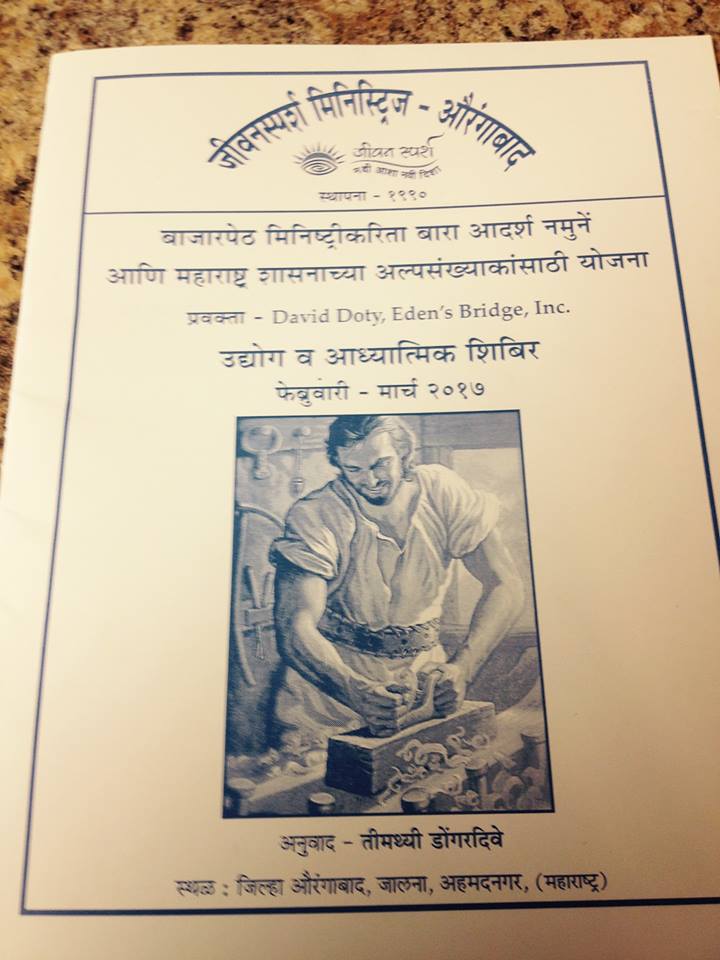
Author’s note: This essay was prepared for inclusion in a Marathi language handbook (see photo at bottom) distributed to participants in Marketplace Ministry / Business as Mission seminars I presented in Aurangabad, Jalna, and Ahmednagar (Maharashtra State), India earlier this month. The essay was prompted by the fact that this question was prevalent in previous sessions and subsequent communications with indigenous business and pastoral leaders.

Though Christians are not “of this world,” we must live in it for now. Bribery is a difficult issue we must face in many parts of the world.

There are typically two approaches to bribery among Christian teachers, missionaries, and pastors in places where bribery is a common practice. The first approach considers bribery as an absolute wrong and never to be done. In part, this is sound thinking as Christians should 1) never demand or accept a bribe, and 2) should never offer a bribe for the purposes of serving injustice. If someone will be harmed by paying a bribe (either materially or physically) while we receive undue benefit, such as a judge wrongly ruling in our favor or a business person seeking advantage over a competitor, both parties in the transaction are clearly guilty of doing wrong.

The second view accepts bribery as a cultural norm and the way things get done. In this view, paying the bribe does not place guilt on the one paying the bribe as it serves extending justice. For example, if a Christian was trying to carry aid to an underground church in a country where such aid would be prohibited by the government, the bribe may be the only realistic means of getting that aid delivered. Another example would be the case of smuggling persecuted people out of a country where their departure would otherwise be prohibited. In these cases, the officials are being paid to “look the other way.” In such cases, disobeying human rule to obey God is a legitimate argument from Scripture for paying the bribe.

The first approach, to consider an absolute ban on paying bribes, would likely have been the practice of the Pharisees. They likely would have allowed neglect or abuse to continue rather than violate the Law. However, the Apostle Paul points out that this is to put the letter of the Law above the Spirit of the Law: But now we have been released from the Law, having died to that by which we were bound, so that we serve in newness of the Spirit and not in oldness of the letter. – Romans 7:6.

Jesus admonished the Pharisees because they failed to perceive higher and lower principles within the whole Law: “Woe to you, scribes and Pharisees, hypocrites! For you tithe mint and dill and cummin, and have neglected the weightier provisions of the law: justice and mercy and faithfulness; but these are the things you should have done without neglecting the others.” – Matthew 23:23.

In paying bribes as a means to extend justice, the Cross comes into clear view where Jesus willingly paid an evil price for the sake of achieving a higher principled goal, the salvation of humankind.

The difficulty becomes, if we see paying a particular bribe as a lesser evil to gain a higher purpose, discerning such times appropriately. Praise God we can seek the counsel of the Holy Sprit in prayer, the Bible, and the advice of those in authority over us in the Church.

What does the Bible say about bribery and what we might infer by extrapolating the texts?

Here are some samples which address the main issues of bribery. Exodus 23:8 clearly and simply states “you shall not take a bribe.” Deuteronomy 10:17 says that God does not take bribes. Deuteronomy 16:19 and 27:25 focus on the power of a bribe to pervert justice. 2 Chronicles 19:7 also places the focus on taking a bribe. Psalm 15:5 is concerned with protecting justice, and Proverbs 17:8 draws a parallel between bribery and witchcraft.

Ecclesiastes 7:7 says that bribes corrupt the heart, in other words, driving participants more deeply into sin. Isaiah 1:23 equates taking bribes to thievery and in 5:23, again, we see the concern for protecting justice (rights). Isaiah 33:15 draws a comparison between unjust gain and taking bribes. In Micah 3:11, judges, princes, and prophets – all social and political leaders in the theocracy of ancient Israel – are all condemned for perverting justice in return for receiving money. Proverbs 29:4 tells us that taking bribes undermines the social, economic, and political stability of nations.

In these passages the clear concern in condemning bribery is that of corrupting justice. When two parties conspire, one demanding and one paying a bribe, to pervert justice (harming the innocent, oppressing the poor, or giving undue favor to the one paying the bribe) someone outside that transaction is being harmed. While Scripture always condemns accepting a bribe for any reason, it is also always wrong to pay a bribe that serves injustice.

But that is not as clear cut as it may appear because the one paying a bribe is harmed financially. This is where we must return to the issue of serving a higher purpose. There are times that not paying a bribe will allow a greater evil to continue or evil grow worse.

Let us consider war as an analogy. The Bible tells us not to “return evil for evil” – 1 Peter 3:9. Many will argue that we should not wage war. But a ruthless enemy can bring economic and social ruin, enslavement and lawlessness. These things hurt the most vulnerable the most. To allow such an enemy to take control is a great evil. But resistance to such an enemy may protect and preserve many, many lives and livelihoods. God grants civil governments the power to wage war on our behalf as a defense against growing evil. The evil of taking lives in resistance to evil power may well be the lesser of evils.

Bribes occur when one party possesses power (authority) that is unavailable to the other party. Either the first party demands a bribe or the second party offers a bribe to motivate the first to act on their authority. The one with power can withhold justice or threaten to perform an injustice or the one offering a bribe may do so with the intent of perverting justice. In both cases, bribery is grossly sinful. However, a bribe may be paid to ensure or restore justice. Here then the burden of sin falls on the person in the power position. This may well be taken an instance in which Peter commends us to submit even to unrighteous authority (unjust masters, 1 Peter 2:18).

Some examples of where the one paying a bribe might not sin would be in making payment to government officials or to utility workers to ensure the timely completion of their duties and tasks. The Bible does not condemn those who paid tribute to conquering kings (a form of bribe to appease aggressors).

It goes without saying that bribes should never have to happen. But there are times, especially as concerns the spread of the Gospel and our service to those in suffering, when we may rest assured that where sin abounds, grace abounds all the more (Romans 5:20). And we can pray that as the Gospel spreads around the world that laws and social morals against bribery will strengthen.

In the end, we must be very careful about paying bribes but there may be times, with proper discernment, that to pay a bribe may be the godly thing to do.

Seminar handbook

Why the Church Should Go into Business

God saw one thing in creation that was not good: Adam was alone. Other than my own ponderings, I have never read or heard why. But God’s response rectified the situation by creating a co-worker for Adam. Most theologians, preachers, and laity would point to Eve being created as Adam’s wife for the production of future generations but that is not how she is first introduced.

In effect, God created a market economy by introducing the division of labor so Adam (and Eve) could prosper together. That is, they could help each other by specializing in their work and thereby increasing the “wealth,” or creature comforts, of their existence by exchanging the fruits of their individual efforts. That increased comfort was to be a sign of God’s blessing, evidence of his grace.

Another little noted reality, which I had to point out to scholars working on a biblical theology of work, is that God did not command Adam to work: God created Adam to work. Read the text again. Commands to work in the Bible come only after Adam’s fall from grace as corrective instruction to overcome the influence of sin.

Vocation first, then trade, or exchange, are central to the original order and intention of creation. We often hear that work is inherently dignifying, giving a person the ability to contribute to their own support. What we miss is that their work contributes to the economic vitality of the whole world. We are, in the parlance of drudgery, simply cogs in the machine. But that perspective is exactly what the world would have us embrace over against God’s intention that we would find personal fulfillment by taking part in the economic health and betterment of all, from our households and co-workers at hand, to the farthest reaches of our tightly globalized economies.

Unfortunately, the Church has moved far away from business as being a “worldly” pursuit taking greed and abuse as the hallmarks of commerce. Should we likewise take infidelity and beatings as the hallmarks of marriage? Obviously, we answer “no” to the latter because we understand that sin has corrupted this “original” institution of God. We should embrace the marketplace just as we do marriage, bringing the redemptive grace of God to bear in the workplace and in trade.

The Church has embraced the concept of charity, that is, of giving through funds, services, and goods. That is right and good. But, though God saw a shortcoming in Adam’s existence he did not simply make it easier for Adam to thrive in Eden by directly providing everything for him. Rather, he gave him a job and created a market place, a more indirect facilitation for blessing.

So, how does this support the idea that the Church should go into business? Well, in many ways, the Church is already in business. We often think of the Church in predominantly institutional terms. But the Church is all of God’s people and the vast majority of its members enter the marketplace on a daily basis. Hence, in significant ways, the Church is already in, and doing, business, by working diligently, by applying the integrity of Christian ethic, and even in positions of empowering leadership.

The results include providing jobs and incomes, facilitating giving, and creating opportunity for growth economics to bless the lives of even more of the global poor, wresting them from the throes of poverty. And there is a significance here that can be easily missed.

When we survey the global scene, we are confronted by a myriad of hardships and striving. We have domestic racial divides and global political and religious conflicts. Interestingly, if we boil them down, nearly all are rooted in economic deprivation or strivings after economic power. Sex trafficking exists because 1) there is a market for sex (meaning people are willing to pay for it) and 2) there are unscrupulous people greedy enough to abuse others (typically the economically vulnerable) to make money.

Most religious conflicts are rooted in power struggles for influence and economic influence is most powerful of all as it affords the one with wealth to wield increasing legal and military strength. Hence we find struggles between ancient religions as they fight for cultural control and seek to extend their reach taking unto themselves more and more power via economic and political strength. No one would be aggressive in war if not for the ability to fund their supply chains and weaponry.

My point is, as we survey the Bible, we will find that there are two main ingredients at work in the devastations of humankind. First is alienation from God. The second is human autonomy due to that alienation. Because we fear deprivation, because we do not know or trust God to provide for and protect us, we hoard wealth and we fight one another. Our alienation from God reaps alienation from our own (human) race.
Why should the Church go into business? Because exchange, based in godly values, overcomes evil. Globalization has cut the rate of global poverty in half in the last twenty years. Trade mitigates strife between nations as trading partners realize the debilitating and economically draining impact of war. Jobs reduce crime in poverty stricken areas. Where more people have access to gainful employment, they are less inclined to steal to feed their families. Where education is understood to be a key element to a healthy economy, jobs proliferate and businesses thrive. Where economic provision reaches the furthest down the economic ladder, shalom, the overall well-being of society-at-large, grows.

Closest to home, we see whole sectors of our metropolitan areas marginalized where business closures and job losses, coupled with poorly run educational institutions, ill preparing youth to take part in even their local economies, lead into a downward spiral of desperation. That desperation supports illicit trade in prostitution (including pornography) and drug trafficking, both of which lend themselves to organized crime and gang activity.

Churches have an opportunity to impact their broader communities but most cloister, either as havens of escape in desperate communities or havens of excuse in wealthier ones. Sadly, most clergy have no concept of the biblical or theological legitimacy of commerce as God’s plan for humankind. It is this ignorance, and feeble preaching that does not pierce the heart to “love one another” and bless the poor, that keeps the Church in the West divided racially and economically. It is this ignorance that makes the Church’s charitable works repetitive trips to the same well, drawing deeper and deeper until the waters must be parsed out sparingly rather than overflowing in abundance.

The Church has the resources, not just of funds but of intellect (reasoning capacity), intelligence (that is, information), experience, and time to change the world, to witness to the glory of God for all the world to see, simply by self-sacrificially reaching out to bless the poor by welcoming them into the “rest” of economic viability. That witness is specifically why the Church should go into business.

On Evolution and Death before Adam’s Fall from Grace

Religious anti-evolution rhetoric poses a hollow argument against the development of God- consciousness in primates (as opposed to the spontaneous creation of full physically and spiritually complete humanity in Adam and Eve) by claiming that death came into the world through sin which did not exist before Adam and Eve partook of the forbidden fruit. On the surface, the argument sounds good but there are some very simple, though subtle, problems that undermine the argument.

First, God told Adam that the very day he should eat the fruit of the tree of the knowledge of good and evil he (Adam) would surely die. The Hebrew term for die is muth which is commonly understood to be physical death throughout the Old Testament so the doctrine of the introduction of physical death by this act of sin would appear to have at least one leg to stand on. The first problem is, if physical death had never occurred before Adam sinned, and obviously before God announced this particular penalty in Genesis 2:17, Adam would have had absolutely no understanding of the concept and God’s proclamation would have been meaningless without such a point of reference in Adam’s experience or knowledge. We have no indication whatsoever from the text that God supernaturally explained or infused a knowledge of death into Adam’s understanding.

The second problem is the bigger one and comes in God’s judgment in Genesis 3:14-24a. The direct result of Adam’s sin was numerous curses placed on Eve, Adam, and the ground, then Adam’s banishment from the Garden in 3:23. The problem is not explicit here but is implied if we take God’s original commandment in 2:17 to mean physical death (as an argument against physical death before the Fall). After he sinned, Adam did not die physically. If we adhere to a literal interpretation, that would mean 1) God lied and 2) the serpent was the purveyor of truth. But we know from the rest of Scripture and by the witness of the Holy Spirit that 1) God does not lie and 2) Lucifer misleads by means of deception.

The solution to this seeming inconsistency on God’s part is to realize that what made Adam and Eve human as divine image-bearers, was not their physicality, that is, we easily assume that our physical nature is not reflective of the image of God since God is Spirit and has no physical nature. What made them human was god-consciousness which allowed for communion with God. It is relatively easy to understand that I can have no overt relationship, and especially an intimate one, with someone or something of which I have no knowledge of its existence. When God breathed life into humanity, he breathed into a pre-existing body which was created before god-consciousness was possible, even according to the order of operations in the text itself in Genesis 2:7. In this sense, becoming a “living being” takes on a very different meaning than simply drawing breath of oxygen. It means drawing a different kind of vitality from the realized, inspired (or “in breathed”), notion of the divine.

When we speak of death, we most often think in physical terms but we do not consider the extended etymology of the term itself. The Hebrew term, muth, carries both a figurative and a literal sense. Adam did not die literally, that is, physically, from God’s judgment on his sin. Rather, Adam died figuratively, spiritually. As he was displaced literally from God’s presence in the Garden, he was also displaced figuratively from God’s presence spiritually, from intimate communion. We do not die in a literal sense when we sin but our sin separates us from communion with God because our unholiness cannot abide with the holiness of God.

If we die unrepentant and unforgiven in our sin, we ultimately suffer twice in the loss of physical communion with the world and our loved ones and also in the loss of spiritual communion with God. We can attest to humankind’s fallen nature and the struggles of life – according to the laborious nature of Adam’s work after the fall and even the resistance he meets in his enduring interactions with the rest of creation (the coming forth of the thorns and thistles from the accursed ground) – due to our spiritual isolation from God.

While our species likely evolved physically very much along the lines science suggests, god-consciousness was the spontaneous act of God’s grace – the infusion of divine breath – that made Adam, and us, aware of the reality of God and called into being response-abled humanity.