Category Archives: Faith in the Marketplace

On Doctrine and Unity

I have been blessed that my research and networking has put me into contact with conversations and writings from a wide range of Christian thought, from Pentecostalism to Roman Catholicism to Calvinism to Wesleyan-Arminianism. What has struck me is the kaleidoscopic array of doctrine and the questions it poses about being right or wrong and what we do with such a spectrum of thought as a divided and, in many unfortunate ways, dysfunctional Church.

It fascinates me that so many highly intelligent people can reach such different conclusions from reading Scripture. There are surely cultural influences and assumptions gleaned from our formational church traditions and surrounding culture. I commend those who defend doctrines of their denomination or tradition but more for their zeal in the pursuit of truth than for their unflappability in adhering to what they hold true. The big divider there is “the pursuit of truth.”

I have come to think that the Church probably holds 95% or more of truly critical doctrinal beliefs in common–the Incarnation, the Virgin Birth, the divinity of Christ, the atonement for sin of the Cross, the Resurrection, and so on. We hold these things as truth and should. Sadly, the other 5% that divides us tends to be where our conversations break down and we go our separate ways in frustration or even in anger.

What is troublesome is that we hold so tightly to doctrine we are willing to sacrifice relationships for the sake of “knowing” that we are right. That flies in the face of the Bible’s consistent message of reconciliation. Of course it would be absurd to cling to doctrines we did not believe. So how do we handle these differences? How do we live with the tensions of not knowing which is right?

Much of the conundrum is created by our propensity toward stating our claims in either / or format. Two problems can arise from such an argument. One, it is possible that the two are not actually contradictory but only contrary. The either / or positions presents them, however, as contradictory and so we assume we must believe one or the other carte blanche. The second problem is that we end up with all or nothing propositions, that is, statements or stands that allow no shades of gray or nuances. Ultimately these propositions are the seeds of legalism.

The origins of holding too strongly to one’s positions are pride and fear. We want to trust in what is “seen,” that is, in propositions we can clearly define, or nailed down, if a very graphic reminder can be allowed. We like black and white because they give us a clear perception of reality. But let us consider what we are discussing here. To follow God we try to know God then formulate our opinions of how to act based on that knowledge. In many cases the appropriate actions are clear enough. But here again, a couple of problems arise.

The first problem is that we create rules. We often hear teachers and preachers talk about how Israel (and we) could not / cannot keep even the Ten Commandments…just ten little rules. The sad thing is, Adam and Eve could not keep even just one! What makes us think we can keep the rules we can state clearly, to live by standards we create from our limited understanding? Or, that we can state enough clearly to be righteous before God? The New Testament is clear…rules divide, the Law kills. In our failing to keep all the rules, we are separated from God. At stake here is living in vital relationship with God, just as we live daily in vital relationship with our sisters and brothers in Christ, with our children and parents and spouses and co-workers and church. Circumstances change and our reactions to these folk ebb and flow depending on how they are acting or responding or based on the circumstances of the situation itself.

Notice that Joshua says that he and his household will serve the Lord (24:15). He frames his religion in terms of availability and obedience based on historic interaction (vv. 2–13), not doctrine. He understands that God commands, leads, and intervenes situationally. Joshua will serve as a response to all that God has done for the patriarchs and the nation Israel. It is about a dynamic relationship. And Jesus lifted David up as a righteous rule breaker (Matthew 12:3–4) in denouncing the legalism of Israel’s religious leaders.

The second problem occurs in our relationship with God. In effect, when we carve our doctrines in stone, we are killing the relationship with God. Rules-making is, in effect, trying to keep God in a box. We reduce God to our control. However, if we were to quantify what we know specifically before the presence of God, it can be defined mathematically as 10-∞, that is, ten to the negative infinity. God is infinite and His knowledge is infinite. Ours can only be expressed in the negative by comparison. Science bears out that we have achieved virtually nothing in trying to understand all of physics and human physiology, let alone trying to comprehend the mysteries of God. We should take to heart 1 Corinthians 3:18-21:

Let no man deceive himself. If any man among you thinks that he is wise in this age, let him become foolish that he may become wise. For the wisdom of this world is foolishness before God. For it is written, “He is the one who catches the wise in their craftiness”; and again, “The Lord knows the reasonings of the wise, that they are useless.” So then let no one boast in men.

To me, “to become foolish” is to recognize my own limitations and, in so doing, to recognize the limitations of others.  Andrew Murray makes the claim in his small book, Humility, that we will be humbled when we recognize God as God, for Who and What He is, and recognize ourselves in light of God. I am a fallen creature redeemed by the blood of Christ. But my flesh, that dwelling place of my pride and fear, would try to convince me that I have attained far more than I have. If I do not make myself aware of my lowly state, of body and mind, then I am truly a fool. If I choose to “become foolish,” I can more easily submit to God and be honest in saying “I don’t know” when it is appropriate, or listening intently for God’s voice when others present ideas or thoughts contrary to my own. That is iron sharpening iron (Proverbs 27:17).

I like Ecclesiastes 3:1-8. This passage sets us up to see that we are faced throughout life with changing circumstances and possibilities of response.

1 There is an appointed time for everything.

And there is a time for every event under heaven– 

2 A time to give birth, and a time to die;

A time to plant, and a time to uproot what is planted. 

3 A time to kill, and a time to heal;

A time to tear down, and a time to build up. 

4 A time to weep, and a time to laugh;

A time to mourn, and a time to dance. 

5 A time to throw stones, and a time to gather stones;

A time to embrace, and a time to shun embracing. 

6 A time to search, and a time to give up as lost;

A time to keep, and a time to throw away. 

7 A time to tear apart, and a time to sew together;

A time to be silent, and a time to speak. 

8 A time to love, and a time to hate;

A time for war, and a time for peace.

The whole point of this essay is that we should humble ourselves and, I think, most especially where it comes to points of doctrine. We are all operating with incomplete knowledge and our pride (thinking we know more than we do) and fear (not trusting those of other doctrine and traditions to the oversight of God) compel us to discount the opinions of others, and even to divide the Church over our opinions. Though we claim to know that we see as through a glass darkly (1 Corinthians 13:12), we are quick to offhandedly dismiss everything someone from an “opposing” camp has to say.

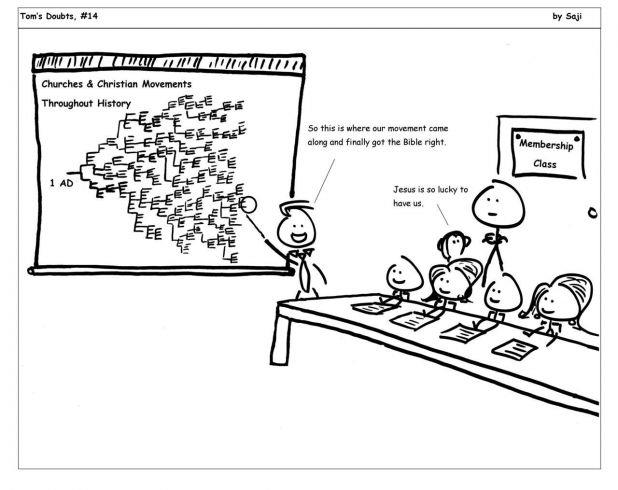
Who among us can say that our understanding of the Bible is the right one? The cartoon below has shown up on Facebook, posted a couple of times by my friends. The absurdity of the cartoon would be funny if it were not so sadly true. Paul wrote, in Philippians 2:3: Do nothing from selfishness or empty conceit, but with humility of mind let each of you regard one another as more important than himself.”

We must not place our trust in those doctrines that consistently divide. Satan knows the Scriptures better than any of us. He also knows us better than we know ourselves. We must be on constant guard to assess what is happening relationally when we find ourselves vexed by various opinions, or more importantly when those opinions start pushing our blood pressure toward the roof.

To justify our positions and our “righteous anger,” we even go so far as to convince ourselves that we have the discernment that Christ had when He became angry in the Temple or called out the Pharisees for their legalism. To appropriate (and adapt) a famous line once delivered during a political debate: “I know Jesus Christ…and I am no Jesus.”

Ultimately, holding our doctrines loosely honors God in the humble recognition that His ways are far above ours (Isaiah 55:8). Do we want to worship a God that we can understand to the nth degree? Our God is far more than we are, beyond our comprehension…able to save us from ourselves when we cannot. Allow God to be mysterious. Love people, even sinners, more than doctrine. Jesus did.

The life of the Church and of the world is at stake here. That is, our spiritual well-being hangs in the balance as we are the Church and the agency of Christ sharing life with the world. What witness is it to the world when within our own body we are afflicted, disjointed, and broken without healing? What value are we to the Kingdom when we stand on being right before we kneel in humility before God?

Leave a comment

Filed under Devotionals & Meditations, Faith, Faith in the Marketplace

For the Love of Drill Bits, or Tool Box Economics

Imagine if you will, a society foreign to our own, where money has been banished from daily life. There is no medium of exchange and the populous is removed from working in a once thriving economy to one of simple barter. That is until someone discovers that, for whatever reason you can imagine, since from the inception of this story you have already been imagining things, that drill bits have been found to be of particular value in this now overly simplified economy.

But drill bits, though valued as highly as they are, are not necessary for daily use in whatever process it is that makes them of such sublime value. But necessary, more generally, they are. Some certain persons began to worry that, at some particular point in the future, they might be in need a of drill bits and find themselves without. They began to be more diligent in the pursuit of drill bits, even resorting to drill bit hoarding, and hence a new currency economy emerged, revolving around (and around and around…pun fully intended) around drill bits.

It absolutely must be shared also that in an adjoining province, the necessity of drill bits was all but nonexistent. Seeking after drill bits and especially hoarding them would have been utterly nonsensical. However, in that adjoining culture, hammers…yes, hammers…were the cat’s meow. If one were, over time, able to collect a multitudinous collection of hammers, that one was not only believed to be secure, in this second tool-based economy, for life, but was generally also widely considered wise and to be admired. Some even began to have their higher quality hammers plated in silver and gold (which were oddly overly abundant) and the handles bedecked with the emeralds, diamonds, and rubies that could be found lying about the fields.

Needless to say, the pursuit of drill bits and hammers took on a life of its own. Some even believed that somehow, mystically, drill bits and hammers, obviously in each respective province, bestowed favor on their possessors. Drill bits and hammers became objects of great desire,…pursuing them, owning them an obsession…to the degree that one might even call it worship, in that many individuals, and whole classes of citizens, committed themselves entirely to the pursuit and exchange of drill bits and hammers. Special storage facilities were created with heavy vaults to keep these precious tools secure and the practice instituted of lending drill bits and hammers to those who might find themselves in need of them but also finding themselves, in that particular moment, without any drill bits or hammers.

The obsession with drill bits and hammers grew enormously popular, to the point that some found themselves unable even to borrow drill bits or hammers because some few in society hoarded so many. For those without, life became a struggle again since drill bits and hammers had become the currency of choice, and the society began to be divided, between those with drill bits or hammers and those without drill bits or hammers, due to the obsession of the With’s. Bitterness ensued and society became less and less congenial and more and more disillusioned and all manner of accusation and divisiveness and muttering was heard daily at the too often barren hardware stores.

Ludicrous as this story may be, I hope it has become obvious that the love of drill bits or hammers supplanted not only a balanced, enjoyable society but unbalanced the minds of the With’s as their obsession overtook social sense.

We are wise to remember that money is just a tool that, like drill bits or hammers, can be used to good purpose for the interest of society or ill-abused to hedge against the fear of falling into poverty or to serve the self-aggrandizement and ego of its possessors. But how odd that we find it ludicrous, the idea of, in effect, serving, that is worshiping, the cause of drill bits or hammers, simple tools, while spending our lives, our relationships, and too often even our health, in the pursuit of money above living in righteous community the way God desires.

“No one can serve two masters; for either he will hate the one and love the other, or he will hold to one and despise the other. You cannot serve God and mammon.” – Matthew 6:24

2 Comments

Filed under Discipleship, Faith in the Marketplace

Doing the Impossible

And Jesus said to him, “’If You can!’ All things are possible to him who believes.” – Mark 9:23

God has charged me with an impossible task. I will not get into that here and now but rather want to think through wrestling with pursuing an impossible vision. I am but one man and the vision is logistically vast and complex, far beyond my capabilities. But Jesus’ words ring in my ears, as do Paul’s: “I can do all things through Him who strengthens me” – Philippians 4:13.

Facing the seemingly impossible, ten of the scouts who went with Joshua (Hoshea) and Caleb into the land of Canaan reported that the people of that land were too strong for the Israelites to overcome (Numbers 13) despite Joshua and Caleb’s faith that Israel could succeed. For the lack of their faith, Israel spent the next forty years wandering in the wilderness. Sadly they had forgotten that God promised to send His angel before them to destroy the inhabitants of Canaan (Exodus 23:23), that He would drive them out Himself (Exodus 34:24). The first key to doing the impossible is the God who calls us to the task. He is able to do all that appears beyond our limitations.

The stories of Moses present several more keys. Two instances in Moses’ response to God’s calling serve as perfect illustrations of how God wants us to respond to His directives when they seem more than we can do. In the first case, Moses cries out to God about his own limitations (or even perhaps out of his reluctance to be the leader of Israel). In the second, having taken charge of his calling, he works himself into a corner and godly counsel finally shows him the way out.

When God called Moses to speak to and lead Israel, Moses complained of his lack of oratory skills, being “slow of speech and tongue” (Exodus 4:10). God was upset with Moses for his lack of faith that God could and would equip him for the job but offered him an out, his brother Aaron, which cut off any further reluctance on Moses’ part. Moses would supply the message and Aaron would speak to the congregation. God gave Moses a co-worker more skilled in one particular aspect of his calling. In business, two working together have proven substantially more likely to succeed, as the cooperative and collaborative efforts of two minds are more effective than someone flying solo. The encouragement of a partner to carry on when one is feeling depressed or defeated increases exponentially the likelihood of endurance and success. The second key to doing the impossible is finding the complementary skills in others that empower the endeavor at its fundamental level. Few if any successful leaders believe they can handle every aspect of leadership.

The second case came later in Moses’ administration as he sat as Israel’s judge. He was, so to speak, the Supreme Court, for a nation that likely numbered at least three million men, women, and children. The caseload was beyond taxing as the people came to Moses “from morning to evening” (Exodus 18:13) to decide their legal cases.

Moses’ father-in-law, Jethro, was a wise man. He had several advantages when looking at what Moses was up against. First, he had more life experience. He was the priest of Midian (Exodus 3:1), so he had some particular experience as a community leader. He also had the advantage of not being buried in the work that Moses was doing. He could stand aside from the situation and see that Moses’ approach was killing him (wearing him out – Exodus 18:18). Jethro had the advantage of objective distance and detachment from the frenzy of the work. The third key to doing the impossible is to seek and listen to godly, objective counsel. Find those who have experience in the things you are pursuing and engage them in the conversation. Then be humble enough to submit to changing your ways. The fourth key, though subtle, is to take care of physical and mental health. Don’t wear yourself out. If you do you are no longer any good to anyone. The fifth key: recognize your own limitations. Be humble enough to recognize to do the things you are best at or are essential to your role, and find others to do the rest.

The last above, recognizing your role and the roles of others, were illustrated in Jethro’s advice. His counsel contained three specific nuggets of wisdom (Exodus 18:20–22). First, he advised Moses to teach the people the statutes and laws so that all would have an understanding. There are two elements to this. The first is that Moses was to create a literate society. The second is that expectations were to be clearly stated. There would follow no real excuse for not knowing how things were supposed to operate going forward.

The second nugget in Jethro’s advice was his “hiring principles.” Those chosen were to be equipped, which gives place to ensuring they have the requisite skills and training, and they were to be humble (god-fearing, truth-seeking, and not ambitious in worldly things). This is all about seeking out those of the right intellect, education, and character.

Jethro went on to advise Moses to create an organizational chart, dividing the tasks to be carried out and installing the lesser judges according to their skills. Moses created a hierarchy of those to oversee thousands (vice presidents), hundreds (executive directors), fifties (directors), and tens (supervisors). Much like our current hierarchic system of courts, issues that arose would have many points of responsibility to pass through before they reached Moses’ desk.

Such order of dividing the tasks and responsibilities of Israel’s organization then made it possible that only the most important, big issues came before Moses. His workload was cut dramatically and he could give due diligence to the heavyweight decisions rather than being distracted by the inconsequential. His tasks were in accord with his position. There is an extra element in bringing such order to any organization. Moses bore the responsibility for overseeing the whole of Israel but he could rest, having chosen lower level leaders prudently and knowing he could trust them to handle issues of less importance without troubling him. Empowering an organization requires empowering everyone down the hierarchy to not fear making decisions pursuant to their level of responsibility. Surely some made mistakes but that is why the stations higher up the hierarchy were there, to ensure consistency and help oversee any corrective measures that needed to be made before these issues found their way to Moses.

Let’s rehash the relevant points (and add a couple more) for Doing the Impossible:

1)     Rejoice, pray, and give thanks. Rejoicing, praying, and giving God thanks are “God’s will for you in Christ Jesus” – (1 Thessalonians 5:16-18). Begin and end all that you do in the will of God. This is living and walking by the Spirit (Galatians 5:25) as children of God’s light (Ephesians 5:8). Rejoice in all that God has done and is doing. Pray listening. Be thankful for God’s blessing, even those found in promises not yet fulfilled in your sight.

2)     Walk uprightly. To know how to walk uprightly, it is best to be in fervent relationship with God, His Church, and the Bible. The bottom line is that God requires that we “do justice, love kindness, and walk humbly with God” – Micah 6:8. We need to understand God’s perspective on justice, kindness, and humility. With that knowledge in hand, root out any behavior that undermines them in any area of life. When we live with integrity, we are “vessels for honor, sanctified, useful to the Master, prepared for every good work” –2 Timothy 2:21.

3)     Have faith. First in God, that He is able to see the task through (with or without us), then that He equips those He calls. We may have some of the skills necessary to complete the task and God typically will not call the utterly inept to a task far outside their expertise, but we must remember, it is God’s mission and He is able. He will provide a way to overcome any shortcomings we have.

4)     Listen to godly, objective counsel. Those with enough detachment to look over the situation and see what we cannot are not under the burden of putting out all the fires we may be battling. Seldom will you find the Fire Chief manning a hose or entering the burning building to rescue those inside. He can stand aside, see the bigger picture, and advise the Captain without distraction.

5)     Set boundaries. The demands of leadership can quickly become overtaxing. There are always more things that could be done than can get done. If we go to our own well too often, one day we will find it has run dry. God’s admonishments are toward rest on regular intervals. If the work is important enough, God will provide for others to help.

6)     Recognize your limitations. We all tend toward having big egos. We also tend to think we know more than we do and take on tasks which are better left to others. God gave Adam a helpmate because He knew Adam could not prosper adequately by doing everything himself. This applies to time management (see Set boundaries above) and humility in recognizing your own lack of particular expertise.

7)     Create a literate and expert culture. Make sure everyone on board has the appropriate knowledge and training for the tasks at hand. In every game, there are rules. In every business there are best practices. Insist that everyone in the organization knows the rules and is always pursuing continuing education.

8)     Be clear about expectations. Nothing undermines organizational achievement more than a lack of well-defined purpose, clear direction, and systematized effort. Make every effort to know that every player in the game knows the game and their part in it. Without these, no endeavor accomplishes anything more than a light bulb in bright sun light. It may expend a great deal of energy but will be of no value to anyone. And it will produce substantial waste.

9)     Hire character. In Christian businesses or not-for-profits, hire those who have already begun the journey of faith in Christ. For one, we are not to be unequally yoked (2 Corinthians 6:14). Be wary of the overly ambitious. Money and career advancement can become gods unto themselves. These folk are at cross purposes with the organization as they place their own ends ahead of the enterprise.

10) Organize and divide the work. One of the best exercises I have ever seen is to design an organization as if it is already all that it is hoped to become. Divide the ultimate work loads into appropriate departments, then create the employee positions suited to the specific kinds of work. Hire the abilities (and character) of the workers who will fill them. This prevents re-inventing the organization, avoiding many unforeseen needs and unplanned hirings, along the way.

God is the God of our well-ordered universe. The design of creation shows that everything produces after its own kind, whether plant, animal, or human. If we want good results, we need good inputs, especially of faith, obedience, and diligence. Ultimately, God is God and only He can do the impossible. Fortunately, He sometimes lets us take part.

2 Comments

Filed under Faith, Faith in the Marketplace

The Redemptive Logic of Subjectivity

Do nothing from selfishness or empty conceit, but with humility of mind let each of you regard one another as more important than himself.” – Philippians 2:3

As I continue research and press forward toward launching the marketplace ministry I believe God has called me to, I find a broad range of views and concerns within the Church expressed along many different lines. Conversations on the theological level, thankfully, in the marketplace arena have not diverged too deeply into the differences of various Christian traditions but there are some interesting conversations that do arise. One twist is the concern over the division of the Church into its various traditions (Eastern, Roman, Protestant) and denominations (now numbering something like 30,000 among Protestants). I am an ecumenist and I believe the greatest opportunity for the unity of the Church may reside in the marketplace where how we go about ministry can easily transcend the particular flavors of faith in which we find ourselves. We even find ourselves thrown together in the marketplace and recognize the shared foundations of our faith without overt concern about how we might differ. Rather, I am encouraged by the focus I continue to find directly toward worshipping God in the overwhelming commonalities of our faith, especially the Lordship of Jesus Christ.

As I awoke this morning, the phrase “the logic of subjectivity” was drifting about in the fog of emerging from sleep. I wondered how that applied to the Christian faith and especially to the marketplace of God’s blessing and ministry to His Church and the world.

I am sure I will get no argument along the line of recognizing my own limitations. I am like everyone else, painfully aware of my own finitude. I have had some great Bible teachers in my life and have sought to study it extensively on my own. But if I have learned anything it is to hang on very loosely to much of what I think I know. I have had the opportunity to meet many gifted Bible scholars. For the most part, these are women and men who will quickly concede, ultimately, they do not know all that much.

I think the idea comes to light if we consider our limitations in light of the unlimited nature of God. That is why we all now see as through a glass darkly (1 Corinthians 13:12), simply due to our complete inability to truly grasp God. He makes Himself known to us in a great many ways but no one of us, or even all of us together, can know Him even remotely as He truly is.

Unfortunately our egos too often get in the way, crowding out true humility as we seek to know God in the context of our relationships with His people and the rest of His creation. We do not care for the tension between our limitations and God’s infinity, so we tend toward pride in establishing all that we think we know, rather more than the foundations we all likely share, as chiseled in stone. Our relentless grasp of various doctrines and beliefs not only chokes our own ability to grow in the Spirit but serves to cut others off from that same grace.

Why would God allow such things? It certainly is not His plan or desire. Jesus prayed for our unity (John 17:11). How can we be unified when we hold so many different positions and opinions?

There is but one path that will “take us home.” The diversity of the Church holds a subtle key to God’s redemptive stroke in overcoming our pride, the pride that divides us. That key is humility. How do we reconcile our differences? By standing on our commanilities. Jesus Christ is Lord, He was crucified, and He arose from the dead. Those facts should astonish us enough.

I consider it nothing other than a demonstration of God’s redemptive genius that by the Holy Spirit He leads us into relationships where differences must always occur. We each live according to our beliefs born out of our unique experiences and knowledge. Not two of us have identical histories. Our views of life and the world on most topics are therefore necessarily subjective, our individual interpretations of reality no matter how closely we align ourselves with a particular sect or teacher.

The genius lies amidst those relationships for, as we encounter the views and beliefs of others (again, within the Christian faith), we are confronted, if we are open and honest, with our own limitations. Hence the opportunity to walk in the humility that is due our created nature. God is God and we are not. His knowledge is perfect. Ours is constrained by our limits and tainted by our broken, sinful flesh.

God’s redemptive logic in allowing us to be so limited in this particular allows us the opportunity to see ourselves honestly. He grants us the opportunity to grow in grace and humility. The kaleidoscopic nature of the Church…of every tribe, and tongue, and people, and nation (Revelation 5:9)…gives us a view and an opportunity to behold some of the beautiful glory of God. If we cannot step away from our egos, our vision is limited and we will miss it.

Leave a comment

Filed under Devotionals & Meditations, Faith in the Marketplace

When Life Gives You Limens (not a misspelling)

A limen is simply a threshold, a point of crossing so to speak as in a cultural shift or a change of employment, income, social class, or any other kind of movement from one status to another. Right now, the world is at a liminal moment. We are moving, full speed ahead, into the information age which is dramatically affecting how we “do business” as an ever increasingly integrated world.

Since most new “products” are information based – data, software programs, digital images or other recordings of sound and video – and the Internet dropping the time and relative cost of moving these products to nearly nothing, how information is shared, bought, or sold is already radically different than it was just twenty years ago. The printing press was such a revolutionary device that created a “new” world by the cheap proliferation of information. The Internet is the printing press on steroids, third generation mutation, then zapped with radioactivity. It is like comparing a student’s backpack for cartage to a shiny new oil supertanker.

So what does this liminal moment mean for the integration of faith and economics, for the spread of religious doctrine, for influencing history toward the aims of God’s mission in the world?

Robert Wright, in his book Non-Zero: The Logic of Human Destiny, makes the point that the speedier the access to sharing information, the more broadly folk interested in similar things can coalesce and increase their effectiveness in getting things done. The business world is already moving very, very fast on this new frontier and has already developed means the Church can appropriate for mission.

There are various communications technologies that churches and mission organizations are already using—multimedia, virtual meetings software, Internet broadcasting. How can we, especially ecumenically and globally, use new technology to advance God’s Kingdom? I am very interested in hearing from as diverse a range of voices on this as possible. Let me know what you think.

I will say this. Businesses, driven by a profit motive alone (the vast majority), are at the forefront of pushing further development of technology and trying to optimize existing technologies to gain productive efficiencies and market share. Does the church not have, ultimately, a more important message and a higher motivation?

As I said before, we are not just at any old threshold in cultural evolution. We are standing on the precipice of epoch level changes in how the world operates. Where do we take this conversation to help answer Jesus’ prayer that the people of God would be one as Jesus and His heavenly Father are one, that we might be salt and light to the world, our works glorifying God?

New technologies, changing economies, thought development…transglobal communications unprecedented in human history. Surely God sees opportunities for us to step up to the next level. My Google search on the phrase “technology in Christian mission” returned disappointing results. Why is the church so sadly behind the rest of the world? I guarantee Greenpeace and the environmental movement in general is way ahead of us on connecting the movement globally.

I would make a special note to mention David Miller of Crosscape Networks in Werrington, New South Wales, Australia (http://www.crosscape.com.au/site/index.php) for creating MissionTechWiki (http://www.missiontech.info/wiki/Main_Page). From there you can jump to the International Conference on Computing and Mission (http://www.iccm.org/).

How many of us have even heard of this organization? We are looking face on at perhaps the greatest opportunity for the advancement of global Christianity yet we seem to be lagging behind. Folk, we have a lot of catching up to do!

Stay tuned…

Leave a comment

Filed under Faith in the Marketplace

From Eden’s Bridge: And Then the End Shall Come (Teleology)

(This essay is a close adaptation excerpted from the book Eden’s Bridge: The Marketplace in Creation and Mission, © David B. Doty, 2011, available from the author or from Wipf & Stock Publishers. This essay should be read with the thesis of Eden’s Bridge—the marketplace is an institution of God, implicit in the creation narrative of Genesis 1–2 and vital to God’s mission in the world—in full view.)

There is on our day a great deal of confusion concerning the end times and such. Teleology, the study of design or purpose, has a great deal to say concerning the future as prophesied in the Bible.

Jesus said, “And this gospel of the kingdom shall be preached in the whole world for a witness to all the nations, and then the end shall come” (Matthew 24:14). The “coming end” occurs at a point in time but time is not the focus of the statement. Rather, this end concerns a particular conclu­sion, in the sense of the adage “the ends justify the means.” The end of which Jesus spoke is the achievement of a new (renewed) status of social and political reality, the end of worldly affairs as they now stand under the corruption of sin. Jesus was speaking of the fulfillment of God’s ob­jectives in human individual and socio-cultural reformation.

Under consideration is the Greek term telos, from which the word teleology is derived, the study of the ultimate purpose or design of things. A telos may correspond to a particular point in time but refers more specifically to a change of status. It is in this sense that “Christ is the end [telos] of the law so that there may be righteousness for everyone who believes” (Romans 10:4). To better understand the end of which Jesus spoke, in contrast to a date, consider the use of telos when the angel spoke to Mary of the son she would bear. She was told that Jesus’ kingdom “will have no telos” (Luke 1:33). In other words, the reign of Christ will endure forever unchanged. The Kingdom of God is the end, the culmination of God’s redemptive intention, recovering God’s people and creation from the current corruption of sin.

Different approaches have been tried to bring about Kingdom te­los, such as social engineering, progressive politics, and even scientific development. If not inspired and led of God, attempts at political and social innovation will only improve conditions temporarily. The telos we look forward to is the ultimate reign of Christ in human hearts and social institutions. Where Christ rules (now only in part), the future culmination of the Kingdom begins to come into view.

In the church, the telos of God has been hindered by shallow the­ology, false doctrine, and misguided isolation from the world. Certain theological claims of the past two centuries have unconsciously reverted to a form of Platonic dualism which puts temporal and spiritual reali­ties in opposition. These claims can result in doctrines of escapism and expectations that the earth will meet a cataclysmic end to be replaced by an entirely different planet. The latter, in turn, can undermine creation care as part of the tending the Garden mandate.

The church has also been guilty of devaluing good that comes from secular activities simply because it was carried out by those who deny or ignore Christ, or who do not know of Him at all. If all good things come from God (James 1:17), then the positive impact of humanistic efforts by environmental groups or secular humanitarian agencies, for example, can be attributed to God. They are still dead works however and impute no righteousness to the participants. Opportunities to glorify God and witness to the world are missed when Christians refuse to come along side non-Christians to do good. God is advancing His mission in some cases in spite of the church, such as environmental efforts by secular organizations like Greenpeace, and social advancement activities like the poverty alleviating efforts of the United Nations and other non-government agencies, no matter how misguided or marginally successful either may be.

We are invited to take part in the Kingdom of God now. Evangelism opens the door to personal and social salvation. It is right that preaching “Christ and Him crucified” (1 Corinthians 2:2) hold the preeminent position in the ministry of the church to the world. But the Great Commission is to make disciples of all nations (Matthew 28:19). Discipleship empowers the reformation of the human social condition, infusing godly wisdom and power into systemic institutions through the disciples He calls to influential roles within them.

The telos of God’s coming Kingdom is modeled in the Garden nar­rative. It is to that model of fellowship with God and abundant provision that the world is being returned. In the interim, the powers (social and economic) and principalities (political) against which we contend are largely the corrupted formal (legal) and informal (cultural) institutions of this world. The Kingdom telos will overcome ungodly cultural norms, the greed of economic injustice, the biases of marginalization (racism, for instance), and the towers of corrupt governance.

In the Kingdom telos, overarching human institutions (i) —family, ideology, education, media, the arts and entertainment, commerce, and governance—will be renewed by the power of Christ’s love, to the glory of God and the restoration of Edenic shalom.

Jesus taught a quite a lot about economics, possibly more so than on any other topic, in relating temporal life to the Kingdom of God. The condemnations of Israel by the prophets were largely focused on the disobedience of God’s will in the economic and political oppression of the masses by the wealthy, priestly, and monarchical authorities. An important focus in the Kingdom telos is distributive justice. God gave a redemptive model of human economics in the statements on His provi­sion for Israel in the promised land of Canaan in Deuteronomy 8. He promised that the land would provide for the people in abundance (vv. 7–8) and that they would lack nothing (v. 9), that it would be a place without miskenuth (scarcity or poverty).

In economic studies, scarcity refers to the fact that finite limitations of material and non-material resources preclude fulfilling all human wants. A lecturer once made a logical point: land is not able to produce beyond its natural limitations. That is to say that material scarcity, in some sense or the other, remains. The requirement for Israel to over­come material shortfall (chaser, to lack or need—Deuteronomy 8:9), however, was adherence to God’s commands (v. 6). The eradication of poverty (lack or indigence) hinges on distributive justice founded in the love of God. Jeffrey Sachs, in The End of Poverty, implies that we have the eco­nomic ability to eliminate abject poverty in this generation. (ii) But we lack the political will to do so. That is a condition of the heart, not the mind, nor the limitation of the land to produce. While we have the ability to provide for all, deprivation is propagated by political failure motivated by selfishness, i.e., sin.

The end (telos) will look a great deal like the beginning, the shalom of Eden restored. God provided for and orchestrated the division of the land of Canaan (Numbers 26:52–27:11; 34:1–3:34; Joshua 13:1–21:45) such that all would have access to the primary means of production for their perpetual provision. God also commanded the jubilee law that would restore any sold land to the original owners (Leviticus 25:9–55) every fifty years (v. 28). No one was precluded from retaining the wealth they may have accumulated other than real estate.

It is not unreasonable to consider that inordinate concentrations of wealth are outside the will of God, specifically if poverty reigns amongst the masses and over multiple generations. The word-picture of the New Jerusalem, with its foundations made of precious stones and the city of gold, in Revelation 21:18 and 21 is poignant. It shows that when the wealth of the world is appropriated according to God’s will and distrib­uted righteously, it will overflow all need, and that the measures, sym­bols, and means of accumulated wealth will be moot.

When the end comes, the date will be of little importance. What will be important is the fulfillment of a new (renewed) social and politi­cal reality, and the just distribution of wealth.

i. Hillman, Os. Reclaiming the Seven Mountains, 2011. No pages. Online: http://www.reclaim7mountains.com. I have adapted and modified the list of cultural pillars, substituting ideology for religion.

ii. Sachs, Jeffrey D. “Introduction” to The End of Poverty: Economic Possibilities for Our Time, 1–4. New York: Penguin Books, 2005.

Leave a comment

Filed under Excerpts from Eden's Bridge the Book, Faith in the Marketplace

from Eden’s Bridge – Excursus: On Capitalism

(This essay is a close adaptation excerpted from the book Eden’s Bridge: The Marketplace in Creation and Mission, © David B. Doty, 2011, available from the author or from Wipf & Stock Publishers. This essay should be read with the thesis of Eden’s Bridge—the marketplace is an institution of God, implicit in the creation narrative of Genesis 1–2 and vital to God’s mission in the world—in full view.)

Market functions have existed on a wide variety of levels from creation forward. Capitalism is a relatively new twist to market economics and human history, evolving through various stages of development over the last five hundred years.(i) But the potential of the marketplace has unleashed an unprecedented era of collective imagination and hope.

Within capitalism, entrepreneurs with access to increasing global wealth have been empowered to think in larger and more efficient ways. The collective faith of risk-taking investors has allowed the development of new technologies and new enterprises that few individuals, even the wealthiest, could have facilitated historically. Pooled capital has helped industries leapfrog from local and regional scales to transnational presence while bringing about dramatic innovations. The advance of medical science is an illuminating and encouraging case validating capitalism.

Corporate management is still prone to corruption at times. Though it may seem prevalent corruption is actually the exception rather than the rule (ii)  and corporations have contributed to an expansion of global wealth unprecedented in human history. The poor in developed countries are now seldom poor by the standards of even fifty years ago, based on household amenities and access to healthcare and education. They remain relatively poor only within the context of their local or national economies. They live with fewer of the difficulties experienced by their parents and grandparents and more than twice the life expectancy. Many of the poor in developing economies have been lifted from abject poverty and middle classes are beginning to emerge. In the last twenty years, China and India have increasingly embraced capital markets, instituting legal and governmental systems with foundations in moral reasoning. (iii) Collaboration and cooperation continue to develop higher efficiencies in market activities, increasing global wealth and its reach further down the economic ladder.

Modern corporations allow for stock ownership through affordable buy-in across a broad range of income groups. Many corporations begin informally among family and friends who pool their funds and talents to make a better life. Small business can be an inexpensive means for a broad range of operators to take greater control of their financial destiny by investing sweat equity. Even the very poor can exercise their entrepreneurial talents starting with very little capital as markets continue to specialize and decentralize, and collaboration increases between operators and resource-oriented NGO’s.

Capitalism is the dominant economic system in the world. But the reality of sin dictates the need for moral direction and constraint. The drive to produce and accumulate wealth makes optimizing profit the primary motivation behind many business decisions. (iv) The church is in a position politically, economically, and philosophically to work with secular, socially-conscious business operators and owners to redirect and ensure capitalism is moving toward supporting just relationships. Despite its shortcomings, capitalism still offers enormous economic and empowering potential, demonstrably more so than any other economic system in history.

In Revelation 21, the New Jerusalem holds untold wealth. The foundations and gates of the city are bedecked with jewels and the city made of gold. In the day that Christ’s Kingdom is fulfilled, precious metals and jewels, the currency of the ancient world and still valued today, will be of no more worth than cinder blocks and pine boards are today.

The call of the church is to encourage a righteous and abundant culture where the individual accumulation of wealth is all but pointless. Capitalism offers the greatest opportunity in our day toward that goal, but only as it is morally restrained and committed to the common good.

i. Novak, Michael. Business as a Calling: Work and the Examined Life. New York: The Free Press, 1996, 80.

ii. It is easy to take a jaded view of corporations given the accounts of corruption and greed in the daily news. But corporations include small businesses in every community, from gas stations and light manufacturing to lawn care companies and restaurants. The majority of business owner/operators are hardworking, honest people simply trying to make a good life for themselves, their families, and their communities. About 80 percent of corporations have less than 10 employees (http://www.census.gov/econ/smallbus.html).

iii. Studying numerous philosophers, political scientists, and economic theorists, like Adam Smith, John Locke, and Thomas Jefferson, is necessary to understand the complexities of democratic governance and market economics. Smith’s The Theory of Moral Sentiments is a good example of the intellectual thought that characterized the democratizing and market developments of the 17th and 18th centuries.

iv. Profit is necessary to ensure financial sustainability. Pursuing profit becomes immoral when it relegates human welfare to a subordinate concern.

Leave a comment

Filed under Excerpts from Eden's Bridge the Book, Faith in the Marketplace

God Calling Marketplace Christians: Introduction to Eden’s Bridge: The Marketplace in Creation and Mission

(This post is the  Introduction to Eden’s Bridge: The Marketplace in Creation and Mission.  The book is now available via Amazon at http://www.amazon.com/Edens-Bridge-Marketplace-Creation-Mission/dp/1610978242/ref=sr_1_1?s=books&ie=UTF8&qid=1329750051&sr=1-1 or from the author on ebay at http://www.ebay.com/itm/Edens-Bridge-Marketplace-Creation-and-Mission-/190624511684?pt=US_Nonfiction_Book&hash=item2c621b36c4.)

Missiologists and mission practitioners have embraced the marketplace as a vital component in wholistic(i) evangelism, as it ministers to the needs of the whole person in mind, body, and soul. Jesus ministered through preaching, healing, deliverance, and feeding the people of His surrounding culture as they came to Him in their real world needs. He spoke of the hope of economic justice to the poor, that the covenantal system was being re-established in the world. As indictment that they would be held to account for perpetrating selfish injustices, Jesus called the rich and ruling classes to repentance.

This book proposes that the marketplace was intentional in God’s original design. Due to the scope of the subject, time and space dictate presenting broad themes in a globalistic way.(ii) The global view looks across disciplinary divides. Practice in the marketplace, politics, the arts, medicine, education and so on, move along a trajectory toward increasing specialization. Such narrowing disciplinary foci create blinders to the interconnectedness of diverse interests.

The treatment of specific material here is necessarily brief. Scholarly considerations of even one component could fill volumes and launch decades of legitimate discussion and development. The intent here is only to open the door a bit wider on a theoretical level and invite others to carry the conversation forward.

I came to this manuscript as a convergence of thirty years business management and administrative experience (fourteen as an entrepreneur starting and co-owning three small businesses) and eighteen years pursuing Christ, both spiritually and intellectually. It is also the culminating point of eight years’ research and reflection begun in 2003 while pursuing my Master’s degree at Asbury Theological Seminary. The early research was undertaken at the suggestion of my professor, mentor, and friend, Dr. Michael Rynkiewich, an anthropological missiologist.

Chapter 1—Proposing a Biblical Marketplace Theology is a brief statement (one page) of seven propositions supporting the central thesis of Eden’s Bridge—that the marketplace is an institution of God. Those propositions involve content of the creation narrative, filtering the biblical text through economic language and theory, the nature and character of God, Eve’s pivotal role, good and evil in commerce, and the missional function of business.

Chapter 2—An Economic Walk in the Garden is a reflective reading of the first three chapters of Genesis, the narrative of the creation and the Fall. This review is intentional in applying economic terminology to the narrative to illuminate the economic foundations in creation and the juxtaposition of the inherent goodness over against the moral corruption of the marketplace.

Chapter 3—Economic Models and Theological Concerns addresses relevant issues in theological and biblical perspective related to these propositions including economic models, God’s mission in the world (the missio Dei, iii), eschatology (the last things), teleology (the end, as goal or outcome), soteriology (salvation), and ecclesiology (the church).

Chapter 4—Engaging Relevant Modern and Ancient Terminology examines terms which, when understood in biblical and historic perspective and logically defined, help toward acquiring a Kingdom perspective of the marketplace. These include economic verbiage, definitions of business and the marketplace, and key biblical terms from the original Old and New Testament languages.

Chapter 5—Redeeming the Marketplace considers marketplace-related issues in God’s mission of redemption including the godhead and consecration (sacredness), and how these relate to scarcity, stewardship and debt, collaboration, competition and capitalism, eschatological vision, and the redemption of worldly wealth.

Chapter 6—Market and Mission reflects on a variety of Christian marketplace initiatives and socio-cultural concerns, the marketplace and evangelism, and possible pitfalls in current mission pursuits as the church explores reformative theories of commerce.

NOTES

(i) The specific spelling wholism is adapted as a linguistic means to distinguish Christian application of the term holistic from its general uses, especially in medicine and pagan religious appropriations. In Christian mission, wholism (or holism) has been predominantly used in two ways. The first references the whole ministry of the church, determining that evangelism and social action are inherently inseparable. The second recognizes that persons are whole in being, more than spiritual or temporal beings in isolation, and that Christian ministry should address all aspects of the person, including their temporal (psychological, emotional, intellectual, social, etc.) and spiritual needs in toto, as it seeks to make disciples.

(ii) Globalist was the term used by Thomas Friedman in The Lexus and the Olive Tree (2000, 23–28) to describe one practicing information arbitrage to span vast and divergent topics to reveal the “bigger picture” and the ecology between diverse parts.

(iii) Missio Dei is the Latin phrase for the mission of God, the redemption and restoration of all creation.

Leave a comment

Filed under Excerpts from Eden's Bridge the Book, Faith in the Marketplace

Overcoming Sweat: A Possible Future

(This essay is a close adaptation excerpted from the book Eden’s Bridge: The Marketplace in Creation and Mission, © David B. Doty, 2011, available from the author or from Wipf & Stock Publishers. This essay should be read with the thesis of Eden’s Bridge—the marketplace is an institution of God, implicit in the creation narrative of Genesis 1–2 and vital to God’s mission in the world—in full view.)

The consequences of Adam’s sin (taking Eve’s curses separately) were guilt, shame, spiritual isolation, banishment from the Garden, the curs­ing of the ground, toil (`itstsabown), and sweat. While Adam did work in the Garden before the Fall, the ease of access to its abundant resources apparently made for easy work, at least by comparison to how we see work afterward.

Creation outside the Garden took on a contentious nature after the Fall, producing weeds that corrupted the fields, stealing essential nu­trients from Adam’s produce, and adding to the actual work needed to produce food. `Itstsabown (Strong’s 6093) is interpreted as pain, labor, hardship, sorrow, or toil. It is easy to picture Adam sowing seed, weed­ing, and harvesting under the heat of the sun, sweating, and groaning from muscle aches. `Itstsabown is also one of the terms used to describe Eve’s pain in childbirth in Genesis 3:16.

Through the ages work has remained tedious and physically de­manding, but there have been dramatic reductions in the monotony and physical difficulty of work in developed economies. The creation and ac­cumulation of new wealth has empowered the development of new tech­nologies that have eased the burden and increased the productivity of work. Labor saving and productivity tools and systems are everywhere, from indoor plumbing to the Internet, from hand tools to earthmoving machinery.

There is a hierarchy to making work easier. The foundation is the essential cooperative element of the marketplace—the division of labor. While this was instituted in the Garden with the introduction of Eve as ezer (one who aids), the Bible reveals the second key, derived from the division of labor, in the very next generation: specialization. Abel was a keeper of flocks and Cain was a tiller of the ground (Genesis 4:2b). It is likely that they each brought different products, of their individual efforts and expertise, to the well-being of the family community.

Specialization fosters the third key: innovation. Practitioners en­hance productive efficiencies through creating innovative processes and technologies. The creative impulse of God, apparent in our inheritance of the imago Dei, enhances human critical and imaginative thinking, such that that which is unseen might be envisioned and brought into reality. Andy Stanley calls this practice visioneering . . . “the [intellectual and action] process[es] whereby ideas and convictions take on substance.”[i]  Innovation invites the fourth key: collaboration. This development moves the marketplace from its basic operations in the exchange of goods and services to include the exchange of ideas. All these—the divi­sion of labor, specialization, innovation, and collaboration—along with the right moral mindset and favorable circumstances, contribute to an upward cycle of increasing human productivity.

World religions have historically spread along trade routes, such as the roadways of the Roman Empire or along the Silk Road, and with mil­itary and colonizing conquests as invaders brought their own religions with them. Despite cultural resistance to the philosophic ideas brought by dominating powers, acceptance by elite groups in conquered societ­ies is often a pragmatic decision as a means to bring higher social order to the receiving culture.[ii]

After the initial spread in the Middle East in its first four centuries, Christianity spread predominantly to the west into Europe and the Americas. In the last two centuries it has continued to spread and is growing dramatically in Asia and Africa.[iii]

A democratizing influence has spread to the West more or less concurrently with Christianity, especially after the Reformation under­mined the centralized political power of the Roman Catholic Church. The underlying principles of the democratic movement have been ap­propriated from liberal Greek philosophy and conjoined to Christian personal and political ethics, especially thought development on indi­vidual liberty of conscience and responsibility. There are, however, argu­ments demonstrating a fair degree of formative liberal government and economic thought derived from the Jesus teachings,[iv] now evident in Roman Catholic social teaching and emerging Protestant literature.[v]

Classical liberal governance and economics have encouraged the pursuit of free enterprise and individual wealth as reactions opposing the oppression of the masses in the history of feudalism and the enslave­ment of monarchical tyranny. Labor and capital consolidated around individuals, households, guilds, and communities to establish their own economic engines and leave the economic fate of others to themselves.

In The Wealth and Poverty of Nations, David Landes examines the influence of the Judeo-Christian value system in social and economic de­velopment, especially its views on private property, freedom, decentral­ization, egalitarianism, accountability, transparency, legal institutions, and so on.[vi] Orthodox Christian eschatology anticipates the re-ordering of human society, compelling it toward ever higher levels of cooperation and collaboration and furthering the institutionalization of accountabil­ity. In short, Christianity promotes economic and governmental systems based on trust, not necessarily of individuals but of the social contract and corresponding systems for avoiding or resolving conflict.[vii]

Trust creates environments conducive to complex economic activi­ties, e.g., the emergence of sophisticated capitalism. Though its founda­tions may be traced even to ancient times and was somewhat developed in Medieval monastic orders, capitalism is a pursuit that has come into its own, so to speak, in the last two hundred years.[viii]

The expansion of global wealth through capitalism has brought the human family to the economic capacity to eradicate extreme hunger. But wealth tends to concentrate in high growth and complex economies rather than being distributed evenly universally. The growth of the economies of India and China in the last quarter century have accounted for the percentage reduction in global poverty. Poverty rates in other places have remained stagnant and some have actually increased.

Two opposing approaches to the alleviation of poverty, or at least economic and political inequality, seem to have reached their polar ze­niths in the last century. One extreme seems right for leveling the playing field for all members of a society. Collectivism and social engineering, top-down efforts, have obviously failed in real ways but still draw the support of a broad audience as the shortest route to the equitable re­distribution of resources and wealth. The political left in democratic societies, while not always collectivists per se, favor coerced redistribu­tion through government interventions of taxation and social programs. These interventions are intended to offset the apparent evils (in their minds) of greed and economic oppression inherent in concentrations of wealth in free market economies. They make a good point that money corrupts political power.

There is a downside, however, to the interventionists’ approach. Free societies designed to protect religious, political, and philosophic freedoms and populated by a broad mix of sub-cultures and ideologies bring a wide variety of views and beliefs to the table. To honor the rights of all value systems governance is forced to become theologically neu­tral. Interventionist idealism is motivated by compassion and moral zeal but moral oversight in a pluralistic, free society must ultimately descend to the lowest common denominator allowing all parties to pursue what “is right in their own eyes” (Prov 21:2).

All that is not to say, however, that the motivations of any political leaders are ideologically neutral. Philosophically-based value systems always have guiding hands in the mix. “Theologically neutral” simply removes God’s Word, along with the sacred texts of other religions, from the public conversation on moral guidance.

The other pole, libertarianism, focuses on liberty as uncoerced personal and corporate responsibility and tends to favor unfettered free markets. Libertarianism would remove all but essential government functions and regulation from bureaucratic hands and leave each person to pursue what “is right in their own eyes”. Sound familiar?

Libertarianism relies on personal character and motivation to supply the needs of society and encourages each individual to optimize their lives according to their wits and resources without the hindrance of overly burdensome regulation or taxes. But like interventionism, liber­tarianism also has serious failings. For one, it discounts the fallen nature of the human heart. Without reasonable legal or cultural restraint cor­ruption abounds. It also offers less protection for those who cannot pro­vide for or protect themselves. Libertarianism undermines recourse to hold abusive wealth and its power to manipulate economies to account.

Both systems stand on moral ground. The left expresses a ready willingness toward personal sacrifice for the greater good. The right favors individual liberty and opportunity. Both have merit on moral grounds, as said, but fail in application.

Within the same time frames which exposed the political and economic failings of socialism, free trade has enhanced the creature comfort of human experience. Newly created wealth does trickle down, but does so slowly. Two problems present themselves in open market systems. One is the current trends in wealth concentration. The other is libertarianism’s willingness to forego government protection against predatory business practices and ensuring reasonable provision for the economically vulnerable. Pervasive sin demonstrates the need for social protection of “the least of these” (Matthew 25:40; 25:45).

The political left has demonstrated a particular righteousness in protecting the economically vulnerable from falling through the cracks. While both sides of the political aisle advocate for government involve­ment in the public and private lives of the citizenry, the right contin­ues to argue for less government control and decreasing government bureaucracy. They favor privatization to use market competitiveness to reduce the inefficiencies inherent in non-competitive government bureaucracies.

Market advocates regularly cite government inefficiency due to the lack of price indexing as a legitimate value indicator. Judging govern­ment performance can be arbitrary subject to the assumptions of the reviewer’s agenda. The political right views the cost of government pro­grams, mostly funded by taxes on corporate and private incomes, as a drain on economic productivity. And in recent history governments and private individuals have relied on increasing debt to pay for the goods and services the public wants.

Public and private debt is overwhelming both rich and poor nations. High concentrations of wealth, which enslaves debtors, in the hands of a small elite is politically dangerous and socially unjust as interest costs drain economic strength from states and households. There is upside potential to high concentrations of wealth if it is invested to increase productivity or is disbursed philanthropically. The downside is not un­like central planning operating from the top down. Wealthy investors and donors form a virtual economic oligarchy and have inordinate say as to what is useful in society. Their decisions affect millions of people in the middle and lower classes. This concentration of economic power, and in turn, social and political power, is a real danger of trickle-down economic philosophy.

No money ever leaves the global economy and even non-pro­ductive[ix] government expenditures are repeatedly cycled through the marketplace. But the more funds are used to support administrative, non-productive work, the less ability those funds have to fuel increasing productive output, and its growth potential is diminished. Government is inefficient by its nature and especially hinders the efficiency of markets where it over-taxes incomes and over-regulates market activities.

A pervasive problem in government is the same self-centeredness (sin) of politicians and bureaucrats that affects markets. Fear motivates actors to take self-protective and self-serving measures by creating im­penetrable fiefdoms and serving their greed. Legislators have the ability to line their own pockets, as shown by the generosity of the retirement and benefits programs of the U.S. House and Senate. The growth of gov­ernment agencies, which further hinders the efficiency of the economy, allows the career entrenchment of bureaucrats. Both causes, self-service and bureaucracy, are protected and economic justice is undermined when the players in the game are allowed to make their own rules. Business is subject to government oversight but still experiences abusive practices. The oversight of government by an ill-informed, lackadaisical electorate exacerbates base human tendencies and abuse which is no less prevalent than in the business world.

Government is necessary to provide for the common good, espe­cially in defense, safety, and public works, such as managing infrastruc­ture, disbursing aid, and providing police protection. Government is also necessary to house the legal institutions that protect against abuses of power by the tyranny of both independent wealth and over-reaching government. In a republic the ultimate responsibility of government falls to the constituency and freedom tends to undermine itself due to the fallen nature of the human heart. Personal liberty requires personal responsibility which appears to be tenuous at best. Living in a “free” so­ciety, the electorate gets exactly the government it creates, and changing the system is stymied by the vested interest of those with economic and political power.

As becomes obvious, the views of the interventionists and the lib­ertarians both have legitimate concerns about the effectiveness of the other.

One way to help overcome sweat, as the laborious burdens of eco­nomic inefficiency, is to re-engineer government to perform its func­tions in efficient and accountable ways. This requires the electorate to establish new standards of performance, such as demanding balanced budgets. All parties must recognize that material scarcity limits having all that we want and demands compromise and efficiency.

Incorporating a second strategy, through the cooperation, col­laboration, and collective creativity of varied points of view working together, enormous good can be done through emerging commercial strategies like social venture. These models, funded by donations or loans, provide jobs and support charitable needs rather than new high-end subdivisions. Social venture uses market mechanisms to serve public needs without relying on government intervention and thereby reduces the need and size of non-productive bureaucracies.

Overcoming sweat requires a focus that walks in the delicate bal­ance between compassion, realistic and reasoned expectations, and a sacrificial willingness to accept delayed gratification. By enhancing just trade and the economic viability of all, even outrageous goals, like redi­recting the industrial-military complex to unleash capital and intellec­tual potential toward more favorable ends, and ecological and economic sustainability have greater chances of becoming realities.

Trade and expanding wealth, as we have seen, can contribute sig­nificantly to the development of peace. While colonialism and impe­rialism have distorted the expansion of wealth, righteous trade across cultural and political borders reduces international strife. Economic aggression, through corporations seeking to manipulate governments and governments pursuing protectionist policies, continues to perpetu­ate widespread injustice, and results in the unintended consequences of political backlash. Global business has a role to play in overcoming economic injustice and promoting peace. International trade focused on achieving equitable, win-win relationships reduces political tension and expands wealth, fostering peaceful and prosperous outcomes.

Overcoming sweat hinges on recognizing the good of cooperation and collaboration founded on trust, the necessity of free-will redistribu­tion through just investment and charitable giving, and the political will to bring them about. That vision of a hopeful eschatology rests on the choices of human will in submission to God. Given the corrupted nature of the human will, Christian vision abides patiently in grace, aligning itself with the movement of God, and encouraging human obedience. The mission of God, the missio Dei, was set on its path before creation, invigorated by Christ’s obedience to the Cross, and empowered by the presence of the Holy Spirit in the church. Changed hearts embrace co­operation, giving, and political good-will, and are changing the world toward Kingdom culmination at Christ’s return and the restoration of Edenic shalom.

Hearts transformed by the Gospel of Jesus Christ and attuned to the Kingdom of God as a functional, temporal reality are the impetus to create the groundswell for radical social change. Just as unfettered capitalism and socialism result in economic and political oligarchies, grassroots entrepreneurial and political movements, guided by the Holy Spirit, offer the greatest future hope for humankind.

This groundswell needs to occur both in the marketplace and the halls of justice to find the appropriate balance between the marketplace and governance. Then “they will hammer their swords into plow­shares” (Isa 2:4). The contrast of these instruments of competitive strife (swords) and economic productivity (plowshares) offers an encouraging vision of the peaceful, just, and life-feeding aims of the actively coming Kingdom.

[i] Stanley, Andy. Visioneering: God’s Blueprint for Developing and Maintaining Personal Vision. Sisters, OR: Multnomah Publishers, 1999, 8.

[ii] Mongomery, Robert L. The Diffusion of Religions: A Sociological Perspective. Lanham, MD: University Press of America, Inc., 1996, 156.

[iii] Jenkins, Philip. “The Future Demographics of Religion,” in The Next Christendom: The Coming of Global Christianity, 89–92. Oxford: Oxford University Press, 2002.

[iv] Such as, Wilson, Clarence True. “Jesus Christ, the Embodiment of Democratic Ideals,” in The Divine Right of Democracy, 46–62. New York: Abingdon Press, 1922.

[v] Three excellent resources: Claar, Victor V. and Robin J. Klay. Economics in Christian Perspective: Theory, Policy and Life Choices. Downers Grove, IL: InterVarsity Press, 2007; Piedra, Alberto M. Natural Law: The Foundation of an Orderly Economic System. Lanham, MD: Lexington Books, 2004; and, Woods, Thomas E., Jr. The Church and the Market: A Catholic Defense of the Free Economy. Lanham, MD: Lexington Books, 2005.

[vi] Landes, David S. The Wealth and Poverty of Nations: Why Some Are So Rich and Some So Poor. New York: W.W. Norton and Company, 1999, 33–35.

[vii] This is not to say that any particular known form of government or economic system is directly or absolutely endorsed by God or the biblical record. The church has flourished under other systems.

[viii] Novak, Michael. Business as a Calling: Work and the Examined Life. New York: The Free Press, 1996. Oxford University Press, 80.

[ix] Government is unproductive when revenues are not used efficiently to promote increasing productivity and wealth. Corporations, whether for-profit or not-for-profit, and households face the realities of living within their means. Government has limited accountability and little overt motivation to pursue efficiency

Leave a comment

Filed under Excerpts from Eden's Bridge the Book, Faith in the Marketplace

Observations on the State of the Church and Ministry in the Marketplace

Europe was the birthplace of the most significant growth of the global Church for more than 1500 years. The Roman Catholic and Protestant traditions there reached out to the world in significant missionary movements to North and South America, Africa, and Asia. Today Church observers and researchers voice concerns of the post-Christian culture of Europe and North America. The world often mocks us for being out of step with reality and relevance.

The consensus seems to be that, while Europe has slipped significantly away from its Christian heritage, the United States has remained significantly more adherent to its Christian faith, though even that adherence appears to be slipping as well. The “American Religious Identification Survey (Aris) 2008”­ reports that from 1990 to 2008 religious self-identification as Christian among U.S. citizenry dropped from 86% to 76%.[i]

“Adherence” among those 76% is also questionable as only about 40% of the U.S. population attends weekly worship services.[ii] The data suggests that of the 125 million who attend weekly services (40% of current U.S. population at 313 million[iii]), about 95 million are regularly practicing Christians (effectively just over 30% of the general population). Many suspect that these data reflect a declining interest in religion in general in recent decades (and surely there are humanistic trends that have gained favor with many) but research on historic trends suggests that the movement toward organized religion, from just 17% of the population at our nation’s birth to 62% in 1980, has generally been on a positive trajectory.[iv]

So questions arise: Why is there a perception that the church is becoming less effective in its mission? And if it is actually becoming less effective, why is it? Is the Church simply inept, given its empowerment by the Holy Spirit to transform individuals and cultures?[v]

Disunity is likely the greatest detriment to ecclesial success. More than a decade ago, there were reportedly 34,000 separate Christian groups in the world.[vi] Given the track record, there would seem to be little to encourage us that that trend has been reversed but that the splintering of the church will just as likely continue toward exponential divisiveness.

I see the disunity of the Church operating simultaneously on the spiritual plane and the functional plane. On the spiritual plane the divisions have largely come due to doctrinal differences motivated by the inability and unwillingness to “live and let live” (or in Wesleyan parlance, to think and let think) in the liberty of the Spirit we have all inherited from Christ. This inability and unwillingness is too often grounded in the politics of power. It may as likely be caused by lacking the intellectual wherewithal necessary to dig deeper in our faith and the Word to discern the spirit of Truth and then, in humility, accept where we might each be wrong or to rejoin having reached consensus that there are issues where God has chosen to not yet reveal “final” truth. Personally, I find it difficult to think that whatever nonessential doctrinal beliefs I hold are the definitive answer to theological questions. I believe what I believe while fully recognizing that I have incomplete knowledge (ignorance) and that I (can it be?) may have drawn wrong conclusions along the way to establishing those beliefs. At worst I hope that I am willing to hear “the other side” of issues but I will not separate myself from other Christians simply because we cannot agree on points that ultimately have little direct bearing on “loving God and others as myself.”

Doctrinal differences are an enormously spiritual issue because how we interpret things may or may not be wrong. But love covers a multitude of sins. If we are not gracious to brothers and sisters in our disagreements with other traditions or interpretations, how are we better, more intellectually responsible, than the humanists of the world who assume human knowledge and wisdom are the end all? Trying to relate to one another through the relationship with an infinite God means that we are each, as finite beings, ill-equipped to judge what we assume to be in the heart or understanding of another. There are times when being fruit inspectors (Matthew 7:17) may require our going separate ways but we often turn to doctrine to determine our alliances before we consider the outcomes (the fruit) of the lives of those with whom we disagree.

The practical issue manifests from the spiritual disunity, whether it be born out of the fear and pride of political and spiritual fiefdoms, ignorance of God’s desire to overwhelm the world by the inward-loving (John 13:35) and unified witness of His Church (John 17:22), or the lack of strategic initiative and intelligence required to work cooperatively and collaboratively to advance the single agenda of the Great Commission, to make disciples of all nations.

Our family owned a small business in Montgomery County, Indiana for nine years. The whole county has a total population somewhere around 35,000 people. Given the conservative and nearly homogenous nature of the community (predominantly white with a significant Hispanic influx in recent decades), one might assume that the 76% cited above (self-identification as Christian) could be closer to 90%. But if only 40% of the 90% are active churchgoers, or roughly 12,600 (a little over 1/3 of the general population), it would divide their church attendance among the more than 120 churches county-wide. Each church then would have an average weekly attendance of just over 100 people. Do you suppose there was any kind of practical organization even remotely similar to United Way operating within that county’s church community? I think you can guess the answer is “No.” There were a few churches which cooperated on a few fronts as concerned food and clothing banks, and such (and usually limited to a single digit participation of churches) but nothing suggested the churches might share building spaces for various functions, or form a cooperative to purchase goods and services at discounted prices, or even consider seriously having joint worship services (other than the Easter sunrise service) to promote unity of spirit and purpose….let alone outreach ministries or community development.

My point is that the church does not often think about the realities of operating on a business model where practicalities of revenues and expenses restrict effectiveness (scarcity in a blessed community where there should be one–Deuteronomy 8:9). While churches do operate on budgets, the one aspect of the business model we could easily leave behind, if we were to so humble ourselves, is competition. We all claim the aim is for the glory of God but any other organization with dozens of facilities and disconnection of function under the headship of a single leader (as we are under Christ) really should face scrutiny as to its worthiness to receive financial and volunteer support. The level of disservice to our witness as salt and light to the world, cause by our disjointedness, tends to overwhelm our effectiveness…and seldom with even a passing thought in our church staff or committee meetings.

Over many centuries the influence of the Church has accomplished astonishing things, like the advancement of public education, the spread of quality healthcare, and the abolition of slavery. But how much more could we do and be in mission if we simply stepped back from the fear, pride, shallow theology, or stupidity we so easily slip into to avoid confronting the challenges, the iron sharpening iron, of Church unity. Is it any wonder Jesus referred to us as His sheep?

We are living in a day of unprecedented global connectedness. We are also witnessing God empowering and releasing His people where they work. Marketplace Christians have the opportunity to advance the Gospel of the Kingdom of God in ways and with impact never before seen. Will we use the gifts and talents God has given us, of revenue generation, of marketing and communications, of logistics, of strategic planning…all these for His glory? The opportunities are right in front of us to coordinate our good works, to let our Light shine before the world in ways the institutional church and its multitude of denominations have yet to accomplish, and likely cannot.

It is right that we attend and support our local churches for fellowship, pastoral care, and teaching. But if we can come together we can “move” the church outside its own walls. Working through the mechanisms and disciplines of the marketplace and setting aside the non-essential disagreements of the teachings of man, by the Holy Spirit, we can witness to the world in unity, actively demonstrating the Gospel in new and dramatic ways. We tend the Garden in a myriad of vocational disciplines but we have been called to work together for such a time as this.


[i] Barry A. Kosmin and Ariela Keysar (2009). “American Religious Idenitification Survey (ARIS) 2008”. Hartford, Connecticut, USA: Trinity College, 2008. Available at http://commons.trincoll.edu/aris/files/2011/08/ARIS_Report_2008.pdf.

[ii] Robert D. Putnam and David E Campbell. American Grace: How Religion Divides and Unites Us. New York: Simon & Schuster.

[iv] Roger Finke and Rodney Stark. The Churching of America, 1776-1990: Winners and Losers in Our Religious Economy. New Brunswick, Rutgers University Press, 1992.

[v] The mandate to influence culture is hotly contested within and across denominational lines. I would recommend Christopher J.H. Wright. The Mission of God: Unlocking the Bible’s Grand Narrative. Downers Grove, IL: IVP Academic, 2006.

[vi] David B. Barrett, et al. World Christian Encyclopedia: A Comparative Survey of Churches and Religions in the Modern World, 2nd edition. New York: Oxford University Press USA, (2001).

2 Comments

Filed under Faith in the Marketplace