Category Archives: Faith in the Marketplace

Economics: Slaying the Two-Headed Beast

Morality is a form of law that governs behavior. Nothing like opening by stating the obvious. External influences, whether institutional, cultural, or spiritual, shape our morality and guide us in knowing right from wrong. We are compelled to act by external forces then shape our responses to them either according to our value systems or altering our value systems to facilitate the expeditious action, internalizing a moral modification. It is a conundrum, like the chicken and the egg, of which comes first – behavior or values. The integration of behavior and values can cloud which holds priority and the adjustments we make in either are often all but undetectable nuances. But we also sometimes deceive ourselves, claiming certain value systems of which we hold imperfect or incomplete knowledge then act discontinuously with our claims. The result is a bifurcation of reality which results in what the Bible labels as double-mindedness, a result of spiritual immaturity and ignorance misinforming faith, of which we all are guilty by varying degrees.

One example occurs in the dis-integration of faith and economics. Technicians have appropriated economics in the last century as a science, and in a strong sense, it is in so far as it is merely formulaic for interpreting data for historic analysis and predictive modeling. But economics is also a study of moral philosophy as economic decisions involve the social contract we hold with all others affected by our decisions. Hence, we tend to think of economics in these two ways and largely in isolation. This divide in our thinking gives way to making business decisions based solely on the numbers and resorting to axioms like “It isn’t personal, it’s just business,” when it comes time to lay off workers during work slowdowns. The unemployed find their status intensely personal and it affects their entire household and external relationships that depend on their spending or giving. The ripples on a pond go a long way.

We need to understand the “two natures” of economics. The scientific one is analytical, i.e., collating data for historic understanding and predictive modeling. The moral nature is applying social value to economic decision making. We will do neither particularly well if we neglect either aspect. That is to say, if we do not understand the consequences of our actions we will make poor decisions, AND making decisions devoid of creational (including not only humankind but also the whole earth) consideration we undermine economic potential.

The study of economics throws around the phrase unintended consequences. These are the things that happen that we simply did not anticipate. These are sometime hidden effects but likely as often result from shortsightedness due to a lack of due diligence in thinking our decisions through. Unintended consequences may also come from willfully not thinking about how far the ripples will reach for fear, even if subconscious, that we will run into a conflict of values. Those conflicts tend to reside on the threshold between worldly values and heavenly values. Avoiding them excuses us from having to make hard or even (seemingly) illogical choices.

Worldly values are an interesting study which leads all the way back to Genesis 3 and Adam and Eve’s fall from grace. In the Garden of Eden, their provision was growing all around them. One suspects that in every season there was low-hanging fruit, easy to reach, ripe and ready to eat at any given moment. In perfect communion with God there was no need of sweating income statements or balance sheets. It was more like a business enjoying an eternal fast growth curve. Granted there was no downside to the provision of the Garden. There were no investors and no concern over profitability, shrinkage, market fluctuations, union strikes, or other effects which are detrimental to commercial success in our time.

The difficulty of work increased substantially after the Fall due to the curse on the ground. The weeds stole precious minerals and water from Adam’s good crops. But the greater setback came in confidence, or rather its loss, in the availability of low hanging fruit, a product of God’s goodness and abundance. Adam relied on God for his daily provision before the Fall. With that direct provision compromised, Adam had to turn to his own wit and wherewithal to provide for himself.

Then there is a long passage of time to 2012. The conflicts that we encounter in our marketplace value judgments are the result of sin, whether systemic or personal. Our culture conditions us to accept that we live in a less than perfect world with no real hope of seeing it changed. Hence, we let less than ideal circumstances “force” us into making difficult and ungodly decisions. But the power of sin in the world has been broken in Christ’s submission to the Cross. That means we have the power to make hard decisions, not according to sight but, in faith according to Truth.

By the power of Christ’s blood, we undertake a revolution countering the introduction and prevalence of sin in the world. It may seem impossible but we have the power to turn the world on its ear. Many of the economic issues we face in the world today seem insurmountable but we have the assurance, poignantly from the story of the rich young man that Jesus encountered, that “with God all things are possible” (Matthew 19:26; Mark 10:27; Luke 18:27). Do we believe that? Will we act like we believe? How can we bring the world to an economic model of godliness? The impossible can (and will) be accomplished “‘not by might nor by power, but by My Spirit,’ says the LORD of hosts” (Zechariah 4:6b).

It is time for the universal church to slay the two-headed beast of economics and re-integrate our work and stewardship (appointed to Adam–Genesis 2:15) with our relational nature, which emanates from being made in the image of God (Genesis 1:26a) and in keeping with the communal reality of Eve’s title of helpmate (Genesis 2:18). To right the economic injustice of the world’s ways will be enormously challenging, both spiritually (demanding intimidating levels of faith) and experientially (facing circumstances and decisions that challenge the culture of reason of the marketplace).

The thesis of my book, Eden’s Bridge: The Marketplace in Creation and Mission, is that the marketplace is an institution of God, implicit in the creation narrative of Genesis 1–2 and vital to the mission of God in the world. Sin has enormously corrupted God’s original economic design and the nature of righteous exchange. The hurdles that must be overcome look a lot like the giants in Canaan (Num. 13:28–31). But, “if God is for us, who is against us?” (Romans 8:31b).

Many of the assertions drawn from Scripture in this essay appear to be little more than platitudes if there is no vision of how these things may come to pass. I will discuss visioneering (to borrow gratefully from Andy Stanley) next time. Suffice it to say for now that only emboldened faith in an all-mighty and righteous God can bring the sentiment of these citations to fruition. Smith Wigglesworth, the famous Pentecostal plumber-cum-preacher, espoused a personal credo of “Just believe,” to see the miraculous of God’s power in action. Jesus did not do many miracles in His hometown due to the unbelief of the residents (Matthew 13:54–58).

The Franciscan monk, Fr. Richard Rohr wrote in his daily devotional broadcast about the lack of teaching on the transition from living under law to walking by the Spirit:

Laws serve us well at the beginning and everybody must go through this stage and internalize these values. But as Paul says, laws are only the “nursemaid” (Galatians 3:24) to get us started. The fact that we have not taught this makes me think that history, up to now, has been largely “first half of life.” (from “Living a Whole Life” daily devotional–February 4, 2012).

The fields are ripe for the harvest (Revelation 14:15e). Now is the time for our righteousness, like Father Abraham’s, arising from faith, to restore the marketplace to God’s intention, to overcome the divided minds that praise God on Sunday and worship at the altar of the world, succumbing to its deceitful intimidations, at work. The “second half” of life is at hand for the church in the marketplace. Will we step out faithfully, trusting God beyond our vision? Will we slay the two-headed economic monster? It is not a matter of “can we” but one of choosing to obey God in faith.

The research that I have conducted over the last several years leads me to believe we are about to see an outpouring of God’s Spirit in the marketplace. The next two or three decades could see a wholesale shift in how many businesses assess success. We are at the threshold of an epochal change. As Ghandi might ask, “Are you ready to be the change you want to see in the world?”


Leave a comment

Filed under Faith in the Marketplace

The Fall and Redemption of Abusive Wealth

(This essay is a close adaptation excerpted from the book Eden’s Bridge: The Marketplace in Creation and Mission, © David B. Doty, 2011, available from the author or from Wipf & Stock Publishers. This essay should be read with the thesis of Eden’s Bridge—the marketplace in an institution of God, implicit in the creation narrative of Genesis 1–2 and vital to God’s mission in the world—in full view.)

Wealth of itself is innocuous. It is inanimate and amoral. At the same time, the pursuit and acquisition of wealth has enormous influence in human behavior. The pursuit and acquisition of wealth will exacerbate and reveal the true dispositions of its possessor, whether for good or ill. There is a great deal of biblical and extra-biblical commentary dealing with wealth justly or unjustly gained and justly or unjustly wielded.

The first consideration here is to illuminate the possibilities sur­rounding the mention of symbols of wealth—gold, bdellium, and onyx—in the Garden narrative (Genesis 2:12). My speculation anticipates the allegorical nature of the creation story. As allegory, the story can be taken to represent truth without necessarily being a historically accurate account. That is, Adam (means man or mankind) and Eve (Chavvah, means life or living), together, represent the fullness of humankind, as their names imply. But reading the creation narrative allegorically helps illuminate the judgment of the King of Tyre in Ezekiel 28.

The mention of gold, bdellium, and onyx in the middle of the cre­ation narrative invites theorizing about concentrated wealth in close proximity to the Garden (as Havilah is a region adjacent to the widely proposed location of the Garden), and what it means to an eschatologi­cal view of the coming Kingdom of Christ.

Gold (zahab) is a focus of discussion throughout the Bible, from this earliest mention to the “streets of gold” of the New Jerusalem (Revelation 21:21). In particular, we may note the use of gold in the making of the Ark of the Covenant, and for the adornment of and the making utensils for use in both the Tabernacle of Moses and the Temple. These give a view of wealth appropriately consecrated to the worship of God.

The onyx (shoham) stone is mentioned eleven times in the Bible. In addition to Genesis, onyx is mentioned seven times in Exodus (25:7; 28:9; 28:20; 35:9; 35:27; 39:6; 39:13) in reference to the two stones mounted on the shoulders and one stone set in the breastplate of the ephod (i) to be worn by Aaron in his role as high priest. The two mounted on the shoulders were engraved each with six of the names of Israel’s sons, the tribes of Israel, and the one on the breastplate a single name, along with eleven other precious stones to represent all twelve tribes.

Onyx is also mentioned in the supplies presented by David for the building and fittings of the Temple (1 Chronicles 29:2), is among precious com­modities mentioned in comparison to the value of godly wisdom (Job 28:16), and is part of the adornment worn by the King of Tyre (Ezekiel 28:13).

Bdellium (bedolach) is mentioned only twice in the Bible. The sec­ond occurrence is in the comparison of its color to the manna (Numbers 11:7) gathered for food by Israel during the desert journey. It has been speculated that bdellium refers either to pearls, due to their availability along the Persian coast, or to an aromatic gum resin used in the manu­facture of highly desirable incenses. Aromatic incense is also used in the worship of God in both the Tabernacle and the Temple, along with gold and onyx which are instruments of accumulated wealth and are symbolic of purity and high value.

Eden is derived from a primitive Hebrew root meaning pleasure or delight, with implications of self-direction, as to delight oneself or to live voluptuously. Isaiah (51:3), Ezekiel (28:13; 36:35), and Joel (2:3) used Eden as the paradisiacal model of the dwelling “place” of those restored to the presence of God. The Septuagint translated this Garden of God as Paradise (paradisi), the idyllic and blessed destination of the righteous. This is echoed three times in the New Testament, by Jesus in His as­surance to the thief dying by His side (Luke 23:43), by Paul when he explains having been transported into the heavenlies (2 Corinthians 12:4), and as the place of glorification granted to those who overcome the world (Revelation 2:7).

Historical interpretations of the creation narrative, influenced in particular by the mention of Havilah in Genesis 2:11, generally assumes the location of the Garden of Eden to have been in the Northwest of Mesopotamia which lends itself to the image of a lush land of plant pro­duction, especially for human provision. The mention of these precious commodities suggests it was a land of great wealth. The presence of gold, onyx, and bdellium in the creation narrative, being present in Havilah, suggests that Eden could have been an important trade center or was in close proximity to major trade centers or routes of the pre-historic world. These items, like other precious metals, stones, and even spices, were means to concentrate and transport wealth, making them easily convertible as forms of currency, though they are not specifically iden­tified as currency in the Genesis account. These items are mentioned as being in the Garden itself in the indictment of the King of Tyre in Ezekiel 28:13:

You were in Eden, the garden of God; every precious stone was your covering: the ruby, the topaz, and the diamond; the beryl, the onyx, and the jasper; the lapis lazuli, the turquoise, and the emerald; and the gold, the workmanship of your settings and sockets, was in you. On the day that you were created They were prepared.

Gum resin (bdellium) was not necessarily available within Eden but possibly originated in Arabia, Media, and India. Coupled with the geographic centrality of Eden to the land bridge between the three con­tinents of Africa, Asia, and Europe, and the listing of gold and onyx, the mention of the gum resin supports the notion of Eden as a significant trading center of the ancient world. This would go a long way in cor­relating the descriptions of self-delight, luxury, and security of Eden to the abundance without want (shalom) in the restored grace of the New Jerusalem.

Again, taking resort in allegory as representational truth over his­toric fact, Adam and Eve may not have been alone in the Garden, a view encouraged by speculations on the origin of their sons’ wives. If com­munal provision and material trade before the Fall had been carried out in just and equitable ways, humankind could well have been living in the abundance of well-being, the peace and harmony Jesus suggests in John 10:10. The abundance of His claim is the fruit of obedience to the will of God, which was empowered by the presence, especially as grace, of God in the Garden fostering communal justice. Living abundantly when in communion with God, in this sense, living righteously, is also an idea strongly defended by the blessings of obedience juxtaposed to the curses of disobedience in Deuteronomy 28.

In a very real way, eating the fruit of the Tree of the Knowledge of Good and Evil, as the central event of the Fall, was when the human community chose to break communion with God, chose the path of self-determination, and established their own system of morality, deciding for themselves the measures of right and wrong. The covenant broken, deprivation ensued.

The Lord’s pronouncement against the King of Tyre in Ezekiel 28 also lends credence to an Edenic marketplace. Some commentators, such as John MacArthur,(ii)  draw attention to the parallelism between this characterization and the judgment of Satan. Tyre was an island citadel protected by virtue of its great walls. The Tyrian kingdom is known for its long enduring wealth in antiquity and its far-reaching colonization.(iii) Tyre was a significant trading partner with Israel under the Kingships of David and Solomon.(iv) Tyre serves, both practically and symbolically, as an example of the potential and accompanying dangers of amassing wealth.

The word of the Lord came again to me saying, “Son of man, say to the leader of Tyre, ‘Thus says the Lord God, ‘Because your heart is lifted up and you have said, “I am a god, I sit in the seat of gods, in the heart of the seas”; Yet you are a man and not God, although you make your heart like the heart of God– Behold, you are wiser than Daniel; there is no secret that is a match for you. By your wisdom and understanding you have acquired riches for yourself, and have acquired gold and silver for your treasuries. By your great wisdom, by your trade you have increased your riches, and your heart is lifted up because of your riches— ‘” (Ezekiel 28:1–5).

You were in Eden, the garden of God; every precious stone was your covering: the ruby, the topaz, and the diamond; the beryl, the onyx, and the jasper; the lapis lazuli, the turquoise, and the emerald; and the gold, the workmanship of your settings and sockets, was in you. On the day that you were created They were prepared. (Ezekiel 28:13).

By the abundance of your trade You were internally filled with violence, and you sinned; Therefore I have cast you as profane from the mountain of God. And I have destroyed you, O cover­ing cherub, from the midst of the stones of fire. Your heart was lifted up because of your beauty; you corrupted your wisdom by reason of your splendor. I cast you to the ground; I put you before kings, that they may see you. By the multitude of your iniquities, in the unrighteousness of your trade, you profaned your sanctu­aries. Therefore I have brought fire from the midst of you; it has consumed you, and I have turned you to ashes on the earth in the eyes of all who see you.” (Ezekiel 28:16–18).

In these passages we read that the King of Tyre proudly proclaimed himself a God (v. 2). He had amassed great amounts of wealth (v. 4), and, having been present in Eden (v. 13), had been adorned with a variety of precious stones, including the onyx. Through his widespread trade (rekullah), he was filled with violence (chamac, v. 16a). Rekullah means trafficking, from a primitive root meaning traveling for trade. Chamac means to be violent or to maltreat, suggesting the possibility of both physical and ethical abuse in dealing. For this sin (v. 16b), the King of Tyre was driven from the mountain (presence) of God (v. 16c). He was very much taken with his own beauty and in pride willingly turned from wisdom (v. 17).

Ezekiel continues that this king’s sinfulness in dishonest and op­pressive trade has desecrated his sanctuaries (v. 18). A fire from God came from the king’s midst to consume him and reduce him to ashes. Amos 1:9 then gives us the ultimate cause of the Tyrian fall in that they “did not remember the covenant of brotherhood” (NAS), as mentioned earlier, focusing only on profit for themselves and at any cost.

By contrast we see gold, onyx, and bdellium used appropriately and instrumentally in the worship of God, on the priestly ephod and in the adornment and service of the Tabernacle and Temple, set against the unholy use of such wealth, especially gained unrighteously and used for self-exaltation.

Self-aggrandizing and prideful abuse of wealth, our abundant ma­terial resources, was apparently birthed in Eden under satanic influence. Yet Isaiah’s pronouncement on the fall of Tyre (in Chapter 23) and the ultimate redemption of its gain (23:18) is that even this unrighteous wealth will yet be consecrated to the Lord.

The last assertion begs the question: how will unrighteous wealth be redeemed? Thus far we have seen that the earth itself, and by implica­tion, the land, is the primary means of production. God informs Israel in Exodus 23:25 that He will go before them in their quest to repossess the land: “I will drive them out before you little by little, until you become fruitful and take possession of the land.” It is a promise that, step by step, they will reclaim their economic viability.

Beyond the land itself, God plundered the possessions of the in­habitants of the land then reminded Israel: “And I gave you a land on which you had not labored, and cities which you had not built, and you have lived in them; you are eating of vineyards and olive groves which you did not plant” (Joshua 24:13). Zephaniah’s pronouncement of God’s judgments on the unrighteous echoes the same sentiment: “their wealth will become plunder” (Zephaniah 1:13). Likewise, Jeremiah does the same in pronouncing judgment against Israel itself (Jeremiah 15:13; 17:3). And Jesus suggests the same in the Sermon on the Mount when He says: “Blessed are the gentle (meek), for they shall inherit the earth” (Matthew 5:5).

The means of production and its associated wealth will be reclaimed for righteous purposes. But like the reclamation of the land it will come step by step. Railing against the status quo is like stopping a runaway train by jumping in front of it. Reclaiming the marketplace for God’s Kingdom will be accomplished as Jesus’ ministry subverts the world. Climbing aboard the train and taking control is a more effective strategy toward redemption than the suicidal leap. The economic and cultural revolution Jesus launched is now 2,000 years in progress. Grassroots efforts, subverting the status quo from within the institutions of gover­nance and economics, by electing righteous candidates and redirecting the means and ends of commercial activity, will demonstrate the fruits of righteousness are far more plenteous that the fruits of self-service.

The redemption of the marketplace lies in the hearts of practitioners who love God, love their neighbor, and choose to serve both with the gifts and opportunities God has placed before them. Social enterprises and investment, and conscientious ownership are the tools in God’s hands to redeem wealth and reclaim the marketplace for His glory, for “the wealth of the sinner is stored up for the righteous” (Proverbs 13:22).

i. An ephod is a gown or robe that is worn to show the office or title of the wearer.

ii. MacArthur, John F., Jr., “The Fall of Satan.” Panorama City, CA, 2000. No pages. Online: http://jcsm.org/StudyCenter/john_macarthur/90-237.htm.

iii. Schultz, Samuel J. The Old Testament Speak, 117, 141. New York: Harper Collins, 2000.

iv. Smith, William. “Tyre,” in A Dictionary of the Bible, 715–18. Philadelphia: The John C. Winston Company, 1884.

2 Comments

Filed under Excerpts from Eden's Bridge the Book, Faith in the Marketplace

Are You on Mission?

One of the hardest things for many Christians to understand is that once we “give” our life to Christ (as if God did not already own us–Psalm 24:1), how do we know what steps to follow or His plan for us or how to discern God’s will?

In the West we have largely focused in recent history on personal salvation. We are saved individually. But the Bible is clear that we are also saved into a community and into a purpose. Both are lifelong commitments that serve God, serve others, and serve ourselves.

Humankind, male and female, were created in the image of God (Genesis 1:27). As a reflection of the Trinitarian community of God, Adam was given a partner, called a helpmate (for the division of labor) and wife (for the perpetuation of the species). They had a new community in an ideal setting. Their provision was available and, by comparison to after the Fall, their work was not stressful or laborious.

The Fall, that is, Adam and Eve’s choice to disobey God, cast a pall over all of humanity and the rest of creation. Being put out of the Garden of Eden launched the largest project in the universe after creation: the mission of God. In theological parlance, that is known as the Latin missio Dei. It is what the rest of the story of the Bible is all about. Christopher Wright contends that God launched His mission with the choice of Abraham as the spiritual father through whom all nations would be blessed. But the coming of Christ, the seed of Abraham, was also the seed of Adam and Noah and every other generation that preceded him in his temporal lineage. The prophets also called Jesus the Son of David. The mission of God was in motion in the mind of God from before even creation and progressed according to His plan.

Wright has done the church and the world a great service in writing a book, simply titled The Mission of God. I promote it with the warning…it is comprehensive which means it is long, well over 500 pages. Fortunately Wright has a very readable style and the progression of the book is methodical in developing the thesis and what it means to us, as the church, as we pursue following Christ and ministering to the world.

The development of focus on personal salvation in the past century has undermined the church’s efforts in God’s grand scheme, His mission. That is not to say that personal salvation is not important. It is relevant as we each are given a new heart, a new disposition, and a new role in the world. Many of us (all of us?) are afflicted with a broad range of maladies, whether physical, economic, psychological, or emotional. Jesus Christ offers us the opportunity to overcome all that has been passed to us generationally or done to us by varying levels of our communities, whether those be impacts from dysfunction in our families, our local communities, our cultures, or the world at-large. He even grants us revitalization to overcome the inheritance of sin passed down, as like-kind progeny, all the way from Adam.

But a great deal of our personal healing comes from the realization that we are not alone. The sufferings we experience, the temptations we face, and the conditions of our lives are not uncommon. That is why Hebrews 3:13 instructs us to encourage one another daily lest we fall back into old patterns of ungodly belief and behavior. I have been burdened with my own set of issues. Many of those have been addressed and healed in Bible study, prayer, and personal discipline. Most of them have been worked out through a series of relationships with other Christians who have consoled me, encouraged me, exhorted me, even scolded me along the way.

But the greatest problem I have faced is getting over myself. This life, my “calling,” gifts and talents . . . none of them are about me per se. God has created me and invited me to join Him as a son, a title I continue to aspire to through continuing the pursuit to know God and live in obedience. Hebrews is clear that I am becoming a son of God. It is a lifelong process that, like the coming of God’s Kingdom is already-but-not-yet, sealed in eternity but playing out in temporal reality.

As I continue that pursuit and God continues to woo me toward Him, I become increasingly aware of His movement on a much grander scale than anything particularized to me or my life. God is in mission and we are invited to join in that movement. My particular role appears to have something to do with understanding what God is doing and why in the marketplace and in global culture in general.

God is moving simultaneously on many fronts. Several years ago Bill Bright and some others formulated the Seven Mountains of Culture–family, church, business, arts and entertainment, government, education, and media–and launched efforts to reclaim them all for the glory of God, a torch now valiantly carried forward by Os Hillman and the Marketplace Leaders Ministries (www.reclaim7mountains.com)

God’s mission is all-encompassing, turning all of human society back toward Himself and His original plan for humankind. In the research for my book, Eden’s Bridge: The Marketplace in Creation and Mission, I reached the conclusion that all these “mountains,” except family and church, fall under the umbrella of the marketplace, where we exchange value with society beyond the household walls (natural family) or the fellowship of the church (spiritual family). Whether it is the exchange of ideas and information (education and media), opportunities for self-expression (arts and entertainment), or matters of law (government), all these contribute to establishing (for good or ill)  the order and well-being of society as relational interactions. Historically these activities were largely carried out in common (shared) public spaces such as the town square, or at the city gates or the threshing floor. All these, in my mind, fall under the marketplace umbrella because they are inextricably linked in the economic formation of society.

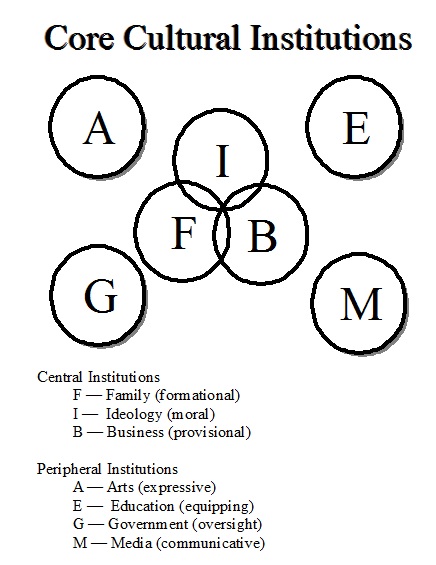
Borrowing from Bright, Hillman, et al, I created the chart below for my own thought development. I was able to see their priority statuses of each institution given what they provide each of us. I modified the original listing, changing “church” to “ideology” because, as we encounter the world as it is, it is obvious that there are many other religions or philosophic systems that inform morality and ethics.

The three “mountains” that I classify as Central Institutions are those that were created in the natural order of the Garden of Eden–family (Adam and Eve in procreative relationship), worship (walking with God in obedience), and business (mutually beneficial exchange for communal provision).*  But all seven institutions are on God’s radar in His mission of the redemption of all creation. Christian workers in all these arenas play a part in carrying that mission forward.

The challenge for the church today is to inform marketplace Christians as to their roles and responsibilities as vital to God’s mission and to release them from the false bifurcation of secular vocation and sacred calling. How does your vocation and how you do your job carry forward that movement? How do your work and work ethic reflect and glorify God? What can you do to “redeem” your industry, your workplace, your position to bring God’s Spirit, in power and truth, to bear in all the relationships touching your career?

It is a challenging question and one not easily answered but one that must be raised: when you go to work, or to the market, or to take in entertainment, or pursue education, or vote . . . are you on mission?

* For a fuller explanation of the role of the marketplace or business in Eden, see Eden’s Bridge: The Marketplace in Creation and Mission (c) David B. Doty, 2011, or the related blog post “The Vital Role of Marketplace Theology.”

Leave a comment

Filed under Discipleship, Faith in the Marketplace

The Vital Role of Marketplace Theology

(This essay is a reflection on the central thesis of the book Eden’s Bridge: The Marketplace in Creation and Mission, © David B. Doty, 2011, available from the author or from Wipf & Stock Publishers.)

In recent decades two strains of theological development have gained a significant amount of attention: the theology of work and the theology of stewardship. Both have proven important in informing us about God’s explosive movement in the marketplace, especially in the last few decades. I spent a fair amount of time investigating both these areas of concern in my own research over the past several years.

But I hit a wall when I came to Deuteronomy 8:18 – “But you shall remember the LORD your God, for it is He who is giving you power to make wealth, that He may confirm His covenant which He swore to your fathers, as it is this day.” In this passage, God is reminding Israel that their economic success does not emerge from either their inherent goodness or the diligence of their work. But there is little to nothing in the surrounding text to answer two critical questions: How did God give them the ability to create wealth?, and how does the increase of their wealth fulfill the covenant God made with Abraham, Isaac, and Jacob?

Unpacking that verse in an attempt to answer those questions is what ultimately led to me writing Eden’s Bridge: The Marketplace in Creation and Mission. While all this is taken up in detail in the book, I offer the following as a brief on the theological message it articulates: the marketplace is an institution of God, implicit in the creation narrative of Genesis 1–2 and vital to God’s mission in the world (the missio Dei).

The first question – How did God give them the ability to create wealth? – is answered by two provisions God made for Israel – land and community. “How is wealth created” as a generic question is answered most simply by three economic components: access to the means of production, the division of labor, and advantageous exchanges between workers, i.e., trade. My quest to understand the interaction of these three, in effect, the functionality of a market economy, as a partial answer to the original question led me to the conclusion that the marketplace, as a means to create wealth (as abundance), is an institution of God. If that is so, I wondered if it was an original intent, that is, in creation or something that came later.

My curiosity led me to re-read Genesis 1–2, which I had read many times before but now from a different perspective. Were those foundational components of the marketplace present in the Garden narrative? Hopefully, the reader has already surmised the conclusion that I finally reached that they are indeed.

In creation, the Garden (the earth), like the land for Israel and now for all, is the foundation of the means of production. Given energy from the sun (and now through materials mined from the ground, gravity, such as tidal and wave energy, environmental energy, such as wind, and ground source, or geothermal, energy), the Garden produced all that the first family needed, not only to survive but to thrive. Adam had only to put forth what must be assumed to be a nominal effort to do well. The land, the eco-creation, is the primary means of production, and remains so even today as buildings, vehicles, electronic devices, clothing, food, and machinery are all constructed or derived from the elements of the earth.

Interesting to note, at least to me, is the realization that God never commanded Adam to work. To work and take care of the Garden, rather, were part of Adam’s reason for being and in particular relationship to his physical context. “Then the LORD God took the man and put him into the Garden of Eden to cultivate it and keep it” (Genesis 2:15). To work and take on the responsibility of overseeing the Garden were, in effect, written into the DNA of what it means to be human in the sense of the purpose, at least in part, for our having been created. But this was Adam’s work . . . alone. His “calling” to work and to stewardship, if you will, was in isolation.

Then God deemed that Adam was not to be or work alone, that it was not good. God did not simply create a wife for Adam to produce progeny and perpetuate the species. God first identifies Eve as the ‘ezer neged, an appropriate or suitable help mate, in Genesis 2:18. She is not identified as wife until 2:24. Not only the foundational elements of labor and stewardship were established in the Garden but the introduction of Eve introduced the expectation of the division of labor.

The division of labor creates the opportunity for expanding economies. The first step is simply by making labor more efficient, dividing the tasks within a given project, whether as foundational as gathering food or complex as transnational manufacturing and marketing of goods. Efficiency gains are productivity gains, the foundation of creating new wealth as an abundance greater than can be produced alone. The division of labor, through increased efficiencies, allows for the development of specialized skills which further enhance productive efficiency within a community.

Thus far we have seen that God has provided, from creation, two of the three elements critical to the establishment of a market economy – access to the means of production (land, in this case) and the division of labor (to move work beyond work in isolation). The third element – exchange – brings up being made in the image of a Trinitarian God, a self-contained community.

Sadly, the only exchange between Adam and Eve given in the creation narrative is when she shared with him the forbidden fruit from the Tree of the Knowledge of Good and Evil. It is easily understood that this awakened them to the determination of their own sense of morality. It was also the violation of the relationship they had with God.

But other exchanges between them are implied by the introduction of the help mate. A lone actor can be diligent and godly in both the mental and physical tasks of their work. A lone actor can also be diligent in protecting and optimizing whatever means of production, whether land, machinery, or information, is available. Hence, the theologies of work and stewardship can be taken as individual concerns. But Adam, even before the introduction of Eve, was never alone, and nor are we. He walked with God in the Garden and now we abide with a cloud of witnesses (Hebrews 12:1).

For many of us, to walk with God (or even having an unseen cloud of witnesses) is largely an ethereal experience given that God is spirit and fundamentally intangible, having no body. The introduction of Eve made the idea of relationship tangible, visible, present in a real way. Adam may have been able to distance himself in his relationship with God if the Presence of God was ethereal but Eve was as real as real could be.

Adam was created in the image of God but his rebellion altered that image. His rebellion changed the relationship with God, who put him out of the Presence in the Garden, and it altered his relationship with Eve. At the heart of God’s creation were two people, designed to work together as a reflection of the image of a holy God. They were designed to be holy as God is holy, that the character of righteousness and justice would dictate their relationships with God and with one another.

To move beyond the theologies of work and stewardship, in fact to create the biblical foundation and the fullness of those theologies, we must come to understand the theology of the marketplace, of the interpersonal exchanges between God and humankind, within the human family, and between humankind and the environment created for our sustainability.

The marketplace is the most pervasive institution in human experience. To some degree, every person is affected by economic interactions with others. At the heart of the theology of the marketplace is God’s design for human community, that we live together in mutual support striving toward the re-establishment of God’s reign in the world, that is, moral order directing and fulfilling economic, political, social, and environmental justice (though, given the multitude of directing moral philosophies, even within Christendom, how that justice works out remains somewhat open to interpretation).

In no way does the Bible endorse socialistic or communistic models of governance or economics as they have come to mean in the present day. It is for freedom that we have been made free (Galatians 5:1) . . . free from the penalties of sin and death, free to worship God without encumberance from within or without, free to become as God originally intended us to be. The governmental, social, political, and economic endeavors of God’s children, however, are undertaken in obedience and response to God’s leading and goodness toward righteousness and justice, by choice rather than by the coercive influences of state or sect.

Though the marketplace was established in creation itself, there was no need of profit for sustainability . . . only obedience to God. We now live in a fallen world and sustainability hinges on working with and within the world’s system to a great degree. A re-oriented view of the marketplace, in Kingdom perspective, however, may lead us to pursue restoring godliness in our relationships with God and one another and, seeking first the Kingdom of God and His righteousness, allowing God the freedom to bless us anew as we cling to His ways and priorities, even if sometimes He asks us to risk worldly security beyond our understanding.

The marketplace, in God’s original intention, was a means to more than sustain us. It is for us to enjoy Him and His creation in abundance. It is for us to develop holy living in relationships. Economic discipline is vital to our survival and flourishing, all of us, and many in our world are not flourishing. Jeffrey Sachs, in The End of Poverty, points out that we have sufficient wealth to end global poverty but lack the political will. Accumulation in the hands of too few keeps too many from the basic needs of nutrition, health care, education, and economic freedom. That is why understanding God’s design and purposes for the marketplace, in creation and now moving toward redemption, is vitally important for the church and the world: because God cares for the least of these.

2 Comments

Filed under Faith in the Marketplace

On Justice and Righteousness (mishpat & tsadaq)—Strong’s 4941 & 6663

[NOTE FROM AUTHOR: This is far and away the most read article on this blog site. Unfortunately, I am unable to track who is reading it or how they are being linked to it. Because it is so popular, I am curious about these two facts. If you would, please contact me at davedoty@edensbridge.org to let me know who you are, how you found this article, and especially if it was helpful to you. Shalom, Dave Doty]

(This essay is a close adaptation excerpted from the book Eden’s Bridge: The Marketplace in Creation and Mission, © David B. Doty, 2011, available from the author or from Wipf & Stock Publishers. This essay should be read with the thesis of Eden’s Bridge—the marketplace is an institution of God, implicit in the creation narrative of Genesis 1–2 and vital to God’s mission in the world—in full view.)

The translation of mishpat as justice oversimplifies its meaning in the Old Testament, especially in modern Western thinking. Mishpat is derived from shawfat (Strong’s 8199) which means to judge. But the modern un­derstanding of to judge tends to focus only on properly judicial activities. In its broader sense, shawfat means to govern. Moses was called and appointed by God, the supreme judge over Israel. It was an all-inclusive position which proclaimed ordinance (legislative), passed judgment (ju­dicial), and carried the authority to punish or release (executive).

Mishpat implies the whole determination and consequence of juxtaposed good and evil. It contains the establishment of law, the interpretation of ordinance, the pronouncement of verdict, and the legal foundation of the authority to execute sentence. The Judeo-Christian tradition accepts this as emanating from God. It is at the seat of the di­vine throne that rights are determined.

Mishpat is a two-edged sword, reminiscent of the duality illumi­nated in Psalm 62:11–12: “Once God has spoken; twice I have heard this: that power belongs to God; and loving kindness is Thine, O Lord, for Thou dost recompense a man according to his work.” It seems the psalmist was struggling in trying to see two sides of the same coin simultaneously.

We sometimes hear of Gods’ wrath (judging authority) illuminated in the Old Testament Law juxtaposed against God’s love (merciful for­giveness) illuminated in Christ in the New Testament. Reconciling the two can challenge human rationale.

“That power belongs to God” recognizes God’s sovereign au­thority to judge. His “loving kindness” reveals God’s grace and mercy to judge according to His heart rather than human logic or notions of fairness. False teachings that isolate Jesus, as the God of the New Testament, from Jehovah, as the God of the Old Testament, at least by implication, erroneously separate God’s wrath and judgment from His love and mercy. This duplicity tends to gloss over the Psalmist’s point: God’s sovereignty empowers the authority to forgive, that power and mercy are not only compatible but congruent in God’s nature and character (see also, Exod 34:6–7).

To borrow an analogy from digital electronics, where 1’s and 0’s represent all reality, nothing exists conceptually without its “null” cor­respondence. There is love so there is conclusively that which is not love. God’s power, the authority to determine, judge, and execute sentence, is the determination of how love acts (i.e., its manifestation). This power differentiates and separates itself, as God is love (1 John 4:8; 1 John 4:16), from that which is not love. Hence, the consequences of not love, techni­cally, must be separate from God. This is the whole of mishpat. Love determines good and evil. It divides (judges and sentences) between love and that which is not love. Love and not love help define each other by the contrasts of their respective natures.

But the digital analogy can be taken too far if it leads to the conclu­sion that good and evil are in perfect balance. God, who is love, retains the sovereign authority to forgive evil and so is necessarily greater than evil. Our hope in Christ resides deeply in the belief that our God is a consuming fire (Heb 12:29) and that the judgment of God ultimately condemns and annihilates evil.

Christians are governed, and therefore should govern, by love. Hopefully this illuminates 1 John 4:16b: “The one who abides in love, abides in God and God abides in him.” By abiding in love, we allow the justice (the mishpat) of God to prevail in our lives.

Marketplace Christians are constantly confronted by the basic ques­tions of abiding in love, bringing God’s mishpat to bear in daily decisions. Jesus exhorted that we should love others as ourselves. This challenges how people are viewed and treated in the workplace. Are employment and layoff decisions based solely on the expediency of profitability? Is pay based entirely on the financial contribution each employee brings to the enterprise or should we take into account real individual and family needs? Are failures, both mistakes and ethical lapses, forgiven? Are there accommodations to afford second and third and even fourth chances (forgiving seventy times seven times—Matt 18:22)? The justice of God is sacrificial and active. How does the marketplace leader make such hard, seemingly incongruent circumstances and values align?

The mishpat of God—determining how love is known (legisla­tive), the sentence (of blessing or curses) is pronounced (judicial), and how judgment is executed (executive)—is the Way of the Cross. It calls Christians to sacrificial life for the benefit of others. How can executives reconcile the divergence of pay and affordable lifestyles between the president and custodian? What values should guide executives faced with contentious vendors? What responsibilities does business have in the broader community?

These are hard questions in light of the systems of this world. Business leaders have a laundry list of rational justifications for the disparate treatment of employees. And the questions keep getting more pointed: Can God be trusted to keep His promises if decisions are made that seem irrational to the world, and even to ourselves? Can the Christian CEO afford to fail by the world’s rules? Should profit come before people? Is Jesus the end (consummation, i.e., telos) of the law or does pragmatism rule?

The key question in Scripture comes from Mark 8:36–37: “For what does it profit a man to gain the whole world, and forfeit his soul? For what shall a man give in exchange for his soul?” How do Christians rec­oncile disparities in compensation or the impersonal commodifying of labor with Galatians 5:14?—“For the whole Law is fulfilled in one word, in the statement, ‘You shall love your neighbor as yourself.’”

Godly mishpat reaches far beyond the single issue of employee relations. It leaves each of us with the responsibility of how to apply it to other relationships, including those with superiors (whether boss or board), vendors, customers, surrounding communities, within our particular industry, including competitors, and the earth itself. The per­vasiveness of the marketplace extends its moral reach beyond issues of economic justice in immediate relationships to its role contributing to the common good in social and environmental justice.

The Word of God can leave us baffled, infuriated, frustrated, con­victed, and conflicted. But we may be encouraged that we are becoming, and shall be, the sons of God as we seek fulfilling His mishpat. Though we all fall short of the glory of God, the opportunities to do good are ever present. And our sanctification is in the process. The wisdom of God is available to all who would ask in humility and brokenness. God has called marketplace Christians to ministry in business for His glory not ours.

To speak of the righteousness (tsadaq—Strong’s 6663) of God seems redundant. Righteousness is mishpat, the justice of God, en­acted. Tsadaq means to be or to make right in a moral or forensic sense. Among its derivatives we find the notions of natural, moral, and legal rights. Tsedeq (Strong’s 6664, a derivative of tsadaq) means equity (in the abstract) and prosperity (figuratively). Equity and prosperity taken together imply a communal rather than individual sense. This is strong iteration of the idea of shalom. Tsedaqah (Strong’s 6666, a derivative of tsadaq) is an abstraction of rightness interpreted subjectively as rectitude or straightness, objectively as justice, morally as virtue, and figuratively as prosperity. Tsidqah (Strong’s 6665, corresponds to tsedaqah) connects righteousness and beneficence. The tsadaq of God inextricably links morality and prosperity. Some popular modern doctrines, especially the “prosperity Gospel,” operate from the egocentric view that the moralist will be blessed with personal prosperity. Tsadaq, however, suggests that righteousness is manifest in beneficence and virtue practiced outwardly toward the common good and help for specific people and classes. Hence, the morally upright will be blessed with communal prosperity.

Justice and righteousness emanate from the nature and character of God. That the people of God are called to abide in that character is presented throughout the Bible. “Learn to do good; seek justice, reprove the ruthless; defend the orphan, plead for the widow” (Isa 1:17). And in Isaiah 16:5 we find, “A throne (seat of honor) will even be established in loving-kindness, And a judge will sit on it in faithfulness in the tent of David; Moreover, he will seek justice And be prompt in righteousness.” Micah 6:8 says, “He has told you, O man, what is good; and what does the Lord require of you but to do justice, to love kindness, and to walk humbly with your God?” And James 1:27 explains, “This is pure and un­defiled religion in the sight of our God and Father, to visit orphans and widows in their distress, and to keep oneself unstained by the world.”

The New Testament reveals that Jesus committed Himself to no home or personal economic endeavor during the years of His minis­try. He was detached from worldly ambition and things. On the other hand, though some may be, we are not all called literally to “sell all” and “give it to the poor.” (Luke 18:22). Jesus was prone to hyperbole to drive home His points (like cutting off a hand or plucking out an eye—Matt 5:29–30). His concern was that wealth has a way of ruling over us and we would do better, if necessary, to rid ourselves of the burden. Marketplace Christians, especially those blessed with power and wealth, run the risk that the cares of this world may overtake the call to Christ (Matt 13:22).

The four vital relationships in which we live—with God, with others, with our environment, and with ourselves—remain under the microscope of mishpat and tsedeq. Constant review of how our market­place relationships are tempered by biblical justice and righteousness is a necessity in following Christ.

53 Comments

Filed under Excerpts from Eden's Bridge the Book, Faith in the Marketplace

On Exchange, Faith, and the Presence of God

Once we have established the presence of two independent producers, i.e., recognizing the division of labor as the foundation of the potential for a marketplace, if those producers can be found to be interested in the product of the other, opportunity arises to exchange, whether goods, services, information, or any other currency item of value to both parties.

From the ability to enter into exchanges arise a plethora of economic relationships. Parties to exchange bring whatever advantage they possess to the bargaining table in the pursuit of the products brought by the other parties. Interestingly, God sought an exchange with human kind that was not material or valuable to God in a financial way. What Adam received was sustenance in abundance beyond our imagination. But what God sought from Adam was loyalty, a commitment to obedience, to holiness, that would allow Adam to remain in God’s presence. To God the valuable was fellowship. Perhaps we find some degree of equivalence in the idea of paying a retainer, knowing that we have not paid for the services of an attorney or accountant per se but when the time comes to engage their services, we already have their commitment to our cause. In that sense, material provision is exchanged for allegiance, or obedience in Adam’s case.

Economic relationships need not be simple, direct exchanges, as in bartering chickens for wheat or giving money for bread, but can be defined by any number of other arrangements, varying by degrees of complexity and depth. Specifically, the economic relationship between God and humankind follows most closely on the model of patron (pater, meaning father or benefactor) and client (cliens, meaning dependent or follower). The patron-client arrangement is typical thought to be one of endurance and may involve a myriad of exchanges in kind and number.

The patron typically does not need the loyalty or efforts of a particular client but does desire that commitment from someone. The client may not need the favor of a particular patron but is able to live more readily if they receive the favor of some patron than if they do not. The exchange between the patron and client then is an agreed upon arrangement, not one of overt coercion by either party but of convenience to both. Either party may suffer unnecessarily without the presence of the relationship but both recognize the greater opportunity to achieve desirable results if a symbiotic balance can be struck.

Opportunity can be created but operators / actors / producers must engage that opportunity to make it a reality. Opportunity can exist on a conceptual level, present and at the same time lost, if passed by. God’s intention in creation is best summed up in Hebrews 2:10 – His desire to bring many sons (and daughters) to glory, to create for Himself a divine family beyond the Trinity itself. A friend of mine is currently finishing a doctoral dissertation on sonship as the unifying theme of the Epistle to the Hebrews, perhaps one of the most important theological developments in the history of biblical research. Through the work of Jesus on the Cross God has made the Way available to enter into redeemed life but, sadly, it is often a door passed by. The glory of God, largely unseen except by being in relationship to God, is disregarded by the passersby.

God created Adam and Eve (made in the image of God both male and female – Genesis 1:27) and in so doing created the opportunity for humankind to live in harmony with Him. After the Fall, the act of the redeeming kinsman, Jesus, re-invigorated the opportunity (Leviticus 25:25). The relationship between God and humankind is a family structure as the Latin pater implies (father) but also an economic arrangement implied by that same term (benefactor, or provider). When Abraham was commanded to sacrifice Isaac and Isaac questioned where they were to find an appropriate animal for the sacrifice, Abraham responded “God will provide for Himself the lamb for the burnt offering” (Genesis 22:7–8).

The combination of provide and God in the passage above is that from which we derive the name Jehovah-Jireh, God-My-Provider. Popular English translations of the Bible interpret the Hebrew raah (Strong’s 7200) as provide. But this meaning may be shortsighted, if you will pardon the pun (about to be revealed). Raah is a primitive Hebrew root which means to see. It appears more than 1300 times in the Old Testament and is only interpreted along the lines of providing in five places, an occurrence of less than one half one percent. Raah has many, MANY interpretations into English in the Old Testament. The predominant uses have to do with sight: seeing, looking, appearing, and so on.

It would almost seem as if Abraham could have been saying, when questioned about the material sacrifice, that God will appear. I take that tack to think along the line of exchanges. In this passage it was an exchange of a material sacrifice in obedience to God’s command to Abraham, a demonstration of Abraham’s loyalty, out of gratitude for God’s goodness to Abraham in the giving of fruitful land and an heir.

If God were to appear in the midst of this exchange, a material sacrifice of loyalty, perhaps we can see a correlation to how we undertake marketplace activities. We live with the promise that God blesses the home of the righteous (Proverbs 3:33). When we act according to holiness in market exchanges, that is, acting righteously and generously trusting in a God who rewards, does God appear in the midst of the transaction? How do we judge our marketplace behaviors, our exchanges, as witness to the glory of God? When we negotiate trade, do we facilitate the manifestation of God’s glory or the presence of others gods? How might God show up in the midst of doing business?

(David Doty has been a serial entrepreneur, a seminarian, and an author. His first book, Eden’s Bridge: The Marketplace in Creation and Mission – Wipf & Stock Publishers, January 1, 2012 – articulates the first theology of the marketplace as an institution of God, implicit in the creation narrative of Genesis 1-2 and vital to God’s redemptive mission in the world.)

2 Comments

Filed under Faith in the Marketplace

On the Glory and Character of God

(This essay is a close adaptation excerpted from the book Eden’s Bridge: The Marketplace in Creation and Mission, © David B. Doty, 2011, to be released in January, 2012 by Wipf & Stock Publishers.)

In pursuing knowledge of the infinite, the human mind is severely limited to conceptualizations that necessarily fall short. In seeking knowledge of an infinite God, it is understandably difficult to define God’s glory. There are no less than eighteen words in the Hebrew language of the Old Testament that have been translated as glory or one of its variations (glorious, glorify, gloriousness, etc.). Of those, only kabod (Strong’s 3519) is translated in the New American Standard Bible concerning the glory of God in Exodus 33–34, a good launch point for investigating God’s glory.

Then Moses said, “I pray Thee, show me Thy glory!” And He said, “I Myself will make all My goodness pass before you, and will proclaim the name of the Lord before you; and I will be gracious to whom I will be gracious, and will show compassion on whom I will show compassion.” But He said, “You cannot see My face, for no man can see Me and live!” Then the Lord said, “Behold, there is a place by Me, and you shall stand there on the rock; and it will come about, while My glory is passing by, that I will put you in the cleft of the rock and cover you with My hand until I have passed by. Then I will take My hand away and you shall see My back, but My face shall not be seen”
(Exod 33:18–23).

Then the Lord passed by in front of him and proclaimed, “The Lord, the Lord God, compassionate and gracious, slow to anger, and abounding in loving-kindness and truth; who keeps loving-kindness for thousands, who forgives iniquity, transgression and sin; yet He will by no means leave the guilty unpunished, visiting the iniquity of fathers on the children and on the grandchildren to the third and fourth generations” (Exod 34:6–7).

The focus here is on the character of God as the “residual” (back side) of his passing presence. Character is revealed as it manifests in action. That is how we know, insofar as we can, the heart of another, that is, as they behave. Words proclaimed are only words proclaimed. Without evidence in compliance with the words, we judge the moral content of the actor’s performance to define their character. We cannot judge the heart of another so we judge the fruit.

The entirety of the Bible is revelatory. It is the story of God and His relationship to His creation and especially His people. Joshua commanded Israel to pile twelve stones in the midst of Jordan as a memorial (Josh 4:3–7), a testimony, to God’s goodness so that subsequent generations could know God by the stories of His gracious deeds.

Our faith and works will one day stand the test of God’s consuming fire, “for we must all appear before the judgment seat of Christ, that each one may be recompensed for his deeds in the body, according to what he has done, whether good or bad” (2 Cor 5:10). Our acts reveal the righteousness of our character. The focus of the passages from Exodus above is on God’s character as a reflection of His glory: compassionate, gracious, slow to anger, abounding in loving-kindness, forgiving, and just.

Previously, God had revealed His name to Moses (Exodus 3:14). Vic Hamilton argues that an exact translation of I AM WHO I AM should be “I am He who is,” that is, He is the God who is present, the One “there with you.”(i) In Creation, God aimed to reveal His glory to humankind that He might make Himself known. Exposure, whether by experience or the testimony of others, is prerequisite to knowing. It was in the passing presence of God before Moses that the glory was revealed. Argued more deeply, the Incarnation was the most(ii) perfect revelation of God’s glory (Heb 1:1–3), His character manifest in Word and deed.

Kabod is derived from a primitive root (kabad—Strong’s 3513) meaning heavy or weightiness, but is used figuratively to speak to both splendor (magnificence) and copiousness (yielding abundance).(iii) This term lends itself to both awe, beholding the majesty of God, and provision, God as the source of our being and supplier of our material needs.

As the Garden narrative demonstrates, God is our provider and sustainer, and the system of our temporal sustenance, the biomechanical workings of the heavens and earth, is good. The Bible also reveals God as loving, and not given to fiat or arbitrariness which would create undue fear in His people due to capriciousness or malevolence.

Kabod witnessed also lends itself to the idea of presence. We take note of those who “change” a room just by entering it. God’s immanence, specifically in the acts of creation, the Incarnation of Jesus Christ, and the Holy Spirit present in and equipping the church, has and is impacting the world.

Moses details God’s glory in the Exodus account by cataloguing character traits. This list reveals the outward-working of holy love. It also corresponds closely to the listing of the fruit of the Spirit (Gal 5:22–23) and informs how righteous relationships are lived out. The relevance to guiding marketplace behavior cannot be missed.

Other common descriptions of the Trinitarian God include egalitarian, unified, wise, and creative. These are also relevant to Christians in the marketplace. They will commonly appear in people devoted to Christ and growing in spiritual maturity. By God’s redemptive grace, the way is open to become like Christ as we “are being transformed into the same image [of Christ] from glory to glory” (2 Cor 3:18). Christians in the marketplace will pursue the increase of His government (rule or dominion, Isa 9:7) in personal and professional ethics, and in social systems and institutions.

i. Hamilton, Victor P. Handbook to the Pentateuch, 2nd Edition (Grand Rapids, MI: Baker Academic, 2008), 144–145.
ii. I use most here due to the limitations of human capacity to comprehend the glory of God.
iii. Harris, R. Laird, Gleason L. Archer, Jr., and Bruce K. Waltke, The Theological Workbook of the Old Testament – TWOT Lexicon (Chicago: Moody Press, 1980, in BibleWorks for Windows, V. 5.0.034a. Norfolk, VA: BibleWorks, LLC, 2001), entries 943d, 943e.

3 Comments

Filed under Excerpts from Eden's Bridge the Book, Faith in the Marketplace

Taking Back the Land: The Reformation of the Marketplace

The topic of land in the Old Testament is said to be only secondary to that of God Himself. It is a complex topic and one I find myself delving into more deeply as an analogy of the marketplace as the means of human provision. Land, from the beginning of creation, has been the primary means of production. It is from the earth that we draw our livelihood as crops for consumption and materials for creating an unfathomable range of products and buildings.

Walter Brueggeman, in his seminal text, The Land, creates a mental picture of the interconnectedness of Yahweh, the land, and God’s people. They are inextricably linked. But God provided for Israel even in their landlessness of the desert journey with meat (quail) and bread (manna) and water, all connected even to that barren land. Their clothes did not wear out and their health was maintained.

We often hear phrases in the church like “taking back the land” as reclaiming something that has been taken from us. The sentiment seems to be that we must take charge of the situation and forcefully drive out those who have misappropriated that which was somehow “ours” (as the people of God).

The land of Canaan was the land promised to Abraham. It represented provision and security, even prosperity, the actualization and fulfillment of the very shalom of God. This was by no means taken by the Hebrews to mean some future, spiritual heavenly status. This was temporal and at hand, in contrast to the slavery of Egypt and the un-settledness of the desert. This was a real promise in real life.

As Joshua and the second desert generation entered the land, God went before them. They had only to march around Jericho, according to God’s command, and the walls tumbled to the ground. The city was taken without war or coercion or the loss of Israeli life or livelihood. The wealth of that great city, except for the foolishness of Achan (Joshua 7), was consecrated to God.

The nation of Israel was walking into a promise that seemed even more unbelievable than the giving of the land. They were to have cities they did not build, houses already furnished, cisterns they did not dig, vineyards and olive trees they did not plant (Deuteronomy 6:10–11). Prosperity was being handed to them on a silver platter!

The phrase “taking back the land” has a clear militancy to it. But as we have just seen, the Lord went before them and prepared the place for Israel (sound familiar?–John 14:2–3). Israel had to do little other than to walk in and take up residence. The Lord had promised that He would do the work of clearing the land (Exodus 23 and Deuteronomy 11:23). It seems reasonable that the Israelites had to war against the inhabitants only as they disregarded seeking God’s counsel and were deceived by the Gibeonites (Joshua 9), and  they fell into disobedience, perhaps in following after the gods of the inhabitants. They lost the purity of their worship of Yahweh and possessing the land became strife laden.

To receive the gift of the land of promise, Israel had only to seek after God with all their heart, mind, soul and strength. This is where I draw a strong analogy to Christians in the marketplace today. It is easy to see how the marketplace has been corrupted by sin.

Our work, whatever our vocation, as worship or service to God (see ‘abad–Strong’s 5647), programmed into the DNA of being human at creation (Genesis 2:15), is a sacred calling and trust. But the land, as gift, should give us pause as to how we work and how we “take back” the marketplace for God. We tend to strategize and create actions plans, we control and manipulate, we scheme and execute . . . all by our striving and, perhaps, by some leading of the Spirit.

But the land, and now the marketplace, as the place of our provision was simply to be lived in, in obedience. We even find encouragement that the marketplace and its wealth is a promise of God for his people and for His glory in Proverbs 13:22b,  “And the wealth of the sinner is stored up for the righteous.”

 Missiologists (those who study the mission of God, the misseo Dei, in the world) are just beginning to observe, catalog, and study God’s movements in the marketplace. In God’s grand scheme of the redemption of all creation, meta-institutions, like government and the marketplace, continue to undergo reformation.

As marketplace Christians, “living into” our vocational callings by obedience, we demonstrate the glory of God in how we first rely on God for His provision amidst the dryness of our deserts and act wisely as he leads us into His promised land, where righteousness, as economic and social justice, will overcome the sinfulness of humankind even in the marketplace.

The work that God gave to Adam, to cultivate and keep the Garden (Genesis 2:15), was without the toil, resistance, and sweat brought on by the sin of disobedience (Genesis 3:17–19). Jesus said, “Come to Me, all who are weary and heavy-laden, and I will give you rest. Take My yoke upon you, and learn from Me, for I am gentle and humble in heart; and you shall find rest for your souls.  For My yoke is easy, and My load is light” (Matthew 11:28-30).

Work is a key component in our daily lives. Our vocations can be fulfilling or troublesome. Hopefully this leads us to question our vocations, or how we are performing in them, if we find ourselves vexed at worked, despising our bosses or even the work itself. If we are “living into” God’s Kingdom, we will stop striving after our ambitions but seek only to please God in the marketplace. By pursuing righteousness, we will see the reward of His “Kingdom come on earth as it is in heaven” (Matthew 6:10), the shalom that passes all understanding (Philippians 4:7), even at work.

(David Doty has been a serial entrepreneur, a seminarian, and an author. His first book, Eden’s Bridge: The Marketplace in Creation and Mission – Wipf & Stock Publishers, January, 2012 – articulates the first theology of the marketplace as an institution of God, implicit in the creation narrative of Genesis 1-2 and vital to God’s redemptive mission in the world.)

2 Comments

Filed under Faith in the Marketplace

The Division of Labor in Creation

The thesis of Eden’s Bridge: The Marketplace in Creation and Mission (Copyright © 2011 David B. Doty) is “The marketplace is an institution of God to facilitate (by way of material provision) an enduring relationship between humankind and the godhead, to foster holiness within human experience and relationships, and to advance the plan of redemption of all creation.”

The following essay, one of a series of word studies, is adapted from Eden’s Bridge (release pending, January, 2012).

To Help (`ezer): Mutual Interests and Community (Genesis 2:18)—Strong’s 5828

“Then the Lord God said, “It is not good for the man to be alone; I will make him a helper (`ezer) suitable for him.” The Triune God recognized the benefits of human community. Eve is designated as `ezer neged before being called wife (Genesis 2:22–24, ‘ishash, as the opposite of man and his mate).(i) This first reference says a great deal about God’s intention for the relationship. An `ezer is a helper, a partner, one who aids and helps protect. The modifier, neged (Strong’s 5048), is translated as suitable only in Genesis 2. Literally, it means in front of (before), conspicuous, in the presence of, or opposite (as in, facing). The opposite aspect may be most clear with Eve as Adam’s sexual counterpart.

Wives share the joys and burdens of life with husbands and vice versa. God expresses concern that it was not good (towb, meaning beneficial—Strong’s 2896b) for Adam to be alone (bad, not bad as in evil—Strong’s 0905). The Hebrew word bad means solitary, separated. It is the term used several times in Exodus for the poles (staves) designed to carry the Ark of the Covenant, as they were individual branches separated (bad) from trees. Allegorically, the lifelessness of a cut branch is not dissimilar to the lonely man cut off from the benefits of being in community. Fellowship in common cause is vital to sustaining human life and increasing the ease with which life is made more tolerable and enjoyable. The deeply intimate social and co-creative aspects of the Trinity were endued to God’s human family in the male and female likeness.

Elijah bemoaned his solitude (bad) in the lonely cave and feared for his life without the company of fellow believers (I Kings 19:9). In Hebrews 3:3, Christians are exhorted to come alongside one another daily to battle falling back into sin. The birth of the church occurred on the day of Pentecost as the 120 were gathered in the Upper Room, likely in deep fear, to encourage one another in light of the recent Crucifixion of Christ and their dismay as to the uncertainty of the future despite Jesus’ already revealed resurrection. Fellowship encourages us, whether in the home, at work, or at leisure with friends, and helps hold us accountable for ungodly behavior. The division of labor, and cooperation and collaboration in the marketplace enhance our quality of life.

The marketplace is where the majority of our social interactions occur. The practice of worship, as trusting and obeying God, was not institutionalized in Genesis 1–2 before the Fall but was experienced in direct fellowship with God. Worship, like marriage and the marketplace, was established in the Garden and was contingent upon the appropriate, submitted relationship of Adam and Eve to God. The earliest form of worship was no more than walking in obedient fellowship with God.

God’s intent for Adam and Eve to work, steward, and procreate (multiply—Genesis 1:28) imply the sacred nature of these activities.(ii) As created and ordered systems, marriage and family, along with business,(iii) were instituted simultaneously with the introduction of Eve as a suitable partner. The ‘ezer neged (suitable helper) facilitated productive partnership. That partnership promoted the expansion of the human family by procreation and of weal,(iv) as the quality of life was improved through increased efficiency making their work more productive.

Worship, marriage (and by extension, family), and business are the original and intended institutions of God in creation. Similarly, theocratic governance, to maintain social order in communal living, is instituted as obedient response to God’s ownership (lordship) and the generous provision of the Garden in the single “rule” (to not eat of the Tree of the Knowledge of Good and Evil) of the pre-Fall Edenic covenant.

The `ezer neged, Eve with Adam, was an echo of the equality and fellowship within the Trinitarian Godhead, completing an acute communal reality of being made in the image of God, male and female. Communalism is a spiritually and temporally (economically) unified reality, hence our mutual human interdependence as emulating and in harmony with God.(v)

NOTES

i. On humankind created male and female, Genesis 1:27 uses the Hebrew neqabah (female) to note the genitalic sexual distinction.
ii. This is discussed in Eden’s Bridge, 5.2 Sacrament: Sacred versus Secular.
iii. This is discussed in Eden’s Bridge, 4.2 Redefining Business—as mutually beneficial exchange between cooperative laborers to facilitate and enhance relationship.
iv. Weal, welfare or well-being, is defined as prosperity, happiness, the general good, and welfare of the community. In effect, true weal is shalom. In the modern sense, wealth (abundant material provision) provides for creature comfort so can be easily understood in the sense of its root, though it can lose its communal character to individualistic greed and material insecurity.
v. Such that communalism not be misunderstood outside the context of the whole of Eden’s Bridge, godly communalism is an uncoerced social construct, that is, living with the regard for all willingly out of the character of one’s spiritual nature rather than as a legal condition created by governmental edict.

4 Comments

Filed under Excerpts from Eden's Bridge the Book, Faith in the Marketplace

Business as Sacrament: On the Sacred versus the Secular

(This essay is a close adaptation of an excerpt from the book Eden’s Bridge: The Marketplace in Creation and Mission, © David B. Doty, 2011, which is due to be released in January, 2012 by Wipf & Stock Publishers.)

Two statements made at a 2010 summer conference undermine the Christian’s role in the marketplace. Both were made by mature Christian business practitioners and in response to pointed questions after speaking to a largely Christian gathering of theologians, business practitioners, students, clergy, and administrators.

The first concerned the role of business in God’s mission in the world (paraphrased): “Business is not ordained of God. It is only a vehicle for doing good.” This would hold true if it were qualified that business is only for the purposes of financial gain. But business serves numerous and far more important purposes.

Experience validates that those in agreement with the speaker are generally uncomfortable trying to reconcile the extensive abuses of the marketplace to the character of God. This concern with the “corrupt nature” of the market, therefore it must not be “of God,” is quickly undone if marriage is held to the same purity test. The corruptions of marriage and the marketplace are due to human sinfulness, not God’s design or intent for either institution. An obvious parallel is God’s allowance for the sin of divorce. Jesus addressed the Mosaic divorce decrees as acquiescence to the hardness of the human heart. God hates divorce (Mal 2:16) just as He hates unjust scales (Prov 16:11; Prov 20:10; Prov 20:23) because both are violations of just relationship.

Marriage is a covenant, an earthly model of the marriage of Christ and His bride (Eph 5:22–33). The household, as marriage and family, serves as a microcosmic model of the marketplace as a unifying and provisional social community. God’s relationship to humanity is covenantal. God did not destroy humankind when the (pre-Fall) Edenic covenant was broken. Grace remained for human provision and to provide the opportunity for restored relationship with God. In the marketplace, formal contracts are legal covenants but we seldom witness grace (forgiveness) from the world when contracts are broken, further evidence of sin’s corrupting presence.

The human social (informal or cultural) contract, as a manifestation of God’s stated moral laws and naturally-ordered law in creation, is fundamentally concerned with economic issues. Law and culturally-based behavioral norms contribute to peace of mind and body and stability to society as they broadly serve the common good. Economics appear to have played a dominant role in God’s indictment and judgment of Sodom, as they did not “help the poor and needy” (Ezek 16:49), and Tyre, where they “did not remember the covenant of brotherhood” (Amos 1:9). The abhorrent acts under indictment were, in the view of God and the godly, clearly unacceptable and violated the shalom of society.

Parts of the human social contract and the pursuit of the common good are upheld by law. But God-followers are morally obligated to do good (Isa 1:17; Mic 6:8), delighting in kindness (Hos 6:6), and preserving justice by doing what is right (Isa 56:1; Zeph 2:3), especially for the poor, orphans, widows, the weak, and afflicted (Ps 82:3; Jer 22:3). These are the sacrifices pleasing to God (Heb 13:16; 1 Pet 2:5) which may go beyond the letter of the law, as Jesus often taught. The focus is toward social equilibrium and flourishing, shalom such that all in society are well provided for.

God commands His people to do good. Business is one means for doing good and in fact does a great deal of good (i), even as it is carried out by non-believers or operators from other faith traditions. Whenever business is carried out justly, it does good and is God-ordained because we are assured that all good things “come from above” (Jas 1:17). God created the marketplace to serve several positive ends. Human provision, facilitated by the beneficial exchanges of the marketplace, is a fundamental function of creation. Commerce can also be, at least informally, a means of revelatory grace, specifically as immanent charis, the kindness, mercy, and goodwill of God in the world, as business generates wealth that can be used to pay wages, feed the hungry, clothe the naked, and care for widows and orphans. Business can be evangelizing witness to the glory of God as operators share their lives and hope with their employees (by paying fair wages), vendors (by being credit-worthy), customers (by giving excellent service), communities (by supporting and participating in civic activities), and to all by their profession of faith and general congeniality. Christ is present in the marketplace when the devout carry out their business in accordance with God’s will, purposes, and character.

The subordination of the marketplace to “worldly” status, as a form of dualism, is an offense to the Scriptures and God. God decreed the cooperative relationship between Adam and Eve and in all its inherently economic, spiritual, social, relational, and ecological nature. We undermine God’s design when we disallow God’s ordination of the marketplace as part of the proper created order.

The second comment came when the other businessman referred to his “secular” business. When that description was challenged from the audience, he claimed that the business was “secular but not secularist.” I admit freely that I did not and do not understand what that means. I believe that, like the first speaker, this man views business as not ordained of God and under God’s ownership and operation, but meant that as the operator of the business he has godly intent and aims. I cannot disagree more vehemently with drawing such a distinction.

How Christians perceive the division of secular and sacred is important. The popular definition of secular absolutely divides temporal and spiritual matters (dualism). Several Biblical and theological concepts, however, reinterpret that definition. In addition to God’s people, all of creation is being redeemed in Christ, as waiting in earnest expectation (Rom 8:19). Is being redeemed, an active process, is the operative phrase. The functional reality of the Christian life is tension between the worldly (fallen temporal) and the heavenly (restored spiritual). Paul sees this as normal when telling the Corinthians that “we will all be changed” (future passive—1 Cor 15:51–52) and that we “are changed” (present passive—2 Cor 3:18). The first is in reference to the bodily resurrection, the second to taking on the image of Christ. Charles Cranfield, the author of the commentary on Romans published in The International Critical Commentary series, argues that this tension is not resolved between Romans Chapters 7 and 8, but rather that the war between the flesh and spirit is the ongoing conflict of the Christian disciple, striving to serve God in holy living yet recognizing how they continue to fall short of his glory.(ii) Both personally and systemically, the Kingdom of God, the growing reign of Christ in individual hearts and the ongoing redemption of social institutions, is already-but-not-yet, now in imperfect operation yet looking to a future, perfect fulfillment.

This moves the discussion toward issues of eschatology, the study of the last thing (eschaton) or last things (eschata).(iii) Mortals peering into the future certainly see “as through a glass darkly” (1 Cor 13:12). The views on what is to come in this world and in heaven run across a broad spectrum. Western orthodox Christian traditions—Roman Catholic, Reformed and the majority of Evangelical—lean toward forms of a post-millennial view that holds Jesus Christ’s earthly reign will occur when He returns (the Second Coming) at the end of a long period of time: a period in which the church is spreading the Gospel throughout the world and leading the transformation of social institutions and cultural norms toward God’s will. These Catholic, Reformed, and Evangelical traditions hold an optimistic view of the future, drawing on Scripture, and the advancement of human institutions in the West, including democratic government and liberalized markets, and the Christian calling to godly ethics in all spheres of life.

The validity of these views is defensible in much of the Old Testament prophetic expectations and the New Testament witness, and poignantly expressed by Jesus’ petition in the Lord’s prayer: “Thy Kingdom come, they will be done, on earth as it is in Heaven” (Matt 6:10).

Eschatology is fundamentally concerned with God’s reign in the last days in the world, from Jesus’ Ascension until His return. The presence and guidance of the Holy Spirit for the Christian life advocates for a significant degree of Kingdom presence in the world as adherents live in obedience, doing good as the agents of God. Kingdom speaks to ownership and rule as it is under the authority of God’s sovereignty that good works are carried out.

Here the discussion shifts to issues of stewardship and sonship. Two strong arguments in Scripture for pursuing the sacred in Christian life are that “the earth is the Lord’s, and all it contains, the world, and those who dwell in it” (Ps 24:1), “and whatever you do in word or deed, do all in the name of the Lord Jesus, giving thanks through Him to God the Father” (Col 3:17). Adam’s appointment as steward (to keep) the Garden was clear. The Bible is filled with considerations of the moral responsibility and character of godly (and ungodly) stewardship.

But more than stewards, Christians are the children of God which involves the important elements of inheritance, ownership, and dominion. It is helpful to remember God’s original intention in creation to create a family for Himself, to ultimately bring “many sons to glory” (Heb 2:10). As any good father would, the heavenly Father wants to bestow a rich inheritance on His children, not just of material blessing but, more importantly, of character. Christians anticipate that inheritance explicitly in being called joint heirs of the glory of God with Christ (Rom 8:17) and look to being changed step-by-step, from glory to glory, into the image of Christ (2 Cor 3:18) as the “event” of receiving the inheritance.

The nature of the glory of Christ and of the heavenly Father is summed up by the four living creatures in adoration before the throne of God: “Holy, holy, holy.” As God followers, Christians live under the hortatory “Be holy for I am holy” (Lev 11:44b), “like the Holy One who called you, be holy yourselves also in all your behavior, because it is written, ‘You shall be holy, for I am holy’” (1 Pet 1:15–16). The call to holiness presents challenges for Christians in the marketplace, in particular by the phrase “in all your behavior” here and Paul’s “do not be conformed to this world” (Rom 12:2). Holiness (hagios—Strong’s 40) is determinative of character in all aspects of Christian practice. To be holy is to be morally upright by intrinsic or divine character. Holiness is available to Christians only through the power and presence of the Holy Spirit.

Christians in the marketplace, feeling pressed by worldly circumstances, may impose an unholy bifurcation on market decisions to allow excuse for ungodly behavior. The nature of holiness has been defined as otherness. God’s glory is so far from our fallen state, for example, that it is understood that we cannot be like God. We cannot be omnipotent, omniscience, or omnipresent. We can, however, seek to know and practice the will of God. Accepting and loving one another, taking on the mind of Christ (Rom 15:5), willingly deferring and sacrificing for one another, submitting ourselves to lives of humble service—these attitudes and acts may challenge the logic of worldly pragmatism (human wisdom) which is limited by the narrow vision of human knowledge.

Holiness may oppose what appears to makes sense: “let no man deceive himself. If any man among you thinks that he is wise in this age, let him become foolish that he may become wise. For the wisdom of this world is foolishness before God. For it is written, ‘He is the one who catches the wise in their craftiness’; and again, ‘The Lord knows the reasonings of the wise, that they are useless’” (1 Cor 3:18–20).

It easily follows that, beyond any limited righteousness “enforced” by the world’s legal documentation and contracts, businesses operated by Christians are to be held as sacred trusts, set apart for the glory and worship of God. That set apartness means these endeavors are sacramental with a small s, having a sacred nature. Any lesser view relegates the marketplace and the workers’ efforts to the profane.

A major influence dividing the spiritual and the secular in Western Christian minds is one hallmark of Platonic dualism: the view that the material world is inherently evil. While creation has been corrupted, this dualism leaves no room for redemption except as an escape from the material realm. This view of the material world encourages false eschatological notions and stands against an already-but-not-yet realization of the Kingdom.

Such isolation of secular and sacred even clouds the argument that God’s glory is demonstrated in nature (Ps 19:1). For example, consider the pending birth of a child. Secular humanism wrestles with the essential nature of a fetus (“When does it become a person?”). Yet logic is not troubled that the fetus is present and possesses the potential of a fuller realization. It is at once a thing living though in a transitional state and as yet unfulfilled. Before I was married, I had the potential to be a father (conceptual), but when my wife became pregnant I was in a state of flux until the child’s birth actualized that role. In a real way, I was already-but-not-yet a father during her pregnancy.

Compartmentalizing our spiritual and temporal natures is a slippery slope excusing and even justifying the necessity of ungodly policies and practices. Profit, for sustainability and increasing wealth, is ordained of God (Deut 8:18), but that ordination remains only as God is obeyed in both generating wealth (means) and using it appropriately (ends). The primary function of the marketplace in creation is for the facilitation of just relationships toward adequate universal provision, the Edenic shalom as both means and ends.

Marketplace Christians are under enormous tension because it is easy to live with just one foot in God’s Kingdom. Compartmentalization is enabling and pragmatism can be self-justifying. Greed and power are strong temptations and compromise easily leads to hypocrisy and dishonors the glory of God.

The false divide of sacred and secular presents difficult disciplines and choices for marketplace Christians. That is why personal and systemic economic issues arise in every section of the Bible. In the Torah we find laws and commandments pertaining to the treatment of the poor (Lev 25:35–55) and the valuation of property (Lev 27). In the historic books, we find the military and economic oppression of Israel by Midian (Judg 6:1–10), Boaz leaving gleanings in his field for the poor (Ruth 2:1–9), and the abolishment of usury (Neh 5:1–13). In the wisdom literature, we see that a righteous man does not exact usury (Ps 15:5), that honest scales are of God (Prov 16:11), and that the Lord hears and responds to the cries of the poor (Ps 34:6).

And so it goes, throughout the prophets, the Gospels and Acts, the Epistles, and Revelation. Creation is economic by design, and economic justice (equilibrium, shalom) is a primary aim of God’s mission.

i. Kennedy, Robert G. “What is the Good That Business Does?,” in The Good That Business Does, 67–85. Grand Rapids, MI: Acton Institute, 2006.
ii. Cranfield, Charles E.B. Romans: A Shorter Commentary, 168–72. Grand Rapids, MI: William B. Eerdmans Publishing Company, 1992.
iii. See Walls, Jerry L., ed. The Oxford Handbook of Eschatology. Oxford: The Oxford University Press, 2008, as an excellent resource for studying eschatology generally.

2 Comments

Filed under Excerpts from Eden's Bridge the Book, Faith in the Marketplace