The Vital Role of Marketplace Theology

(This essay is a reflection on the central thesis of the book Eden’s Bridge: The Marketplace in Creation and Mission, © David B. Doty, 2011, available from the author or from Wipf & Stock Publishers.)

In recent decades two strains of theological development have gained a significant amount of attention: the theology of work and the theology of stewardship. Both have proven important in informing us about God’s explosive movement in the marketplace, especially in the last few decades. I spent a fair amount of time investigating both these areas of concern in my own research over the past several years.

But I hit a wall when I came to Deuteronomy 8:18 – “But you shall remember the LORD your God, for it is He who is giving you power to make wealth, that He may confirm His covenant which He swore to your fathers, as it is this day.” In this passage, God is reminding Israel that their economic success does not emerge from either their inherent goodness or the diligence of their work. But there is little to nothing in the surrounding text to answer two critical questions: How did God give them the ability to create wealth?, and how does the increase of their wealth fulfill the covenant God made with Abraham, Isaac, and Jacob?

Unpacking that verse in an attempt to answer those questions is what ultimately led to me writing Eden’s Bridge: The Marketplace in Creation and Mission. While all this is taken up in detail in the book, I offer the following as a brief on the theological message it articulates: the marketplace is an institution of God, implicit in the creation narrative of Genesis 1–2 and vital to God’s mission in the world (the missio Dei).

The first question – How did God give them the ability to create wealth? – is answered by two provisions God made for Israel – land and community. “How is wealth created” as a generic question is answered most simply by three economic components: access to the means of production, the division of labor, and advantageous exchanges between workers, i.e., trade. My quest to understand the interaction of these three, in effect, the functionality of a market economy, as a partial answer to the original question led me to the conclusion that the marketplace, as a means to create wealth (as abundance), is an institution of God. If that is so, I wondered if it was an original intent, that is, in creation or something that came later.

My curiosity led me to re-read Genesis 1–2, which I had read many times before but now from a different perspective. Were those foundational components of the marketplace present in the Garden narrative? Hopefully, the reader has already surmised the conclusion that I finally reached that they are indeed.

In creation, the Garden (the earth), like the land for Israel and now for all, is the foundation of the means of production. Given energy from the sun (and now through materials mined from the ground, gravity, such as tidal and wave energy, environmental energy, such as wind, and ground source, or geothermal, energy), the Garden produced all that the first family needed, not only to survive but to thrive. Adam had only to put forth what must be assumed to be a nominal effort to do well. The land, the eco-creation, is the primary means of production, and remains so even today as buildings, vehicles, electronic devices, clothing, food, and machinery are all constructed or derived from the elements of the earth.

Interesting to note, at least to me, is the realization that God never commanded Adam to work. To work and take care of the Garden, rather, were part of Adam’s reason for being and in particular relationship to his physical context. “Then the LORD God took the man and put him into the Garden of Eden to cultivate it and keep it” (Genesis 2:15). To work and take on the responsibility of overseeing the Garden were, in effect, written into the DNA of what it means to be human in the sense of the purpose, at least in part, for our having been created. But this was Adam’s work . . . alone. His “calling” to work and to stewardship, if you will, was in isolation.

Then God deemed that Adam was not to be or work alone, that it was not good. God did not simply create a wife for Adam to produce progeny and perpetuate the species. God first identifies Eve as the ‘ezer neged, an appropriate or suitable help mate, in Genesis 2:18. She is not identified as wife until 2:24. Not only the foundational elements of labor and stewardship were established in the Garden but the introduction of Eve introduced the expectation of the division of labor.

The division of labor creates the opportunity for expanding economies. The first step is simply by making labor more efficient, dividing the tasks within a given project, whether as foundational as gathering food or complex as transnational manufacturing and marketing of goods. Efficiency gains are productivity gains, the foundation of creating new wealth as an abundance greater than can be produced alone. The division of labor, through increased efficiencies, allows for the development of specialized skills which further enhance productive efficiency within a community.

Thus far we have seen that God has provided, from creation, two of the three elements critical to the establishment of a market economy – access to the means of production (land, in this case) and the division of labor (to move work beyond work in isolation). The third element – exchange – brings up being made in the image of a Trinitarian God, a self-contained community.

Sadly, the only exchange between Adam and Eve given in the creation narrative is when she shared with him the forbidden fruit from the Tree of the Knowledge of Good and Evil. It is easily understood that this awakened them to the determination of their own sense of morality. It was also the violation of the relationship they had with God.

But other exchanges between them are implied by the introduction of the help mate. A lone actor can be diligent and godly in both the mental and physical tasks of their work. A lone actor can also be diligent in protecting and optimizing whatever means of production, whether land, machinery, or information, is available. Hence, the theologies of work and stewardship can be taken as individual concerns. But Adam, even before the introduction of Eve, was never alone, and nor are we. He walked with God in the Garden and now we abide with a cloud of witnesses (Hebrews 12:1).

For many of us, to walk with God (or even having an unseen cloud of witnesses) is largely an ethereal experience given that God is spirit and fundamentally intangible, having no body. The introduction of Eve made the idea of relationship tangible, visible, present in a real way. Adam may have been able to distance himself in his relationship with God if the Presence of God was ethereal but Eve was as real as real could be.

Adam was created in the image of God but his rebellion altered that image. His rebellion changed the relationship with God, who put him out of the Presence in the Garden, and it altered his relationship with Eve. At the heart of God’s creation were two people, designed to work together as a reflection of the image of a holy God. They were designed to be holy as God is holy, that the character of righteousness and justice would dictate their relationships with God and with one another.

To move beyond the theologies of work and stewardship, in fact to create the biblical foundation and the fullness of those theologies, we must come to understand the theology of the marketplace, of the interpersonal exchanges between God and humankind, within the human family, and between humankind and the environment created for our sustainability.

The marketplace is the most pervasive institution in human experience. To some degree, every person is affected by economic interactions with others. At the heart of the theology of the marketplace is God’s design for human community, that we live together in mutual support striving toward the re-establishment of God’s reign in the world, that is, moral order directing and fulfilling economic, political, social, and environmental justice (though, given the multitude of directing moral philosophies, even within Christendom, how that justice works out remains somewhat open to interpretation).

In no way does the Bible endorse socialistic or communistic models of governance or economics as they have come to mean in the present day. It is for freedom that we have been made free (Galatians 5:1) . . . free from the penalties of sin and death, free to worship God without encumberance from within or without, free to become as God originally intended us to be. The governmental, social, political, and economic endeavors of God’s children, however, are undertaken in obedience and response to God’s leading and goodness toward righteousness and justice, by choice rather than by the coercive influences of state or sect.

Though the marketplace was established in creation itself, there was no need of profit for sustainability . . . only obedience to God. We now live in a fallen world and sustainability hinges on working with and within the world’s system to a great degree. A re-oriented view of the marketplace, in Kingdom perspective, however, may lead us to pursue restoring godliness in our relationships with God and one another and, seeking first the Kingdom of God and His righteousness, allowing God the freedom to bless us anew as we cling to His ways and priorities, even if sometimes He asks us to risk worldly security beyond our understanding.

The marketplace, in God’s original intention, was a means to more than sustain us. It is for us to enjoy Him and His creation in abundance. It is for us to develop holy living in relationships. Economic discipline is vital to our survival and flourishing, all of us, and many in our world are not flourishing. Jeffrey Sachs, in The End of Poverty, points out that we have sufficient wealth to end global poverty but lack the political will. Accumulation in the hands of too few keeps too many from the basic needs of nutrition, health care, education, and economic freedom. That is why understanding God’s design and purposes for the marketplace, in creation and now moving toward redemption, is vitally important for the church and the world: because God cares for the least of these.

2 Comments

Filed under Faith in the Marketplace

The Conundrum of Christian Faith in the West

John Wesley was concerned that Christian faith undermines itself due to the increasing wealth of adherents. As Christ-followers gave up costly vices and began to live more frugally, their wealth increased. Unfortunately, that brought new temptations of costly clothing, richer dwellings, frivolous entertainment, and so on.

This is very much the conundrum facing many Christians in the West today. By global standards, many of us are wealthy. Even within our own context, many have increasingly expensive homes, automobiles, furnishings, and sumptuous meals. We have more than met our needs. We live in abundance and buy into a false gospel that says we deserve it.

God chose Israel, not because they were better than anyone else, but as an isolated nation through whom He could make a name for Himself. God had been and continues to work outside Israel (and now the church), often blessing the righteous to advance His agenda of transforming the world.

But wealth may be one of the greatest traps we can fall in to. We work hard, we plan and are prudent with our resources, we live well . . . and see it all as somehow something we deserve. But we thank God for blessing us for our diligence and call our part “being faithful.” But our faithfulness tends to stop at our front door.

The average giving in churches in the United States is something around three per cent. Imagine the good that churches could do in their own communities and around the world if we simply adhered to the ten percent tithe. That does not touch the potential if we were to give sacrificially (the hallmark of God’s love in His work on the Cross).

Part of the problem in the past has been ignorance. We were not aware of global conditions, of regional wars, large-scale disasters, and abject poverty that continue to plague whole nations. But now, via electronic communications, God is laying the world at our doorstep and challenges us anew, albeit in suffering silence, to ask ourselves, “Am I my brothers keeper?”

Acts 2:44–45 speaks of the church having “all things in common” and “sharing as anyone had need.” Right now, even in our context there are thousands of Christians without jobs. How often, and to what depth, are the members of their churches aware or addressing the needs of those families? Unemployment has dipped to about 8.5% recently. That means 91.5% are employed. Even if we double the official rate, taking into account those who are no longer able to draw unemployment, 83% are still employed. Can four help take care of the one?

If we expand globally, our conviction should deepen. Our standard of living is still that to which much of the world can only dream to achieve. There are orphans in Indian and African facilities who remain unsponsored, often for as little as $25.00 or $30.00 a month to provide clothing, housing, education, and healthcare. There are millions unemployed who might be helped to build their local economies if even a small portion of Western portfolios were re-directed into small business, micro-venture funds (some even paying an annual return, albeit lower than optimizing a blue chip mix).

The church is faced with perhaps the greatest opportunity in history to be a witness to the glory of God. If we can strategize how to move capital into the communities of greatest need (both foreign and domestic) while also creating mechanisms designed to improve the odds of success (especially skills training and access to pertinent information), all boats can rise.

If the church will truly reach out to minister to the economic needs of its own, the world will see what Jesus said about them “knowing we are His followers by our love for one another” (John 13:35). James was absolutely right when he said that it is not enough to say “Go in peace, be warmed and be filled,” if we do not make accommodation for actually meeting their needs.

Will we take all this into consideration as admonition from God to step up and begin to be the followers and church we claim to be, or will we remain complacent, underfunding ministries and outreach to those in real need while we wallow in our comfort zones?

This essay will likely anger some, saying that I have resorted to manipulation and guilt. I would argue that I have only resorted to the directives of justice and righteousness of the Bible we claim to uphold and the leading of the God we claim to worship. This journey has been difficult for me. I have historically worked very hard to provide well for myself. God, in His wisdom, has chosen this season to re-direct my thinking.

I have chosen recently to focus on two passages from Scripture that speak to our needs and wants.

Psalm 37:4 – “Delight yourself in the Lord and He will give you the desires of your heart,” and Matthew 6:33 – “Seek first the kingdom of God and His righteousness, and all these things (our necessities) will be added to you.”

Many will read these verses and delight in God’s promises to not only meet our needs but to give us the desires of our hearts. The real focus is to re-orient ourselves to the opening phrases, “delight yourself in the Lord” and “seek first the kingdom of God and His righteousness.”

If we have any wonder why our possessions cause us so much worry and demand so much time and money to care for; if we wonder why the church in the United States is struggling to fulfill its mandate to lead social and political change; if we wonder . . .

The answer is most likely that we have focused first on our needs and desires rather than seeking to glorify God, willingly living in humility and with an attitude of servitude toward God and others.

2 Comments

Filed under Discipleship

On Justice and Righteousness (mishpat & tsadaq)—Strong’s 4941 & 6663

[NOTE FROM AUTHOR: This is far and away the most read article on this blog site. Unfortunately, I am unable to track who is reading it or how they are being linked to it. Because it is so popular, I am curious about these two facts. If you would, please contact me at davedoty@edensbridge.org to let me know who you are, how you found this article, and especially if it was helpful to you. Shalom, Dave Doty]

(This essay is a close adaptation excerpted from the book Eden’s Bridge: The Marketplace in Creation and Mission, © David B. Doty, 2011, available from the author or from Wipf & Stock Publishers. This essay should be read with the thesis of Eden’s Bridge—the marketplace is an institution of God, implicit in the creation narrative of Genesis 1–2 and vital to God’s mission in the world—in full view.)

The translation of mishpat as justice oversimplifies its meaning in the Old Testament, especially in modern Western thinking. Mishpat is derived from shawfat (Strong’s 8199) which means to judge. But the modern un­derstanding of to judge tends to focus only on properly judicial activities. In its broader sense, shawfat means to govern. Moses was called and appointed by God, the supreme judge over Israel. It was an all-inclusive position which proclaimed ordinance (legislative), passed judgment (ju­dicial), and carried the authority to punish or release (executive).

Mishpat implies the whole determination and consequence of juxtaposed good and evil. It contains the establishment of law, the interpretation of ordinance, the pronouncement of verdict, and the legal foundation of the authority to execute sentence. The Judeo-Christian tradition accepts this as emanating from God. It is at the seat of the di­vine throne that rights are determined.

Mishpat is a two-edged sword, reminiscent of the duality illumi­nated in Psalm 62:11–12: “Once God has spoken; twice I have heard this: that power belongs to God; and loving kindness is Thine, O Lord, for Thou dost recompense a man according to his work.” It seems the psalmist was struggling in trying to see two sides of the same coin simultaneously.

We sometimes hear of Gods’ wrath (judging authority) illuminated in the Old Testament Law juxtaposed against God’s love (merciful for­giveness) illuminated in Christ in the New Testament. Reconciling the two can challenge human rationale.

“That power belongs to God” recognizes God’s sovereign au­thority to judge. His “loving kindness” reveals God’s grace and mercy to judge according to His heart rather than human logic or notions of fairness. False teachings that isolate Jesus, as the God of the New Testament, from Jehovah, as the God of the Old Testament, at least by implication, erroneously separate God’s wrath and judgment from His love and mercy. This duplicity tends to gloss over the Psalmist’s point: God’s sovereignty empowers the authority to forgive, that power and mercy are not only compatible but congruent in God’s nature and character (see also, Exod 34:6–7).

To borrow an analogy from digital electronics, where 1’s and 0’s represent all reality, nothing exists conceptually without its “null” cor­respondence. There is love so there is conclusively that which is not love. God’s power, the authority to determine, judge, and execute sentence, is the determination of how love acts (i.e., its manifestation). This power differentiates and separates itself, as God is love (1 John 4:8; 1 John 4:16), from that which is not love. Hence, the consequences of not love, techni­cally, must be separate from God. This is the whole of mishpat. Love determines good and evil. It divides (judges and sentences) between love and that which is not love. Love and not love help define each other by the contrasts of their respective natures.

But the digital analogy can be taken too far if it leads to the conclu­sion that good and evil are in perfect balance. God, who is love, retains the sovereign authority to forgive evil and so is necessarily greater than evil. Our hope in Christ resides deeply in the belief that our God is a consuming fire (Heb 12:29) and that the judgment of God ultimately condemns and annihilates evil.

Christians are governed, and therefore should govern, by love. Hopefully this illuminates 1 John 4:16b: “The one who abides in love, abides in God and God abides in him.” By abiding in love, we allow the justice (the mishpat) of God to prevail in our lives.

Marketplace Christians are constantly confronted by the basic ques­tions of abiding in love, bringing God’s mishpat to bear in daily decisions. Jesus exhorted that we should love others as ourselves. This challenges how people are viewed and treated in the workplace. Are employment and layoff decisions based solely on the expediency of profitability? Is pay based entirely on the financial contribution each employee brings to the enterprise or should we take into account real individual and family needs? Are failures, both mistakes and ethical lapses, forgiven? Are there accommodations to afford second and third and even fourth chances (forgiving seventy times seven times—Matt 18:22)? The justice of God is sacrificial and active. How does the marketplace leader make such hard, seemingly incongruent circumstances and values align?

The mishpat of God—determining how love is known (legisla­tive), the sentence (of blessing or curses) is pronounced (judicial), and how judgment is executed (executive)—is the Way of the Cross. It calls Christians to sacrificial life for the benefit of others. How can executives reconcile the divergence of pay and affordable lifestyles between the president and custodian? What values should guide executives faced with contentious vendors? What responsibilities does business have in the broader community?

These are hard questions in light of the systems of this world. Business leaders have a laundry list of rational justifications for the disparate treatment of employees. And the questions keep getting more pointed: Can God be trusted to keep His promises if decisions are made that seem irrational to the world, and even to ourselves? Can the Christian CEO afford to fail by the world’s rules? Should profit come before people? Is Jesus the end (consummation, i.e., telos) of the law or does pragmatism rule?

The key question in Scripture comes from Mark 8:36–37: “For what does it profit a man to gain the whole world, and forfeit his soul? For what shall a man give in exchange for his soul?” How do Christians rec­oncile disparities in compensation or the impersonal commodifying of labor with Galatians 5:14?—“For the whole Law is fulfilled in one word, in the statement, ‘You shall love your neighbor as yourself.’”

Godly mishpat reaches far beyond the single issue of employee relations. It leaves each of us with the responsibility of how to apply it to other relationships, including those with superiors (whether boss or board), vendors, customers, surrounding communities, within our particular industry, including competitors, and the earth itself. The per­vasiveness of the marketplace extends its moral reach beyond issues of economic justice in immediate relationships to its role contributing to the common good in social and environmental justice.

The Word of God can leave us baffled, infuriated, frustrated, con­victed, and conflicted. But we may be encouraged that we are becoming, and shall be, the sons of God as we seek fulfilling His mishpat. Though we all fall short of the glory of God, the opportunities to do good are ever present. And our sanctification is in the process. The wisdom of God is available to all who would ask in humility and brokenness. God has called marketplace Christians to ministry in business for His glory not ours.

To speak of the righteousness (tsadaq—Strong’s 6663) of God seems redundant. Righteousness is mishpat, the justice of God, en­acted. Tsadaq means to be or to make right in a moral or forensic sense. Among its derivatives we find the notions of natural, moral, and legal rights. Tsedeq (Strong’s 6664, a derivative of tsadaq) means equity (in the abstract) and prosperity (figuratively). Equity and prosperity taken together imply a communal rather than individual sense. This is strong iteration of the idea of shalom. Tsedaqah (Strong’s 6666, a derivative of tsadaq) is an abstraction of rightness interpreted subjectively as rectitude or straightness, objectively as justice, morally as virtue, and figuratively as prosperity. Tsidqah (Strong’s 6665, corresponds to tsedaqah) connects righteousness and beneficence. The tsadaq of God inextricably links morality and prosperity. Some popular modern doctrines, especially the “prosperity Gospel,” operate from the egocentric view that the moralist will be blessed with personal prosperity. Tsadaq, however, suggests that righteousness is manifest in beneficence and virtue practiced outwardly toward the common good and help for specific people and classes. Hence, the morally upright will be blessed with communal prosperity.

Justice and righteousness emanate from the nature and character of God. That the people of God are called to abide in that character is presented throughout the Bible. “Learn to do good; seek justice, reprove the ruthless; defend the orphan, plead for the widow” (Isa 1:17). And in Isaiah 16:5 we find, “A throne (seat of honor) will even be established in loving-kindness, And a judge will sit on it in faithfulness in the tent of David; Moreover, he will seek justice And be prompt in righteousness.” Micah 6:8 says, “He has told you, O man, what is good; and what does the Lord require of you but to do justice, to love kindness, and to walk humbly with your God?” And James 1:27 explains, “This is pure and un­defiled religion in the sight of our God and Father, to visit orphans and widows in their distress, and to keep oneself unstained by the world.”

The New Testament reveals that Jesus committed Himself to no home or personal economic endeavor during the years of His minis­try. He was detached from worldly ambition and things. On the other hand, though some may be, we are not all called literally to “sell all” and “give it to the poor.” (Luke 18:22). Jesus was prone to hyperbole to drive home His points (like cutting off a hand or plucking out an eye—Matt 5:29–30). His concern was that wealth has a way of ruling over us and we would do better, if necessary, to rid ourselves of the burden. Marketplace Christians, especially those blessed with power and wealth, run the risk that the cares of this world may overtake the call to Christ (Matt 13:22).

The four vital relationships in which we live—with God, with others, with our environment, and with ourselves—remain under the microscope of mishpat and tsedeq. Constant review of how our market­place relationships are tempered by biblical justice and righteousness is a necessity in following Christ.

53 Comments

Filed under Excerpts from Eden's Bridge the Book, Faith in the Marketplace

On Exchange, Faith, and the Presence of God

Once we have established the presence of two independent producers, i.e., recognizing the division of labor as the foundation of the potential for a marketplace, if those producers can be found to be interested in the product of the other, opportunity arises to exchange, whether goods, services, information, or any other currency item of value to both parties.

From the ability to enter into exchanges arise a plethora of economic relationships. Parties to exchange bring whatever advantage they possess to the bargaining table in the pursuit of the products brought by the other parties. Interestingly, God sought an exchange with human kind that was not material or valuable to God in a financial way. What Adam received was sustenance in abundance beyond our imagination. But what God sought from Adam was loyalty, a commitment to obedience, to holiness, that would allow Adam to remain in God’s presence. To God the valuable was fellowship. Perhaps we find some degree of equivalence in the idea of paying a retainer, knowing that we have not paid for the services of an attorney or accountant per se but when the time comes to engage their services, we already have their commitment to our cause. In that sense, material provision is exchanged for allegiance, or obedience in Adam’s case.

Economic relationships need not be simple, direct exchanges, as in bartering chickens for wheat or giving money for bread, but can be defined by any number of other arrangements, varying by degrees of complexity and depth. Specifically, the economic relationship between God and humankind follows most closely on the model of patron (pater, meaning father or benefactor) and client (cliens, meaning dependent or follower). The patron-client arrangement is typical thought to be one of endurance and may involve a myriad of exchanges in kind and number.

The patron typically does not need the loyalty or efforts of a particular client but does desire that commitment from someone. The client may not need the favor of a particular patron but is able to live more readily if they receive the favor of some patron than if they do not. The exchange between the patron and client then is an agreed upon arrangement, not one of overt coercion by either party but of convenience to both. Either party may suffer unnecessarily without the presence of the relationship but both recognize the greater opportunity to achieve desirable results if a symbiotic balance can be struck.

Opportunity can be created but operators / actors / producers must engage that opportunity to make it a reality. Opportunity can exist on a conceptual level, present and at the same time lost, if passed by. God’s intention in creation is best summed up in Hebrews 2:10 – His desire to bring many sons (and daughters) to glory, to create for Himself a divine family beyond the Trinity itself. A friend of mine is currently finishing a doctoral dissertation on sonship as the unifying theme of the Epistle to the Hebrews, perhaps one of the most important theological developments in the history of biblical research. Through the work of Jesus on the Cross God has made the Way available to enter into redeemed life but, sadly, it is often a door passed by. The glory of God, largely unseen except by being in relationship to God, is disregarded by the passersby.

God created Adam and Eve (made in the image of God both male and female – Genesis 1:27) and in so doing created the opportunity for humankind to live in harmony with Him. After the Fall, the act of the redeeming kinsman, Jesus, re-invigorated the opportunity (Leviticus 25:25). The relationship between God and humankind is a family structure as the Latin pater implies (father) but also an economic arrangement implied by that same term (benefactor, or provider). When Abraham was commanded to sacrifice Isaac and Isaac questioned where they were to find an appropriate animal for the sacrifice, Abraham responded “God will provide for Himself the lamb for the burnt offering” (Genesis 22:7–8).

The combination of provide and God in the passage above is that from which we derive the name Jehovah-Jireh, God-My-Provider. Popular English translations of the Bible interpret the Hebrew raah (Strong’s 7200) as provide. But this meaning may be shortsighted, if you will pardon the pun (about to be revealed). Raah is a primitive Hebrew root which means to see. It appears more than 1300 times in the Old Testament and is only interpreted along the lines of providing in five places, an occurrence of less than one half one percent. Raah has many, MANY interpretations into English in the Old Testament. The predominant uses have to do with sight: seeing, looking, appearing, and so on.

It would almost seem as if Abraham could have been saying, when questioned about the material sacrifice, that God will appear. I take that tack to think along the line of exchanges. In this passage it was an exchange of a material sacrifice in obedience to God’s command to Abraham, a demonstration of Abraham’s loyalty, out of gratitude for God’s goodness to Abraham in the giving of fruitful land and an heir.

If God were to appear in the midst of this exchange, a material sacrifice of loyalty, perhaps we can see a correlation to how we undertake marketplace activities. We live with the promise that God blesses the home of the righteous (Proverbs 3:33). When we act according to holiness in market exchanges, that is, acting righteously and generously trusting in a God who rewards, does God appear in the midst of the transaction? How do we judge our marketplace behaviors, our exchanges, as witness to the glory of God? When we negotiate trade, do we facilitate the manifestation of God’s glory or the presence of others gods? How might God show up in the midst of doing business?

(David Doty has been a serial entrepreneur, a seminarian, and an author. His first book, Eden’s Bridge: The Marketplace in Creation and Mission – Wipf & Stock Publishers, January 1, 2012 – articulates the first theology of the marketplace as an institution of God, implicit in the creation narrative of Genesis 1-2 and vital to God’s redemptive mission in the world.)

2 Comments

Filed under Faith in the Marketplace

Ordering Glitch – FIXED

The link in the original post is fixed. You can also order Eden’s Bridge HERE.

Dave Doty

Leave a comment

Filed under Announcements

Eden’s Bridge: The Marketplace in Creation and Mission – NOW AVAILABLE!

Eden’s Bridge: The Marketplace in Creation and Mission – NOW AVAILABLE!

Get yours at Amazon.com . . . click here.

Is Business “of God”?

 Eden’s Bridge: The Marketplace in Creation and Mission

Copyright © 2011 David B. Doty. All rights reserved.

ISBN13: 978-1-61097-824-8 (Wipf & Stock Publishers)

Given the current global economic crisis, there are likely few more important topics than the marketplace and its function in Christian worldview. Beyond historic theologies of work and stewardship, Eden’s Bridge articulates the first biblical theology of the marketplace as an intentional function in God’s created order.

Eden’s Bridge explores a marketplace model implicit in the creation narrative of Genesis 1–2 and seven supporting propositions. In the end, Eden’s Bridge makes two very serious and impactful statements in general: 1) The marketplace as an institution of God makes our business practice a sacred enterprise, infused with holy purpose and as witness to the glory of God, and 2) it validates marketplace vocations as Christian calling, meaning all Christians working in the marketplace can embrace their employment as having missional significance toward the redemption of all creation.

The six chapters of Eden’s Bridge cover the central thesis and propositions, a review of the economic / marketplace elements found in Genesis 1–2, biblical economic models and theological concerns, a review of key biblical and marketplace terminology, the process of redeeming the marketplace, and the roles and function of the marketplace in the mission of God (misseo Dei) in the world.

I, as an author, entrepreneur, and seminarian, came to the thesis and writing of Eden’s Bridge amidst a thirty year business management and administrative career. Eden’s Bridge is the result of nine years’ research that began while I was pursuing a Master of Arts in World Mission and Evangelism at Asbury Theological Seminary (2006). I am currently interested in inviting discussion concerning the theology of the marketplace Eden’s Bridge presents and am available for speaking engagements with Christian business-related groups, pastors, academicians, and churches.

Thanks,
I am looking forward to hearing from you.
Dave Doty
Author, Eden’s Bridge: The Marketplace in Creation and Mission
http://www.edensbridge.org

1 Comment

Filed under Announcements

On the Glory and Character of God

(This essay is a close adaptation excerpted from the book Eden’s Bridge: The Marketplace in Creation and Mission, © David B. Doty, 2011, to be released in January, 2012 by Wipf & Stock Publishers.)

In pursuing knowledge of the infinite, the human mind is severely limited to conceptualizations that necessarily fall short. In seeking knowledge of an infinite God, it is understandably difficult to define God’s glory. There are no less than eighteen words in the Hebrew language of the Old Testament that have been translated as glory or one of its variations (glorious, glorify, gloriousness, etc.). Of those, only kabod (Strong’s 3519) is translated in the New American Standard Bible concerning the glory of God in Exodus 33–34, a good launch point for investigating God’s glory.

Then Moses said, “I pray Thee, show me Thy glory!” And He said, “I Myself will make all My goodness pass before you, and will proclaim the name of the Lord before you; and I will be gracious to whom I will be gracious, and will show compassion on whom I will show compassion.” But He said, “You cannot see My face, for no man can see Me and live!” Then the Lord said, “Behold, there is a place by Me, and you shall stand there on the rock; and it will come about, while My glory is passing by, that I will put you in the cleft of the rock and cover you with My hand until I have passed by. Then I will take My hand away and you shall see My back, but My face shall not be seen”
(Exod 33:18–23).

Then the Lord passed by in front of him and proclaimed, “The Lord, the Lord God, compassionate and gracious, slow to anger, and abounding in loving-kindness and truth; who keeps loving-kindness for thousands, who forgives iniquity, transgression and sin; yet He will by no means leave the guilty unpunished, visiting the iniquity of fathers on the children and on the grandchildren to the third and fourth generations” (Exod 34:6–7).

The focus here is on the character of God as the “residual” (back side) of his passing presence. Character is revealed as it manifests in action. That is how we know, insofar as we can, the heart of another, that is, as they behave. Words proclaimed are only words proclaimed. Without evidence in compliance with the words, we judge the moral content of the actor’s performance to define their character. We cannot judge the heart of another so we judge the fruit.

The entirety of the Bible is revelatory. It is the story of God and His relationship to His creation and especially His people. Joshua commanded Israel to pile twelve stones in the midst of Jordan as a memorial (Josh 4:3–7), a testimony, to God’s goodness so that subsequent generations could know God by the stories of His gracious deeds.

Our faith and works will one day stand the test of God’s consuming fire, “for we must all appear before the judgment seat of Christ, that each one may be recompensed for his deeds in the body, according to what he has done, whether good or bad” (2 Cor 5:10). Our acts reveal the righteousness of our character. The focus of the passages from Exodus above is on God’s character as a reflection of His glory: compassionate, gracious, slow to anger, abounding in loving-kindness, forgiving, and just.

Previously, God had revealed His name to Moses (Exodus 3:14). Vic Hamilton argues that an exact translation of I AM WHO I AM should be “I am He who is,” that is, He is the God who is present, the One “there with you.”(i) In Creation, God aimed to reveal His glory to humankind that He might make Himself known. Exposure, whether by experience or the testimony of others, is prerequisite to knowing. It was in the passing presence of God before Moses that the glory was revealed. Argued more deeply, the Incarnation was the most(ii) perfect revelation of God’s glory (Heb 1:1–3), His character manifest in Word and deed.

Kabod is derived from a primitive root (kabad—Strong’s 3513) meaning heavy or weightiness, but is used figuratively to speak to both splendor (magnificence) and copiousness (yielding abundance).(iii) This term lends itself to both awe, beholding the majesty of God, and provision, God as the source of our being and supplier of our material needs.

As the Garden narrative demonstrates, God is our provider and sustainer, and the system of our temporal sustenance, the biomechanical workings of the heavens and earth, is good. The Bible also reveals God as loving, and not given to fiat or arbitrariness which would create undue fear in His people due to capriciousness or malevolence.

Kabod witnessed also lends itself to the idea of presence. We take note of those who “change” a room just by entering it. God’s immanence, specifically in the acts of creation, the Incarnation of Jesus Christ, and the Holy Spirit present in and equipping the church, has and is impacting the world.

Moses details God’s glory in the Exodus account by cataloguing character traits. This list reveals the outward-working of holy love. It also corresponds closely to the listing of the fruit of the Spirit (Gal 5:22–23) and informs how righteous relationships are lived out. The relevance to guiding marketplace behavior cannot be missed.

Other common descriptions of the Trinitarian God include egalitarian, unified, wise, and creative. These are also relevant to Christians in the marketplace. They will commonly appear in people devoted to Christ and growing in spiritual maturity. By God’s redemptive grace, the way is open to become like Christ as we “are being transformed into the same image [of Christ] from glory to glory” (2 Cor 3:18). Christians in the marketplace will pursue the increase of His government (rule or dominion, Isa 9:7) in personal and professional ethics, and in social systems and institutions.

i. Hamilton, Victor P. Handbook to the Pentateuch, 2nd Edition (Grand Rapids, MI: Baker Academic, 2008), 144–145.
ii. I use most here due to the limitations of human capacity to comprehend the glory of God.
iii. Harris, R. Laird, Gleason L. Archer, Jr., and Bruce K. Waltke, The Theological Workbook of the Old Testament – TWOT Lexicon (Chicago: Moody Press, 1980, in BibleWorks for Windows, V. 5.0.034a. Norfolk, VA: BibleWorks, LLC, 2001), entries 943d, 943e.

3 Comments

Filed under Excerpts from Eden's Bridge the Book, Faith in the Marketplace

Eden’s Bridge book interview @ Poverty Cure

Elise Hilton of Acton Institute posted a review / interview on Eden’s Bridge: The Marketplace in Creation and Mission on the Poverty Cure website:
http://www.povertycure.org/media/blog/edens-bridge-the-marketplace-in-gods-kingdom-a-partner-spotlight/

Leave a comment

Filed under Announcements

Taking Back the Land: The Reformation of the Marketplace

The topic of land in the Old Testament is said to be only secondary to that of God Himself. It is a complex topic and one I find myself delving into more deeply as an analogy of the marketplace as the means of human provision. Land, from the beginning of creation, has been the primary means of production. It is from the earth that we draw our livelihood as crops for consumption and materials for creating an unfathomable range of products and buildings.

Walter Brueggeman, in his seminal text, The Land, creates a mental picture of the interconnectedness of Yahweh, the land, and God’s people. They are inextricably linked. But God provided for Israel even in their landlessness of the desert journey with meat (quail) and bread (manna) and water, all connected even to that barren land. Their clothes did not wear out and their health was maintained.

We often hear phrases in the church like “taking back the land” as reclaiming something that has been taken from us. The sentiment seems to be that we must take charge of the situation and forcefully drive out those who have misappropriated that which was somehow “ours” (as the people of God).

The land of Canaan was the land promised to Abraham. It represented provision and security, even prosperity, the actualization and fulfillment of the very shalom of God. This was by no means taken by the Hebrews to mean some future, spiritual heavenly status. This was temporal and at hand, in contrast to the slavery of Egypt and the un-settledness of the desert. This was a real promise in real life.

As Joshua and the second desert generation entered the land, God went before them. They had only to march around Jericho, according to God’s command, and the walls tumbled to the ground. The city was taken without war or coercion or the loss of Israeli life or livelihood. The wealth of that great city, except for the foolishness of Achan (Joshua 7), was consecrated to God.

The nation of Israel was walking into a promise that seemed even more unbelievable than the giving of the land. They were to have cities they did not build, houses already furnished, cisterns they did not dig, vineyards and olive trees they did not plant (Deuteronomy 6:10–11). Prosperity was being handed to them on a silver platter!

The phrase “taking back the land” has a clear militancy to it. But as we have just seen, the Lord went before them and prepared the place for Israel (sound familiar?–John 14:2–3). Israel had to do little other than to walk in and take up residence. The Lord had promised that He would do the work of clearing the land (Exodus 23 and Deuteronomy 11:23). It seems reasonable that the Israelites had to war against the inhabitants only as they disregarded seeking God’s counsel and were deceived by the Gibeonites (Joshua 9), and  they fell into disobedience, perhaps in following after the gods of the inhabitants. They lost the purity of their worship of Yahweh and possessing the land became strife laden.

To receive the gift of the land of promise, Israel had only to seek after God with all their heart, mind, soul and strength. This is where I draw a strong analogy to Christians in the marketplace today. It is easy to see how the marketplace has been corrupted by sin.

Our work, whatever our vocation, as worship or service to God (see ‘abad–Strong’s 5647), programmed into the DNA of being human at creation (Genesis 2:15), is a sacred calling and trust. But the land, as gift, should give us pause as to how we work and how we “take back” the marketplace for God. We tend to strategize and create actions plans, we control and manipulate, we scheme and execute . . . all by our striving and, perhaps, by some leading of the Spirit.

But the land, and now the marketplace, as the place of our provision was simply to be lived in, in obedience. We even find encouragement that the marketplace and its wealth is a promise of God for his people and for His glory in Proverbs 13:22b,  “And the wealth of the sinner is stored up for the righteous.”

 Missiologists (those who study the mission of God, the misseo Dei, in the world) are just beginning to observe, catalog, and study God’s movements in the marketplace. In God’s grand scheme of the redemption of all creation, meta-institutions, like government and the marketplace, continue to undergo reformation.

As marketplace Christians, “living into” our vocational callings by obedience, we demonstrate the glory of God in how we first rely on God for His provision amidst the dryness of our deserts and act wisely as he leads us into His promised land, where righteousness, as economic and social justice, will overcome the sinfulness of humankind even in the marketplace.

The work that God gave to Adam, to cultivate and keep the Garden (Genesis 2:15), was without the toil, resistance, and sweat brought on by the sin of disobedience (Genesis 3:17–19). Jesus said, “Come to Me, all who are weary and heavy-laden, and I will give you rest. Take My yoke upon you, and learn from Me, for I am gentle and humble in heart; and you shall find rest for your souls.  For My yoke is easy, and My load is light” (Matthew 11:28-30).

Work is a key component in our daily lives. Our vocations can be fulfilling or troublesome. Hopefully this leads us to question our vocations, or how we are performing in them, if we find ourselves vexed at worked, despising our bosses or even the work itself. If we are “living into” God’s Kingdom, we will stop striving after our ambitions but seek only to please God in the marketplace. By pursuing righteousness, we will see the reward of His “Kingdom come on earth as it is in heaven” (Matthew 6:10), the shalom that passes all understanding (Philippians 4:7), even at work.

(David Doty has been a serial entrepreneur, a seminarian, and an author. His first book, Eden’s Bridge: The Marketplace in Creation and Mission – Wipf & Stock Publishers, January, 2012 – articulates the first theology of the marketplace as an institution of God, implicit in the creation narrative of Genesis 1-2 and vital to God’s redemptive mission in the world.)

2 Comments

Filed under Faith in the Marketplace

The Division of Labor in Creation

The thesis of Eden’s Bridge: The Marketplace in Creation and Mission (Copyright © 2011 David B. Doty) is “The marketplace is an institution of God to facilitate (by way of material provision) an enduring relationship between humankind and the godhead, to foster holiness within human experience and relationships, and to advance the plan of redemption of all creation.”

The following essay, one of a series of word studies, is adapted from Eden’s Bridge (release pending, January, 2012).

To Help (`ezer): Mutual Interests and Community (Genesis 2:18)—Strong’s 5828

“Then the Lord God said, “It is not good for the man to be alone; I will make him a helper (`ezer) suitable for him.” The Triune God recognized the benefits of human community. Eve is designated as `ezer neged before being called wife (Genesis 2:22–24, ‘ishash, as the opposite of man and his mate).(i) This first reference says a great deal about God’s intention for the relationship. An `ezer is a helper, a partner, one who aids and helps protect. The modifier, neged (Strong’s 5048), is translated as suitable only in Genesis 2. Literally, it means in front of (before), conspicuous, in the presence of, or opposite (as in, facing). The opposite aspect may be most clear with Eve as Adam’s sexual counterpart.

Wives share the joys and burdens of life with husbands and vice versa. God expresses concern that it was not good (towb, meaning beneficial—Strong’s 2896b) for Adam to be alone (bad, not bad as in evil—Strong’s 0905). The Hebrew word bad means solitary, separated. It is the term used several times in Exodus for the poles (staves) designed to carry the Ark of the Covenant, as they were individual branches separated (bad) from trees. Allegorically, the lifelessness of a cut branch is not dissimilar to the lonely man cut off from the benefits of being in community. Fellowship in common cause is vital to sustaining human life and increasing the ease with which life is made more tolerable and enjoyable. The deeply intimate social and co-creative aspects of the Trinity were endued to God’s human family in the male and female likeness.

Elijah bemoaned his solitude (bad) in the lonely cave and feared for his life without the company of fellow believers (I Kings 19:9). In Hebrews 3:3, Christians are exhorted to come alongside one another daily to battle falling back into sin. The birth of the church occurred on the day of Pentecost as the 120 were gathered in the Upper Room, likely in deep fear, to encourage one another in light of the recent Crucifixion of Christ and their dismay as to the uncertainty of the future despite Jesus’ already revealed resurrection. Fellowship encourages us, whether in the home, at work, or at leisure with friends, and helps hold us accountable for ungodly behavior. The division of labor, and cooperation and collaboration in the marketplace enhance our quality of life.

The marketplace is where the majority of our social interactions occur. The practice of worship, as trusting and obeying God, was not institutionalized in Genesis 1–2 before the Fall but was experienced in direct fellowship with God. Worship, like marriage and the marketplace, was established in the Garden and was contingent upon the appropriate, submitted relationship of Adam and Eve to God. The earliest form of worship was no more than walking in obedient fellowship with God.

God’s intent for Adam and Eve to work, steward, and procreate (multiply—Genesis 1:28) imply the sacred nature of these activities.(ii) As created and ordered systems, marriage and family, along with business,(iii) were instituted simultaneously with the introduction of Eve as a suitable partner. The ‘ezer neged (suitable helper) facilitated productive partnership. That partnership promoted the expansion of the human family by procreation and of weal,(iv) as the quality of life was improved through increased efficiency making their work more productive.

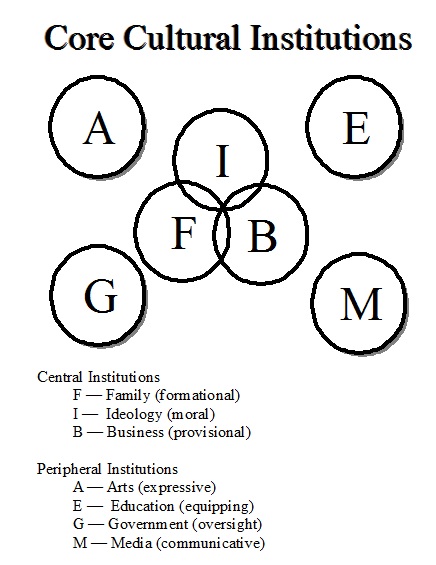
Worship, marriage (and by extension, family), and business are the original and intended institutions of God in creation. Similarly, theocratic governance, to maintain social order in communal living, is instituted as obedient response to God’s ownership (lordship) and the generous provision of the Garden in the single “rule” (to not eat of the Tree of the Knowledge of Good and Evil) of the pre-Fall Edenic covenant.

The `ezer neged, Eve with Adam, was an echo of the equality and fellowship within the Trinitarian Godhead, completing an acute communal reality of being made in the image of God, male and female. Communalism is a spiritually and temporally (economically) unified reality, hence our mutual human interdependence as emulating and in harmony with God.(v)

NOTES

i. On humankind created male and female, Genesis 1:27 uses the Hebrew neqabah (female) to note the genitalic sexual distinction.
ii. This is discussed in Eden’s Bridge, 5.2 Sacrament: Sacred versus Secular.
iii. This is discussed in Eden’s Bridge, 4.2 Redefining Business—as mutually beneficial exchange between cooperative laborers to facilitate and enhance relationship.
iv. Weal, welfare or well-being, is defined as prosperity, happiness, the general good, and welfare of the community. In effect, true weal is shalom. In the modern sense, wealth (abundant material provision) provides for creature comfort so can be easily understood in the sense of its root, though it can lose its communal character to individualistic greed and material insecurity.
v. Such that communalism not be misunderstood outside the context of the whole of Eden’s Bridge, godly communalism is an uncoerced social construct, that is, living with the regard for all willingly out of the character of one’s spiritual nature rather than as a legal condition created by governmental edict.

4 Comments

Filed under Excerpts from Eden's Bridge the Book, Faith in the Marketplace