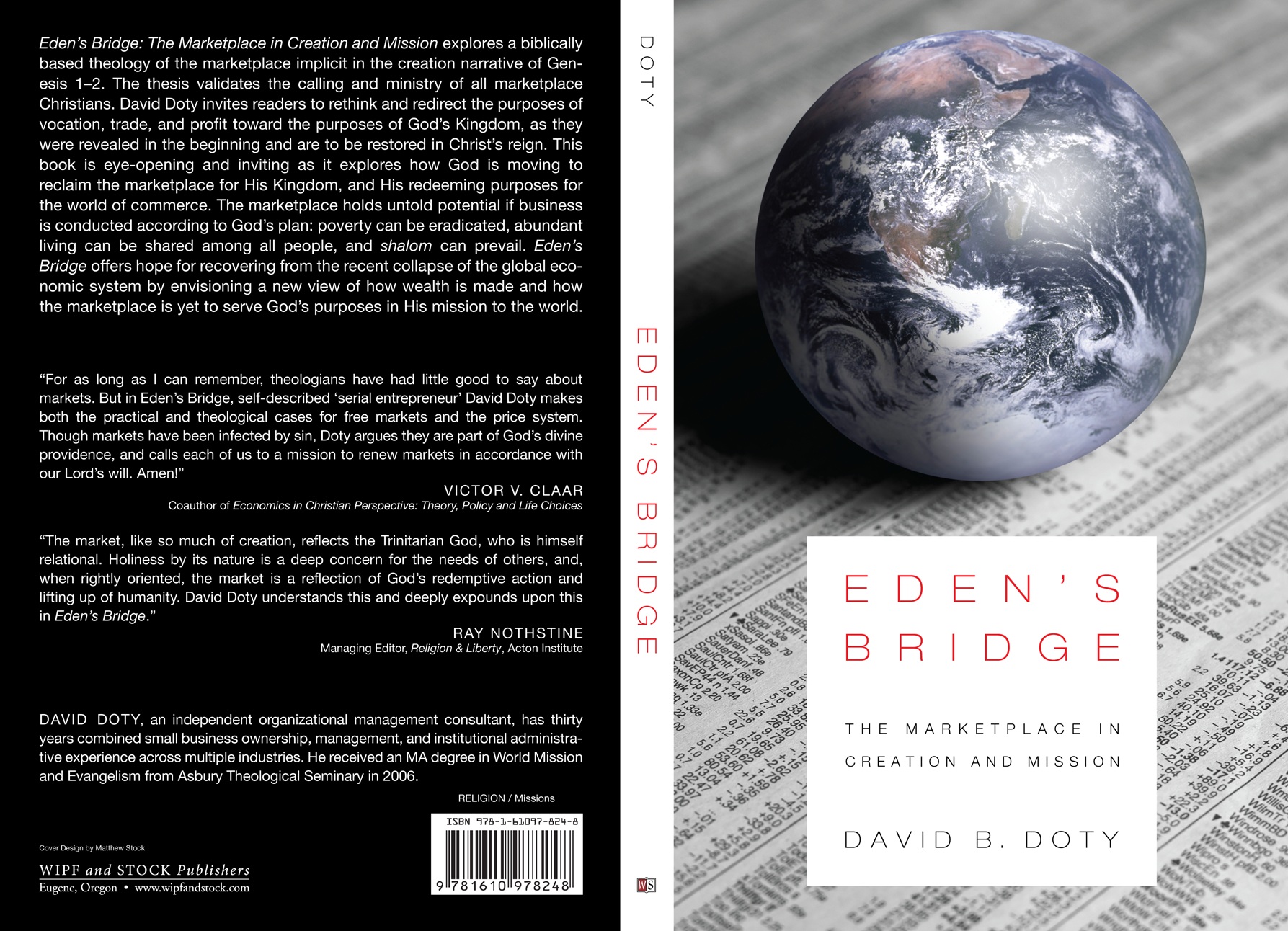
Cover art for Eden’s Bridge: The Marketplace in Creation and Mission

How exciting is this? Eden’s Bridge should begin shipping within two weeks, available for order from Wipf & Stock or directly from me for single or multiple copy orders. Dave Doty – 859.621.3636 // davedoty@edensbridge.org

Leave a comment

Filed under Announcements

Business as Sacrament: On the Sacred versus the Secular

(This essay is a close adaptation of an excerpt from the book Eden’s Bridge: The Marketplace in Creation and Mission, © David B. Doty, 2011, which is due to be released in January, 2012 by Wipf & Stock Publishers.)

Two statements made at a 2010 summer conference undermine the Christian’s role in the marketplace. Both were made by mature Christian business practitioners and in response to pointed questions after speaking to a largely Christian gathering of theologians, business practitioners, students, clergy, and administrators.

The first concerned the role of business in God’s mission in the world (paraphrased): “Business is not ordained of God. It is only a vehicle for doing good.” This would hold true if it were qualified that business is only for the purposes of financial gain. But business serves numerous and far more important purposes.

Experience validates that those in agreement with the speaker are generally uncomfortable trying to reconcile the extensive abuses of the marketplace to the character of God. This concern with the “corrupt nature” of the market, therefore it must not be “of God,” is quickly undone if marriage is held to the same purity test. The corruptions of marriage and the marketplace are due to human sinfulness, not God’s design or intent for either institution. An obvious parallel is God’s allowance for the sin of divorce. Jesus addressed the Mosaic divorce decrees as acquiescence to the hardness of the human heart. God hates divorce (Mal 2:16) just as He hates unjust scales (Prov 16:11; Prov 20:10; Prov 20:23) because both are violations of just relationship.

Marriage is a covenant, an earthly model of the marriage of Christ and His bride (Eph 5:22–33). The household, as marriage and family, serves as a microcosmic model of the marketplace as a unifying and provisional social community. God’s relationship to humanity is covenantal. God did not destroy humankind when the (pre-Fall) Edenic covenant was broken. Grace remained for human provision and to provide the opportunity for restored relationship with God. In the marketplace, formal contracts are legal covenants but we seldom witness grace (forgiveness) from the world when contracts are broken, further evidence of sin’s corrupting presence.

The human social (informal or cultural) contract, as a manifestation of God’s stated moral laws and naturally-ordered law in creation, is fundamentally concerned with economic issues. Law and culturally-based behavioral norms contribute to peace of mind and body and stability to society as they broadly serve the common good. Economics appear to have played a dominant role in God’s indictment and judgment of Sodom, as they did not “help the poor and needy” (Ezek 16:49), and Tyre, where they “did not remember the covenant of brotherhood” (Amos 1:9). The abhorrent acts under indictment were, in the view of God and the godly, clearly unacceptable and violated the shalom of society.

Parts of the human social contract and the pursuit of the common good are upheld by law. But God-followers are morally obligated to do good (Isa 1:17; Mic 6:8), delighting in kindness (Hos 6:6), and preserving justice by doing what is right (Isa 56:1; Zeph 2:3), especially for the poor, orphans, widows, the weak, and afflicted (Ps 82:3; Jer 22:3). These are the sacrifices pleasing to God (Heb 13:16; 1 Pet 2:5) which may go beyond the letter of the law, as Jesus often taught. The focus is toward social equilibrium and flourishing, shalom such that all in society are well provided for.

God commands His people to do good. Business is one means for doing good and in fact does a great deal of good (i), even as it is carried out by non-believers or operators from other faith traditions. Whenever business is carried out justly, it does good and is God-ordained because we are assured that all good things “come from above” (Jas 1:17). God created the marketplace to serve several positive ends. Human provision, facilitated by the beneficial exchanges of the marketplace, is a fundamental function of creation. Commerce can also be, at least informally, a means of revelatory grace, specifically as immanent charis, the kindness, mercy, and goodwill of God in the world, as business generates wealth that can be used to pay wages, feed the hungry, clothe the naked, and care for widows and orphans. Business can be evangelizing witness to the glory of God as operators share their lives and hope with their employees (by paying fair wages), vendors (by being credit-worthy), customers (by giving excellent service), communities (by supporting and participating in civic activities), and to all by their profession of faith and general congeniality. Christ is present in the marketplace when the devout carry out their business in accordance with God’s will, purposes, and character.

The subordination of the marketplace to “worldly” status, as a form of dualism, is an offense to the Scriptures and God. God decreed the cooperative relationship between Adam and Eve and in all its inherently economic, spiritual, social, relational, and ecological nature. We undermine God’s design when we disallow God’s ordination of the marketplace as part of the proper created order.

The second comment came when the other businessman referred to his “secular” business. When that description was challenged from the audience, he claimed that the business was “secular but not secularist.” I admit freely that I did not and do not understand what that means. I believe that, like the first speaker, this man views business as not ordained of God and under God’s ownership and operation, but meant that as the operator of the business he has godly intent and aims. I cannot disagree more vehemently with drawing such a distinction.

How Christians perceive the division of secular and sacred is important. The popular definition of secular absolutely divides temporal and spiritual matters (dualism). Several Biblical and theological concepts, however, reinterpret that definition. In addition to God’s people, all of creation is being redeemed in Christ, as waiting in earnest expectation (Rom 8:19). Is being redeemed, an active process, is the operative phrase. The functional reality of the Christian life is tension between the worldly (fallen temporal) and the heavenly (restored spiritual). Paul sees this as normal when telling the Corinthians that “we will all be changed” (future passive—1 Cor 15:51–52) and that we “are changed” (present passive—2 Cor 3:18). The first is in reference to the bodily resurrection, the second to taking on the image of Christ. Charles Cranfield, the author of the commentary on Romans published in The International Critical Commentary series, argues that this tension is not resolved between Romans Chapters 7 and 8, but rather that the war between the flesh and spirit is the ongoing conflict of the Christian disciple, striving to serve God in holy living yet recognizing how they continue to fall short of his glory.(ii) Both personally and systemically, the Kingdom of God, the growing reign of Christ in individual hearts and the ongoing redemption of social institutions, is already-but-not-yet, now in imperfect operation yet looking to a future, perfect fulfillment.

This moves the discussion toward issues of eschatology, the study of the last thing (eschaton) or last things (eschata).(iii) Mortals peering into the future certainly see “as through a glass darkly” (1 Cor 13:12). The views on what is to come in this world and in heaven run across a broad spectrum. Western orthodox Christian traditions—Roman Catholic, Reformed and the majority of Evangelical—lean toward forms of a post-millennial view that holds Jesus Christ’s earthly reign will occur when He returns (the Second Coming) at the end of a long period of time: a period in which the church is spreading the Gospel throughout the world and leading the transformation of social institutions and cultural norms toward God’s will. These Catholic, Reformed, and Evangelical traditions hold an optimistic view of the future, drawing on Scripture, and the advancement of human institutions in the West, including democratic government and liberalized markets, and the Christian calling to godly ethics in all spheres of life.

The validity of these views is defensible in much of the Old Testament prophetic expectations and the New Testament witness, and poignantly expressed by Jesus’ petition in the Lord’s prayer: “Thy Kingdom come, they will be done, on earth as it is in Heaven” (Matt 6:10).

Eschatology is fundamentally concerned with God’s reign in the last days in the world, from Jesus’ Ascension until His return. The presence and guidance of the Holy Spirit for the Christian life advocates for a significant degree of Kingdom presence in the world as adherents live in obedience, doing good as the agents of God. Kingdom speaks to ownership and rule as it is under the authority of God’s sovereignty that good works are carried out.

Here the discussion shifts to issues of stewardship and sonship. Two strong arguments in Scripture for pursuing the sacred in Christian life are that “the earth is the Lord’s, and all it contains, the world, and those who dwell in it” (Ps 24:1), “and whatever you do in word or deed, do all in the name of the Lord Jesus, giving thanks through Him to God the Father” (Col 3:17). Adam’s appointment as steward (to keep) the Garden was clear. The Bible is filled with considerations of the moral responsibility and character of godly (and ungodly) stewardship.

But more than stewards, Christians are the children of God which involves the important elements of inheritance, ownership, and dominion. It is helpful to remember God’s original intention in creation to create a family for Himself, to ultimately bring “many sons to glory” (Heb 2:10). As any good father would, the heavenly Father wants to bestow a rich inheritance on His children, not just of material blessing but, more importantly, of character. Christians anticipate that inheritance explicitly in being called joint heirs of the glory of God with Christ (Rom 8:17) and look to being changed step-by-step, from glory to glory, into the image of Christ (2 Cor 3:18) as the “event” of receiving the inheritance.

The nature of the glory of Christ and of the heavenly Father is summed up by the four living creatures in adoration before the throne of God: “Holy, holy, holy.” As God followers, Christians live under the hortatory “Be holy for I am holy” (Lev 11:44b), “like the Holy One who called you, be holy yourselves also in all your behavior, because it is written, ‘You shall be holy, for I am holy’” (1 Pet 1:15–16). The call to holiness presents challenges for Christians in the marketplace, in particular by the phrase “in all your behavior” here and Paul’s “do not be conformed to this world” (Rom 12:2). Holiness (hagios—Strong’s 40) is determinative of character in all aspects of Christian practice. To be holy is to be morally upright by intrinsic or divine character. Holiness is available to Christians only through the power and presence of the Holy Spirit.

Christians in the marketplace, feeling pressed by worldly circumstances, may impose an unholy bifurcation on market decisions to allow excuse for ungodly behavior. The nature of holiness has been defined as otherness. God’s glory is so far from our fallen state, for example, that it is understood that we cannot be like God. We cannot be omnipotent, omniscience, or omnipresent. We can, however, seek to know and practice the will of God. Accepting and loving one another, taking on the mind of Christ (Rom 15:5), willingly deferring and sacrificing for one another, submitting ourselves to lives of humble service—these attitudes and acts may challenge the logic of worldly pragmatism (human wisdom) which is limited by the narrow vision of human knowledge.

Holiness may oppose what appears to makes sense: “let no man deceive himself. If any man among you thinks that he is wise in this age, let him become foolish that he may become wise. For the wisdom of this world is foolishness before God. For it is written, ‘He is the one who catches the wise in their craftiness’; and again, ‘The Lord knows the reasonings of the wise, that they are useless’” (1 Cor 3:18–20).

It easily follows that, beyond any limited righteousness “enforced” by the world’s legal documentation and contracts, businesses operated by Christians are to be held as sacred trusts, set apart for the glory and worship of God. That set apartness means these endeavors are sacramental with a small s, having a sacred nature. Any lesser view relegates the marketplace and the workers’ efforts to the profane.

A major influence dividing the spiritual and the secular in Western Christian minds is one hallmark of Platonic dualism: the view that the material world is inherently evil. While creation has been corrupted, this dualism leaves no room for redemption except as an escape from the material realm. This view of the material world encourages false eschatological notions and stands against an already-but-not-yet realization of the Kingdom.

Such isolation of secular and sacred even clouds the argument that God’s glory is demonstrated in nature (Ps 19:1). For example, consider the pending birth of a child. Secular humanism wrestles with the essential nature of a fetus (“When does it become a person?”). Yet logic is not troubled that the fetus is present and possesses the potential of a fuller realization. It is at once a thing living though in a transitional state and as yet unfulfilled. Before I was married, I had the potential to be a father (conceptual), but when my wife became pregnant I was in a state of flux until the child’s birth actualized that role. In a real way, I was already-but-not-yet a father during her pregnancy.

Compartmentalizing our spiritual and temporal natures is a slippery slope excusing and even justifying the necessity of ungodly policies and practices. Profit, for sustainability and increasing wealth, is ordained of God (Deut 8:18), but that ordination remains only as God is obeyed in both generating wealth (means) and using it appropriately (ends). The primary function of the marketplace in creation is for the facilitation of just relationships toward adequate universal provision, the Edenic shalom as both means and ends.

Marketplace Christians are under enormous tension because it is easy to live with just one foot in God’s Kingdom. Compartmentalization is enabling and pragmatism can be self-justifying. Greed and power are strong temptations and compromise easily leads to hypocrisy and dishonors the glory of God.

The false divide of sacred and secular presents difficult disciplines and choices for marketplace Christians. That is why personal and systemic economic issues arise in every section of the Bible. In the Torah we find laws and commandments pertaining to the treatment of the poor (Lev 25:35–55) and the valuation of property (Lev 27). In the historic books, we find the military and economic oppression of Israel by Midian (Judg 6:1–10), Boaz leaving gleanings in his field for the poor (Ruth 2:1–9), and the abolishment of usury (Neh 5:1–13). In the wisdom literature, we see that a righteous man does not exact usury (Ps 15:5), that honest scales are of God (Prov 16:11), and that the Lord hears and responds to the cries of the poor (Ps 34:6).

And so it goes, throughout the prophets, the Gospels and Acts, the Epistles, and Revelation. Creation is economic by design, and economic justice (equilibrium, shalom) is a primary aim of God’s mission.

i. Kennedy, Robert G. “What is the Good That Business Does?,” in The Good That Business Does, 67–85. Grand Rapids, MI: Acton Institute, 2006.
ii. Cranfield, Charles E.B. Romans: A Shorter Commentary, 168–72. Grand Rapids, MI: William B. Eerdmans Publishing Company, 1992.
iii. See Walls, Jerry L., ed. The Oxford Handbook of Eschatology. Oxford: The Oxford University Press, 2008, as an excellent resource for studying eschatology generally.

2 Comments

Filed under Excerpts from Eden's Bridge the Book, Faith in the Marketplace

The Pitfall of Applying Christian Principles in the Marketplace (or anywhere else!)

I once heard a seminary professor say something along the lines of “I hope I never find myself extracting principles from the Bible.” I was admittedly shocked and appalled. Was not the Bible the hallmark for establishing Christian principles?

Over time, I have reflected on his comment and continued to strive after understanding. I think it finally came as I contemplated 1 Thessalonians 5:17: “pray without ceasing” (NAS). This verse has been one that I have tried to think on since the early days of my Christian walk nearly two decades ago. What does it mean to “pray without ceasing”?

As I reflect, I see two ways to embrace Scripture. In one sense, it is a guidebook, a means to know what behavior is acceptable and what is not, hence it creates an opportunity for me to establish a set of guidelines, a moral checklist, so to speak, by which I will know daily if I am a good person, a holy one, or an evil, unholy one. This is a principles-based religion, the essence of the Mosaic Law.

The other option is to embrace Scripture as a story revealing God and His character, and me and mine, juxtaposed to each other. It also reveals what God has done to alleviate the shortcomings I find in my own character. Rather than a principles-based understanding, I find myself confronted with a relational understanding of what the Bible is all about.

There is a deep philosophic question pertaining to character and behavior as to which precedes the other. Do we act out of behavior or into it? The problem arises in the Western mind by applying an undue bifurcation. Why do we insist that it is a question of Option A or Option B? In truth, we see that character on-display (ethic or behavior) is a product of mindset (belief or morality) and, at the same time, mindset is a product of character (moral determination). And both involve willful choices, choosing both what to believe and what to do.

The first, that our mindset determines our behavior is seen in that we base many decisions on what we believe already to be true, especially as concerns moral issues. The story of Jesus teaches us we should be compassionate and since I am a follower of Jesus that is the ethical response to the world I should embody. And from that mindset we tend to practice compassion even sometimes when we do not feel particularly compassionate, or even feel nothing at all. This is a principles-based response.

At the same time, we form the character of children, or disciples, by teaching and directing them to think and act in particular ways and, much like practicing the piano, the behavior is learned and improved by practice and correction for misbehaving. Receiving moral instruction begins to establish neural links that are then reinforced or undermined by ongoing behavior and events. At the same time, being fundamentally pragmatic creatures bent on survival and a desire to thrive, we sometimes act, assess the results of our actions, then determine beliefs based on the corresponding relationships between the events.

As becomes apparent, the conundrum appears in that we are not always able to discern which came first, the proper order of things, such as the classic chicken and egg paradox. So, how then should we anticipate engaging Scripture?

The fundamental issue lies in the heart of our beliefs about the God of the Bible, and the nature of our relationship to Him. Is God disconnected from us, having simply handed down directives to inform our behavior, or is God vibrantly relational, speaking into every situation? The Bible is limited by the reality of being a set number of words and sentences. Some will be put off by that but I ask that they consider we are talking about an infinite God. No number of books could contain all about God nor would our limited human capacity allow us to know and retain all about Him.

But let’s put the “pray without ceasing” into another analogy. Psalm 150:6 says “Let everything that has breath praise the Lord.” If we understand that all of creation exists from the impetus of God and that God’s will holds creation in suspension. In a very real way, as we live and breathe we are interacting either within or outside the will of God. As our heart pumps blood through our bodies, we rely on God’s favor to keep it beating. In this sense, we are always connected to or communicating with the reality of God. Hence, by becoming aware of that and practicing a continuing awareness of it, we start to understand how “praying without ceasing” is bringing the core of our being into relationship with God.

If I believe that God supplies every breath and ensures each heart thump, and think on it intentionally, I begin to realize that God’s voice, the voice that spoke creation into being and sustains it now, never stops speaking. It is an eternal voice. Whether we are aware of it or not, we are always in contact with the divine. But if we are aware, then we have the opportunity to bring our will into alignment with God’s will. Our “praying without ceasing” gives us opportunity to examine what our appeals to God are saying as we pursue knowing God, as we would any other with which we have relationship.

The relational nature of the Bible is meant to help us know God as His character is stated and demonstrated. Knowing His character will help us in learning to hear His voice, to recognize that voice as it speaks through others, through the Bible itself, or as it speaks through circumstances and opportunities. The three persons of the godhead—the Father, Son, and Holy Spirit—are just that: persons. As we look to know God we discover how God acts and responds to us and we measure persons by character. Are they trustworthy? Are they consistent? Are they just? And we respond, we relate, to the character.

We do not live our earthly social relationships consciously according to principles lest we miss the subtle nuances of relationships and the importance of give and take within them. We live human relationships according to how we see and anticipate the other parties we engage. If we act only according to principles, we become complex automatons guided by an increasingly complex set of rules. The complexity of the number of circumstances we face through time, given the extent and varied experience of the entire human family, is beyond quantifying. Hence, “principles” must remain fluid for the purposes of adaptability and they tend to lose their fixed-ness as we must adapt to changing social and cultural constructs. The farther we go in life, the more difficult it is to predict how we should or will react in every possible circumstance.

In the end, a principles-based approach, whether it be to how we practice business, how we play team sports, or how we relate to our spouses, children, or church families, must become overly legalistic on the one hand if we try to keep it simple enough to manage, or pointless on the other hand if we leave it flexible enough to adapt to every circumstance and it become unmanageable.

A major tenet of Christian faith is that we are being “reconstituted,” being transformed and taking on the divine character. As this process occurs, generally labeled sanctification, who we are is redefined, most especially as to how we relate to God, others, and ourselves. Our responses to God, people, and circumstances then should be assessed according to character rather than principle, and we act out of who we are (or desire to become) rather than principles which are, in effect, a catalog of do’s and don’t’s.

As the article title intimates, there is an inherent pitfall in trying to approach business (or any endeavor, in fact) with a principles-based mindset. The pitfall is that it puts us in charge of determining what is good and evil, exactly the downfall that led to Adam and Eve being put out of the Garden of Eden. We establish a set of moral tests that determine outcomes but hit a wall when confronted by circumstances that do not fit our model. Our behavior might be assessable by a principled review but trying too much to be led by principles will either not allow us the flexibility to adapt to unforeseen possibilities or our system will be undermined, under constant revision and increasingly fluid, as we realize the rigidity of that approach.

As said, trying to “be Christian” is a chicken and egg conundrum. Jesus and the other models of holiness in the Bible show us what holy behaviors looks like and we should set out to emulate them. We will find ourselves unable and frustrated when we fail because, at given points in time, our character has not yet been transformed such that righteousness is as natural as breathing. Principles are a good tool for assessing ourselves and others, inspecting the fruit of our lives as evidence of character. But being in vital relationship with God, praying without ceasing, will guide every circumstance and situation without the burden of Law.

1 Comment

Filed under Faith in the Marketplace

On Priorities

I have been a long time fan of the Humane Society, having adopted several pets from shelters throughout my adult life. But I have hit a bit of a snag, not with the Humane Society per se, I do believe in the work they do. The snag comes in how a particular recent event demonstrates the social and economic imbalance of the world in which we live.

The Atlanta Humane Society opened its new Mansell Campus recently in the Roswell / Alpharetta area. It is housed in a car dealership building, valued at $6 million, that was donated. An additional $2 million was spent renovating the space. The overall price tag of $8 million is where I hit the snag.

I serve on the board of Life Light Ministries (lifelightinc.com), an indigenous Christian mission in Aurangabad, India. They house eighty orphans, operate two Christian schools, and conduct a multitude of outreach ministries including the support of nine pastors and church plants. Last year, Life Light’s entire budget was $100,000.

If $8 million can be spent on rescuing and adopting out cats and dogs, how much more could have been accomplished through ministries like Life Light? If $8 million were placed in an endowment for Life Light, it would easily produce $350,000 to $400,000 annually and cover all the operating, capital, and growth needs of the ministry…forever.

I am trying to raise funds to travel to India to help Life Light with organizational and staff development. They also have about 30 children right now in need of $35 / month support. I have established a campaign at http://www.indiegogo.com/Indigenous-Indian-Mission-Assistance to raise the immediate travel funds. Would you prayerfully consider supporting Life Light Ministries?

Leave a comment

Filed under Discipleship

We’ve Moved!

All previous post content has been moved to our new website: www.edensbridge.org.

Please visit us there!

Thanks,

Dave Doty

Leave a comment

Filed under Announcements

Sacred Vocation

While conducting research into the integration of Christian faith and economics, I have run across many professionals who have already “retired” from their secular job to go into full time ministry or missions work or are looking forward to doing so. In light of that separation between how they view their professional vs. ministry careers, I wanted to synopsize a devotional that I have been working on for a career transition group meeting.

Theologically we have had no problem with proscribing dignity to productive work since God worked in the six days of creation. And we see clearly in Genesis 2:15 – ” Then the LORD God took the man and put him into the garden of Eden to cultivate it and keep it.” Part of being fully human, part of our created purpose and function in the universe, is to work. The first thing God gave Adam was a job.

I want to start from Genesis 2:15 and discuss briefly how the Bible frames our understanding of our material provision coming as a result of working, then look at the ultimate purpose of work. In the verse cited above, it is interesting to note that God never commanded Adam to “cultivate and keep” the Garden as He commanded Adam and Eve to multiply and fill the earth. Seeing work as an integrated component in being human, one could argue easily that our work, in turn, works with creation to provide for our material needs to sustain us…and it does.

But there is another purpose in the relationship between our work and our provision. Two verses that echo each other will help illuminate my point. The first is Psalm 37:4 – “Delight yourself in the LORD; And He will give you the desires of your heart.” The Hebrew word for desires – mish`alah – means petitions or requests. In effect, this verse is telling us that God will answer our prayers. In the Lord’s Prayer (Matthew 6:10-13), Jesus taught us the kinds of things to request from God – that His kingdom and will would manifest on earth, that we would be fed, that our debts would be forgiven, and that we would be protected from temptation and evil. Nestled between God’s Kingdom manifestation and the protection from temptation and evil are two substantial economic concerns – food and debt. That these debts refer to forgiving personal sins is arguable in the immediate context.  But the forgiveness of material debt is part of God’s Law given to Israel in how to live together in community so I prefer to take this to mean both material and relational debt and forgiveness. But that topic is a bit of a diversion here.

Let’s move on. The second verse that echoes the sentiment I want to examine was in the midst of Jesus’ Sermon on the Mount in Matthew 6:33 – “But seek first His kingdom and His righteousness; and all these things shall be added to you.” The “all these things” Jesus is talking about are material provision, specifically sustenance: what we eat, drink, and wear (6:31). Physical survival is very definitely an economic concern since the marketplace is where we create income and buy our provisions.

But I wanted to draw attention to the first clause in each of these verses: “Delight yourself in the Lord,” and “seek first His kingdom and His righteousness.” The emphasis is not on receiving our material provision but about being joyful about God and, by coming to know Him and His ways, bringing about His Kingdom and will on earth. It sets a priority of communion with and obedience to God that precedes our material well-being. Our provision is of secondary concern to being in right relationship with God.

These verses test our faith by challenging our focus. Will I seek to know and obey God and not so much worry about or take matters of vocation into my own hands? That is not to say we should not be diligent about working, or seeking work, but that all we do is subordinated to God and our faith that He will provide for our needs.

Finally I want to offer the ultimate purpose of our work. The church often speaks of witnessing to the world, that is, sharing our faith with unbelievers. But there are ways other than vocally, and often with greater impact, to share what our faith means to us and how it affects our lives. St. Francis is famously attributed with having said, “Witness always, if necessary use words.”

The last verse I wanted to draw into this is from Matthew 5:16 when Jesus says, “Let your light shine before men in such a way that they may see your good works, and glorify your Father who is in heaven.” The entire book of James is about the relationship between faith and works. We typically take that to mean charitable works but I think it is much broader than that. God gave Adam a job (really two jobs – to cultivate / labor and to keep/ management) in the Garden. It was productive, sustenance providing work. There was no need for charitable work in the abundance of the Garden.

All this leads to the following observations. Work is part of being human, in our DNA, so to speak. Our works, of all kinds, bear witness to what we believe and how we act in response to God. Our provision is a product of God’s design of creation which Scripture tells us repeatedly gives glory to the Creator (such as Romans 1:20 and Colossians 1:23). If we are willing to subordinate our vocation to obedience to God, bringing His ethic and the indwelling Holy Spirit with us into the workplace, we embrace our work as a sacred offering and God will be glorified, His ultimate purpose for His creation.

David Doty is the author of Eden’s Bridge: The Marketplace in Creation and Mission (publication pending under contract to Wipf & Stock Publishers), which articulates an unprecedented biblically-based theology of the marketplace.  Doty is currently writing Downside Up: The Kingdom of God and Economic Potential, re-considering economic system designs in light of sound biblical theology.

Leave a comment

Filed under Faith in the Marketplace

Release Pending: Eden’s Bridge: The Marketplace in Creation and Mission

Release Pending: Eden’s Bridge: The Marketplace in Creation and Mission (Wipf & Stock Publishers)

Expected availability: (around) January 1, 2012
It has been suggested that, given the importance of articulating a Biblically-sound theology of the marketplace, I host a series of informal round table discussions to review Eden’s Bridge. The book establishes a Biblical foundation for the marketplace as an institution of God and His intent for it in creation and His mission in the world. We live in very exciting times and I believe we are about to see God move even more mightily, even miraculously, in the marketplace.
I would like to determine the interest level in having six, two-hour meet ups in the North Atlanta (GA) area. Most likely we would meet at 9 a.m. on Saturdays at two week intervals, beginning around the first of February. This would allow time to think on, discuss, and revisit the book in its entirety in a thorough way. Pre-registered participants, or those interested in pre-ordering the book, would be able to purchase Eden’s Bridge directly from the author at a 20% discounted purchase price (to be determined).
The series would be as follows:
Eden’s Bridge: The Marketplace in Creation and Mission
Session 1 – Introducing a Biblical Theology of the Marketplace (seven propositions)
Session 2 – An Economic Walk in the Garden (the marketplace in the creation narrative)
Session 3 – Key Economic Models in the Bible & Theological Concerns
Session 4 – Relevant Ancient (Biblical) and Modern Terminology
Session 5 – Issues of Redemption of the Marketplace
Session 6 – issues of the Integration of Market and Mission
Let me know if such a series would interest you or how I might consider structuring it differently than I have suggested to be most effective.
Thanks,
I am looking forward to hearing from you.
Dave Doty
Author, Eden’s Bridge: The Marketplace in Creation and Mission 
859-621-3636

Leave a comment

Filed under Announcements

To Work (`abad): To Work, Serve, and Worship (Genesis 2:15)

There has been a great deal written about the dignity of work, and rightly so. The following is adapted from Eden’s Bridge: The Marketplace in Creation and Mission (©2011, David B. Doty – pending publication under contract to Wipf & Stock Publishers of Eugene, Oregon).

“Then the Lord God took the man and put him into the garden of Eden to cultivate (`abad) it and keep it.” `Abad is an especially poignant word in Scripture. In this passage, it is translated into a variety of familiar terms: to dress (KJV), to cultivate (NAS), to work (NIV), and to till (RSV). According to Strong’s Concordance, `abad means to work but also, by implication, to serve, or to till.

But `abad also carries a sense of worship. In Exodus, `abad is used repeatedly in the dialogs between Moses and Pharoah about Israel going out to the desert to serve the Lord. In Numbers, the Levites served (`abad) in the Tabernacle of Moses.

It is easy to understand this multi-leveled term. Consider ownership retained by an investor who pays wages in return for the labor necessary to fulfill the purposes of the thing owned, whether a field or factory, a store or the whole world. Moving into the idea of worship is no more difficult to understand than embracing the idea of honoring one’s master and provider as a matter of respect, in humble and ardent gratitude for benefits bestowed.

The Bible exhorts that God-followers do all things as unto the Lord (Col 3:23). We honor God by how we serve His aims in following His commands. Just and righteous works are acts of worship. In undertaking our work as worship, the holiness of God will manifest in our daily lives, witnessing Christ’s glory in the marketplace and the home.

Interestingly, God did not command Adam to work and keep the Garden. To work and keep it was simply part of the DNA of being human, of our function and purpose in the universe. Our work is part of the design of creation and disseminates the redemptive grace of God in the marketplace. How we anticipate the marketplace as an ordained institution in God’s created moral order, and act accordingly in all we do, helps clarify the sacred nature of our commercial endeavors.

6 Comments

Filed under Excerpts from Eden's Bridge the Book, Faith in the Marketplace

A Brief Theology of Profit-Making

Adapted from Eden’s Bridge: The Marketplace in Creation and Mission (© 2011 by David B. Doty, publication pending with Wipf & Stock Publishers).

Some Christians wrestle with earning profit, questioning whether it should be pursued at all. Some consider profit “onerous,” meaning “troublesome or oppressive; burdensome.” Others take a more neutral stance citing numerous biblical passages and arguing along principled lines that profit is inert, being neither evil nor good. The bottom line: profit is good and an ordinary product of God’s creation.

If we ask “should Christians seek making profit?”, the discussion may be launching from the middle of the conversation. Better questions to ask are “what should Christians pursue?” and “what does the Bible teach on the origin and nature of profit?”

Eve was created as `ezer, a help to Adam, before she was called wife. The creation of human community established the division of labor. Workers can attest that most tasks can normally be done with greater efficiency with a helper than if working alone. The bigger the task, the more division of labor, the greater the efficiency.

The division of labor fosters collaboration, specialization, and innovation. The natural outcome of these is increased output, which we can label increase, gain, or profit. Corporations, for-profit and not-for-profit, are collective human efforts toward producing outcomes more efficiently (gainfully) and effectively.

The physical union of Adam and Eve and the multiplying effect of planted seeds demonstrate that God’s created ecosystem is productive in a positive trajectory. The procreation of the first couple has led to a global population nearing seven billion souls. Corn and wheat reproduce toward the multiplied blessing of the thirty, sixty, or hundredfold return.

Nature itself, which glorifies God, shows that gain is intentional in God’s plan for all creation, including humankind. Many Christians practice righteousness in business—paying good wages, paying their bills on time, offering quality products, etc. Their profitability and increasing wealth demonstrate that material gain is a natural outcome of righteous relationships and the just exchange of goods and services. Profit (increase) comes when creation, including us, acts in harmony with God and the created order (aka natural law).

In Kingdom economics profit is not to be the aim but will be a natural outcome of the pursuit of righteousness. Jesus taught, “Seek first [God’s] Kingdom and His righteousness, and all these other things shall be added to you” (Matt 6:33).

As Christians we have but one priority: to worship God. Our worship is wrapped up succinctly in the single Hebrew word, `abad, which in various contexts means to work, to serve, and/or to worship. Our work, service, and worship are inextricably linked and together, in our pursuit of God, will draw us toward holiness.

Profit is a desirable outcome but it is not the primary pursuit for a Christian in business. Discipleship at the feet of Christ is our first aim. By obedience to God and trusting in His promises, we will profit. A growing knowledge of Christ and righteousness fostered in that relationship will guide us to worthwhile employment and grant us wisdom for the use of our gains.

God affirmed this when reminding Israel in Deuteronomy 8:18 that it was not by their efforts but His, acting on His covenant, that they would grow wealthy: “But you shall remember the LORD your God, for it is He who is giving you power to make wealth, that He may confirm His covenant which He swore to your fathers, as it is this day.”

God gave us work, responsibility, relationships, and the call to holiness. But “what does it profit a man to gain the whole world, and forfeit his soul?” (Mark 8:36). Christians are to pursue Christ in every aspect of life, including doing business. Profit will come as God sees fit. It is an intended function in a well ordered universe.

1 Comment

Filed under Excerpts from Eden's Bridge the Book, Faith in the Marketplace

Mustard Seed Economics

Mustard Seed Economics

Global economic turmoil has thrown millions of people and whole governments into confusion bordering on panic. And times such as this present an opportunity for powerful Christian witness. There are those in the church who will step up and lead us to dig more deeply than ever before to give and help those who are teetering on the brink of personal economic collapse. And they do so rightly. Christians have a powerful opportunity to demonstrate the generosity and genuine concern Christ has for every man, woman, and child living in dire straits.

But there is an even greater opportunity to change the world in a fundamental way. It requires faith that asks Christian, especially in the well-developed economies of the West, to reconsider how we invest our earthly treasures.

There are two basic problems with the way most currently invest. The first is that it tends to follow a fear-based investment strategy which flies in the face of the consistent “fear not” message of the Bible. Too often we put stock (pardon the pun) in what we can see. Investment strategies include diversifying to include holding blue chip stocks and precious metals as a hedge against the volatility of market fluctuations. These companies and commodities tend to hold their value and weather the storms of sudden and jerky market fluctuations.

On the other hand, the Gospel is a fearless strategy for living as it challenges us to trust in a God we cannot see: a God who challenges us to live a faith which “invests” in things unseen. This God warns us that we cannot know what tomorrow brings, that we are not to lay up treasures in the earth, that this life is very short, and fear-based living undermines our faith. We are called to a radical idea of hope and of the future that is bold. In that very boldness lies our strongest witness as it turns into real-world action.

Here is the crux of Mustard Seed Economics. The name is obviously borrowed from Jesus’ popular parable of the Mustard Seed. Jesus compares the Kingdom of God to the smallest of seeds but one that will grow up into a substantial plant. Small beginnings…great potential. The potential of the mustard seed is inherent within the seed itself. It will draw moisture and nutrition from the surrounding soil when planted but the kernel of the seed will develop and grow using those outside resources to become something far greater than its original state. But its original state, as a very tiny seed, is all about potential.

The difference between the world’s view of the market and that of the Mustard Seed Economics view is faith. The world has faith only in what it can see, understand, and attempt to control. It relies almost entirely on the knowledge and cunning of the individual or group of investors. Praise God that He sends rain on the just and the unjust and, given creative human intelligence created in the image of God, by our wits the human race has achieved great things. But the state of the world’s economy demonstrates how very limited we really are.

The Mustard Seed Economist understands that our wisdom comes from outside of us, not even from the collaborative intelligence of the church itself, but from the inspiration and leading of the Holy Spirit working in and through God’s people.

The problem arises when we invest in the world’s system by the world’s standards and we reap the fear we have sown. We exercise only a small amount of faith and, if our portfolio is well balanced, we reap eight, ten, or perhaps even fifteen percent annual returns (yields). How does that compare to the thirty, sixty, and hundredfold return of which Jesus spoke? It is sad but we consider this investment strategy as safe…a fear-based approach.

Faith grows as faith is practiced. Any Olympian can attest to the diligence and tireless efforts required to reach the podium and receive the coveted medal. Just like their daily routines of exercise and the discipline of dietary restrictions, faith is a choice and an effort. Choosing to believe God and the promises of the Bible is demanding and challenging and often mind-numbingly operating in the dark before we see the light at the end of the tunnel. But that is the very nature of faith, hoping for the yet unrealized.

The challenge of Mustard Seed Economics is to view the world through different eyes, eyes that spell faith R-I-S-K. But is it risk to invest in a God we profess to trust and obey? The upside of faith is beyond our imagination.

Economic and governmental policies have led us to where we are today. Socialism and communism tried to control markets from a top-down perspective, attempting to predict production needs. The predictive mathematic models were the least of the problems of central planning. The greater problem was that people were disallowed the opportunity to strive to be more than they were, to achieve toward their own potential, as their work was confined to predetermined vocations that fit into the formula. Those controlling the model formed an elitist oligarchy that controlled production and squelched human creativity.

Today open markets have resulted in inequitable wealth distribution that the majority do not find palatable. While we consider political freedom a positive thing, high concentrations of wealth have resulted in an economic oligarchy with extremely wealthy investors now dictating, not unlike their central planning counterparts, where funds should be invested, what products should be created, and how best to manipulate labor to glean the most from the system. Unfortunately, their mathematic predictive modeling is often little better than that of the central planners.

Here is what I believe they are missing. Because they live in fear, separated from faith in God, or anything else outside themselves, they try to invest safely, not to grow toward the greatest potential but to protect what they already have. They operate on increasingly narrow margins as economies tighten. If you own a billion dollars in stock perhaps a two or three percent annual return is tolerable. But when economies grow very slowly and wealth is increasingly concentrated in fewer and fewer hands, those in the middle classes are squeezed and those at the bottom are choked off from any real hope and potential.

The question remains: how is all this turned around? Good question and the answer is that it will be turned by faith. The problem with central planning and with the economic oligarchy under which we now live is they are both top down approaches trying to pull people up from the bottom into the middle class. A growing middle class will always increase the power and stability of an economy. The more middle class, the more wealth that is created and all boats rise. But, as mentioned, the collective intelligence of those at the top is miniscule by comparison to the collaborative and creative intelligence of the entire human race.

The faith factor comes in when Christians stop relying on the world’s systems, release their fears, and follow God into a new economic model. When Jesus stated that the poor would always be with us, it was not a statement on how things were meant to be. Rather it was an indictment of the worldly hoarding their wealth as if that wealth would afford them any kind of real security. His statement was in direct contrast to God’s revelation that there would be no poor in Israel…so long as the Israelites followed God’s prescribed economic model. Jesus’ statement illustrates that Israel had not followed that model but that the wealthy and powerful had chosen to follow their own wisdom for their personal security.

The Mustard Seed Economic model rests on one simple principle: potential. To use another agricultural analogy, one does not grow watermelons by planting watermelons. The harvest of watermelons is already present in the potential of a watermelon seed. Planted, the seed grows into a vine which can produce many watermelons and, within them, numerous more watermelon seeds. The design of creation has potential built in but the greatest potential exists in the smallest packages…the seeds.

The Mustard Seed Economic model then is based on investing at the bottom. Rather than trying to formulate economic growth from the top down, the Mustard Seed Economist understands that by empowering the collaborative and creative power of the broadest spectrum of people the greatest potential will be realized.

As a serial entrepreneur, I am well aware that many small start-up businesses will fail in the first five or ten years, usually to the tune of eighty percent or more. But those that make it tend to grow astronomically and yield returns to the tune of the thirty, sixty and hundredfold. It does not take but the two out of ten that succeed to more than offset the funds invested in those that fail. But even then, the monies invested in the failures inject capital into the lowest levels of the economy that human creativity will eventually find a way to put to work more effectively. The key is that those at the bottom, hungry to succeed, will find creative ways to claw their way up the economic ladder if they have a little capital springboard from which to launch.

There are a multitude of economically-empowering initiatives being put into place around the world to allow the poor the opportunity to grow their own futures. And their success will trickle up to increase the wealth of those already higher up the ladder….all boats rise. The challenge to the church is stark: can we overcome our fear, which is a form of unbelief, of distrusting God for our provision, and invest in the risky business ventures of the poor?

In a previous essay, “A Brief Theology of Profit-Making,” I argued that profit is not the aim of the marketplace Christian. Rather, our first priority is righteousness as we follow and cling to Christ for our security and hope. Joseph, Daniel, and David were not seeking to become wealthy but their righteousness led them to success in Egypt, Babylon, and Israel. Profit follows righteousness more than it follows fear.

The church is standing at the precipice of an opportunity to demonstrate the glory of God to the world in unprecedented ways. Given the current global economic turmoil, the wealthy of the church, those with invested retirement funds, those who own multiple homes, those purchasing new cars ever year or two, have an opportunity to drive an economic witness to the world that would have been all but impossible even one hundred years ago.

Globalization and electronic communications present opportunities to increasingly connect producers and markets, to shout from the house top of the glory of our God, to live in righteousness, investing in the least of these, to show the world that our God reigns. With or without our individual assent or participation, God is moving in the marketplace. He will glorify Himself and He is inviting us to take part. Jesus said, “They will know you are my disciples by your love for one another.” Love goes far beyond the utterance of “be warm and well fed” or prayers whispered in our closets. Love is active…just as active as Christ willingly sacrificing His own life on a Cross.

What are you investing in today? Worldly security or a challenging faith? Are you a Mustard Seed economist, willing to put faith to the test? Invest wisely, as one day all accounts will be reviewed.

3 Comments

Filed under Faith in the Marketplace