Category Archives: Faith in the Marketplace

Holiness and Exchange

Most marketplace ministry and marketplace theology focuses on an incomplete picture by trying to read the creation narrative at face value. The key points are taken from Genesis 2:15: “Then the LORD God took the man and put him into the garden of Eden to cultivate it and keep it.” From this verse we delve into the theologies of work and stewardship, both of which are relevant to marketplace theology but do not complete the picture, so to speak.

The real keys are two-fold. The first is God’s pronouncement that it was not good for the man to be alone and that a suitable helper was necessary for “goodness” to be fulfilled (Genesis 2:18). After examining the various creatures that were already with Adam in the Garden, it was determined no such partner existed and God created the ezer neged, Eve. Ezer neged means, most literally, something like helper in sight, helper in front of, or helper opposite. There are three implications here. The first is the helper is present, visible to the one being helped. Adam is aware of Eve’s presence and her role as co-worker. The second is the helper is not in a position of prominence, not behind, not beside but in front of Adam, that is, the helper is in a position that Adam must deal with right up front. This hints at some degree of equality which is not at issue until after the Fall when he is placed over her in the fallen order. The role and relevance of the helper cannot be easily ignored, disregarded, or dismissed. Finally, the helper is in a complementary position, opposite. This is probably most apparent in the sexual differentiation between Adam and Eve. They are counterparts. The sense of opposite here does not mean contrary (though many couples may think it a more appropriate explanation of things) as we commonly think of opposition but rather serves functionally in a correspondent way (co-respondent, specifically, to God).

There are three ways in which it was not good that Adam was alone that only the presence of Eve could resolve. The first, which is also the one most apparent in the text, is in the role of wife for the sake of procreation. It was biologically impossible for Adam to produce progeny without Eve. The organism was not designed like an amoeba that would simply divide to reproduce. The second is in material prosperity. We have all likely experienced the difference of tackling large projects alone and of tackling them with a co-worker. Gained efficiency is typically apparent in that the division of labor and the sharing of overwhelming tasks (either mentally or physically) in the midst of the project. Camaraderie, which dispels the loneliness of being alone and offers encouragement at discouraging moments, adds a psychological boost to the physical work. In any case, as we recognize in the functioning of the marketplace, the division of labor requires ordered cooperation and leads to heightened specialization and collaboration, deepening the interdependency of workers and corporations, all to greater gains of efficiency, which is the crux of creating wealth through increased productivity.

The third component in the partnering of Adam and Eve is the most critical to God and man. As we have noted, Adam’s material prosperity was very limited without Eve, given the absent proliferation of the species and the inefficiencies naturally inherent in working alone. But more importantly, Adam could not prosper spiritually without Eve. That may, at first glance, seem preposterous since he was often (always?) in the presence of God in the Garden but there was no way for him to rightly relate to a veritable equal, someone like himself, that is, not God.

In Genesis 1:27, we are told that the image of God included both the male and female forms. That indicates that Adam was incomplete and can be most easily related to the [pro]creative aspect of God’s image. Adam could not “create” more generations without the female counterpart. But, the image of God also included the community of the Trinity in that three co-equal but distinct persons within the godhead were always in intimate relationship with one another. To fulfill the image of God, Adam needed a co-equal human. Herein lies the key to his spiritual reflection (image) of the holiness of God, in the relationship with Eve.

As I discuss in Eden’s Bridge: The Marketplace in Creation and Mission, there was no need of profit in the Garden of Eden. The abundance of the Garden might be said to have been, in business parlance, all low hanging fruit and easy pickings. Work in the Garden was neither tedious or demeaning. Basically, the production of the ground was so prolific that Adam did not even work up a sweat in getting the job done. There was more than ample supply for Adam, Eve, and the generations that would follow. But if there was no need of profit, what was the point, first, of creation and, second, of the relationship between Adam and Eve? If we continue in the line of considering the reflection of the image of God in Adam and Eve, we must consider how the holiness of God can be seen.

I posited in a recent online post that “holiness is practiced and perfected in our interpersonal exchanges, not the least of which, or perhaps more appropriately, among the most meaningful of which are our economic exchanges.” The central importance of economic relationships in the Bible is found throughout when the prophets rail against the injustice of neglecting and oppressing the poor, Jesus’ accusations of the social, political, and economic elitism of the Israeli leadership in his day, and the multitude of exhortations of Paul and, especially, James concerning how Christ-followers handle wealth and possessions.

The mishandling of economic relationships is far and away one of the greatest hindrances of the church in the West as we can attest to the disparity between the affluence of even our lower middle class by comparison to lifestyles of Christians across the world, and even across town. Sadly, this is not an issue spoken of with regularity in the churches of America that most need to hear it. It is enormously recognized by the poor and their cries are being heard by God. But for most of us, our possessions have come to possess us and our concerns of securing our households and retirement have taken precedence over acting compassionately toward the rest of the church, the world, and even our enemies, all of which, the New Testament is clear, are our responsibilities.

We have convinced ourselves that our prosperity is a clear sign of God’s blessing for being righteous by our hard work, diligence, and wise investment. This conflicts with the message of the Bible, especially in the Old Testament, and the witness of Jesus Christ and the New Testament authors makes it clear that our prosperity is a poor means test of our holiness. Even in the Old Testament the wildly successful king of Tyre is exposed for the violence inherent in the acquisition and use of wealth accumulated through unjust trade (Ezekiel 28:16). If we believe that our prosperity somehow reflects righteousness then those who become rich by unethical, and even immoral or illegal, means can hold up their prosperity to demonstrate that apparently God does not condemn them for their practices. Obviously that makes for a ludicrous argument but it is one which we buy all to easily in justifying our own marginal business ethics (means) and the abundance of our prosperity (accumulation as ends). We all too easily deflect the accusation of unrighteousness by resorting to the worldly adage that “it’s is not personal, it’s business.” But business is always personal. No matter how remotely we may carry out our transactions, our marketplace decisions, whether in the practice of conducting a business or in our purchase decisions, always affect the lives of a multitude of others, moving outwardly from us like ripples on a still pond.

But, we have a multitude of opportunities every day to glorify the presence of God with us and within us in our economic transactions. The most immediate that come to mind might be paying our bills on time and with gratitude for the wonderful products and services we receive in return, tipping wait staff generously as a demonstration of how graciously God has poured out his kindness on us, or restricting our “wants” to practical limitations, welcoming the growth of personal discipline we gain by delayed gratification, awaiting the promises we will inherit in the life to come.

Less apparent is to be conscientious consumers, wary of corporations that stroke our egos by the cool factor of obtaining their products, and of our own desire for status and self-indulgence in the homes, luxury automobiles, sumptuous meals, and “deserved” vacations we buy. The globalized world, always at our fingertips through the magic of wireless modems, presents opportunities to pursue the selfless glory of God every day. Our commitment to shalom, far more than peace as the absence of conflict, but rather the well-being of every human being made in the image of God, is tenuous at best. Shalom is a communal word, not meant to be privatized for our own self-satisfaction and security. True shalom reflects the glory of the Trinitarian godhead, the perfect creative, life-giving community of love.

Money is not the root of all evil but, as the root of all kinds of evil, it whispers us away from godliness in the subtlest of ways, but most especially in its promise of security. The disciples left all to follow Christ, the one homeless with no place to lay his head. Yet the disciples gained family, households, and wealth through the fellowship of the church wherever they went, and it is unlikely that Jesus, during the years of his earthly ministry, spent many nights without a roof over his head. His provision, whether of bed or board, came from the hospitality and generosity of his followers, in holy exchanges, self-sacrificial acts for the sake of following a higher Way.

The creation narrative of Genesis 1-2 reveals the life God intended for his people. We now live in a fallen world in which we hope to witness to the glory of God that, in the Kingdom to be consummated at Christ’s return, we shall live in abundance without scarcity, that no child of God will be without place and provision. Jesus proclaimed that the Kingdom had come, in himself, into the world. Our best witness of the power of the Incarnation is to put our money where our mouths are, doers of the word and not just hearers, deceiving ourselves (James 2:2). If we claim to be that which our actions deny, we are no better than the hypocritical Pharisees, practicing a form of godliness but without the transforming power of God (2 Timothy 3:5), power that transforms both us and the world.

The New Testament gives four strong messages concerning wealth and possessions. These are discussed in detail in Sondra Ely Wheeler’s Wealth as Peril and Obligation (Eerdman’s, 1995). Wheeler’s chapters examining four key passages on wealth and possessions lead to deeper considerations of wealth, in Chapter 8, as a stumbling block, as the object of devotion (worship),  as evidence of economic injustice, and as a vital resource for meeting human needs. The first two chapters, explaining her methodology for the study, can be a bit heady for many readers but well worth the effort to understand how she reaches the conclusions she shares. I would recommend this book to any Christian who considers themselves serious disciples of Jesus Christ. Wealth as Peril and Obligation is deeply challenging. It does not prescribe specific courses of action (rules), simply because the myriad of life circumstances facing Christians crosses a broad spectrum of possible responses to the Bible. But the book ends by asking a long list of hard questions which need to be asked, especially in the modern age of explosive global capital growth and the disparity of wealth within the church itself between the developed world and the developing world, and between affluent neighborhoods in our urban centers and those neighborhoods and small towns struggling in poverty.

The Parable of the Talents, from which we famously derive the misty-eyed looking-forward-to-hear “Well done, good and faithful servant,” was a story of economic exchanges analogous to how we expend (invest) all our resources, whether monetary, our time, or the gifts and talents which God has bestowed upon us each. Every interaction with God or others is an exchange. Many are done casually without deep consideration of eternal ramifications. Each, including economic exchanges, is an opportunity to walk according to the Spirit, as light and salt to the world because a measure of holiness, inherent as we are relational, is inherent in every exchange.

7 Comments

Filed under Discipleship, Faith in the Marketplace

Real Marketplace Evangelism

There are many forms of Christian ministries in the marketplace. Likely the most prevalent are prayers groups, Bible studies, and deliberate discipleship development. Then there is the business-as-mission movement which has been gaining steam for more than twenty years but is still largely unknown outside missions groups and academia. Fortunately there have been a significant number of business leaders that understand “feeding the five thousand” can be continued today through the intentional evangelistic outreach of business development among the poor.

When Jesus fed the five thousand, he realized that he would lose his audience if their hunger distracted them from his teaching. Rather than ask them to go, eat, and reconvene at a later hour, he sat them down and provided a meal. The poor are too often distracted by the demands of mere survival, many working seven days a week, just to stay alive. In fact, about 15,000 people die every day around the world simply because they are too poor to make it to the next morning. They haven’t time for a religious message that, in effect, is as empty as “be warm and well fed” spoken to an empty stomach.

Traditional welfare and aid programs have failed dismally. They have created dependency, robbing their recipients of the opportunity to work, a human trait designed in to being human when God placed Adam in the Garden of Eden “to till and tend it.” Without meaningful, life-sustaining work, reduced to only a caricature of being human, people languish, losing hope of being what God intended them to be. One of the most important impacts of work is in the exchange. Economies are built on the vibrancy of the intricate network of trade between market players. Trade requires a level of trust to be built into a society and democratizing influences flourish. Trade enhances cooperation and then, as the complexity of the marketplace increases, deeper and deeper collaboration, enhanced by increasing transparency. Modern global corporations have found their greatest opportunities reside in the exchanges of information. Brick and mortar, machinery, and inventories are not nearly the measure of success they once were. Now intellectual capital is often worth more than cash.

Markets prove the validity of Nash’s Equilibrium Theory that says there are points in a game where no one can advance their status without the cooperation of another player. Imagine the results of the game if all the players cooperated fully. Likely we would not see a perfect balance of beneficial outcomes but all the players would benefit more in aggregate than if they all insist on competition as the only way. They see only the possibility of winners and losers when, in fact, all could win. This requires some sacrifice of potential, at least in the short term, by those players sitting on the most chips. But the economic development of the last two hundred years demonstrates that sitting on our chips results in the “rusting of our gold” (James 5:3) without increasing the benefits of our talents (Matthew 25:14-30).

“Rich” Christians, which oddly enough encompasses most of the middle class church-goers in developed economies, at least by comparison to the global distribution of wealth, have fallen into two significant traps in economic thinking. First, there is, whether we claim otherwise or not, the idea that we are playing in zero-sum game, that the pie only provides X number of pieces and we must wrangle for and then cling to the slice we have. As mentioned, the growth of wealth of the last two centuries proves this mentality deluded. God designed the abundance of the earth to multiply and gave humankind the reasoning capabilities to make it happen. Second, we fall into thinking there is actually little we can do, as individuals or households, to make a real difference. That is true so long as our thinking remains isolated, i.e., as individuals or households. But we are the church. We are one body in Christ. As such we have incredible power, in the work of the Holy Spirit in and through us, and in the practical power of collective action.

Let’s play with a few numbers. There are about 313 million people in the United States, more than 75% of whom claim to be Christian, or about 235 million. The average size of American households is 2.6 people, representing 90.3 Christian households. What if each household committed to giving just $20.00 per month toward small business development among the poor as an evangelical outreach effort? Rounding off, 90 million households would pool $1.8 BILLION dollars every MONTH! If that money was put to work promoting business development and achieved a 2.5% annual increase, the cumulative result over ten years would be more than $245 billion, more than the annual GDP of Portugal (2012, est.). That is equivalent to the average household income ($51,914) of nearly 4.7 MILLION homes in the United States. More significantly, it equates to the average household income ($9,218) of more than 26 million households in the world. All achieved at $20 per month. The point is, collective action, even if done in very small increments creates a groundswell. If the impact can be leveraged to yield 3.5% per annum, the result is nearly $259 billion. At 6.0%, the number jumps to almost $300 billion, now approaching the annual GDP of oil-rich Venezuela. That’s impact! But further, that money, not in the form of businesses, in effect, has become innumerable money machines that will continue to produce incomes, that is, fruitful yields, without further investment, indefinitely into the future.

Remember, the thirty, sixty, and hundredfold return of Jesus’ illustration (Matthew 13:8) came from a handful of seeds. Using corn as an example, three seeds per hole in the garden floor produces one stalk with three ears, each with about 800 kernels. That is a 800:1 return. Seeds are powerful things and that is why entrepreneurs and financiers identify start up funding as seed capital. But we all know that not every stalk grows nor does every stalk produce three ears with eight hundred kernels . . . but those are the averages in modern agriculture. So to, not every business grows and not every business returns 800:1 on investment. But good gardeners, with lots of practice, get higher yields!

The church has a second opportunity to witness the glory of God by ensuring the funds invested in these small businesses produces the greatest results by matching seasoned business veterans with the start-up entrepreneurs. By coaching, mentoring, and accountability, success rates can be substantially higher.

One wonders, then, how is all this evangelism? The Greek term translated as gospel, ninety-nine times in the New Testament, is always a form of euaggelion, which means simply “good news” (which also appears seven times in the New Testament and is also always translated from a form of euaggelion). Jesus’ declarative statement in identifying himself with the arrival of the Kingdom of God on earth was “to preach the gospel to the poor. He has sent Me to proclaim release to the captives, And recovery of sight to the blind, To set free those who are downtrodden, To proclaim the favorable year of the Lord” – Luke 4:18-19. Four of the five points of his speech – the poor, the captives, the downtrodden, and the favorable year – were economic issues. While salvation in Christ is our preeminent gain in knowing Christ, the overturning of the world system of cultural, social, economic, and political elitism, all feeding greed and oppression, was intended in Christ’s Incarnation, his coming among us to preach in precise detail the failing of Israel to become the “wise and understanding people” God intended them to be as a witness of his glory to the nations surrounding them (Deuteronomy 4:6). If the failure rate among new Christian businesses was significantly less than the failure rates of all new businesses, the world would take notice. The Harvard Business Review would publish articles and the goodness of God would be ever more prominently shared.

Too often, modern evangelism has lost sight of the real world impact the Gospel was intended to have and turned too far to an escapist mentality, embracing faulty doctrines of eschatology that deny the redemption of all creation, God’s intent in his mission in the world. Too much focus has been placed on personal salvation as a singular event in the life of the believer without actually fulfilling the discipleship mandate of the Great Commission. christian discipleship means that we carry forward the work of Christ in the world, feeding the hungry, clothing the naked, housing the poor by the most effective means we can muster. We, the church in developed economies, have the opportunity to make a difference in our world by demonstrating the goodness of God, that is, witnessing to his glory, in tangible ways. That is the heart evangelism because that is good news to the poor, the good news of the Kingdom of God “on earth as it is in heaven.”

Are we ready and willing to lay down our lives by putting our money, our time, and our expertise where our mouths are as the acts of “no greater love” to which we have been called? – John 15:13. Who is the neighbor we are willing to love as we love ourselves? – Matthew 22:39.

I invite you to engage with me as I formally launch the Eden’s Bridge Business and Mission Institute. The ministry is knowledge-based to encourage broader and deeper collaboration within the church to reach the world, to reveal the glory of God, that by demonstrating his love, serving the poor in the name of Jesus Christ through market mechanisms for the alleviation of poverty, and empowering people to be the productive workers God intended, the kindness of God leads to repentance (Romans 2:4). It is not enough to simply share in words what God has done in our lives nor even proclaim the good news of salvation in Christ. We are, as Jesus did and we are all called to follow him, to minister in actual feeding, healing, and releasing of all God’s children, revealing the grace and mercy of God: “Little children, let us not love with word or with tongue [as nothing more than clanging cymbals], but in deed and truth [in sacrificial action] – 1 John 3:18.

8 Comments

Filed under Faith in the Marketplace

Seeking Professional Input

LinkedIn Friends, Connections, and Groups:

I am at a transitional point in my career. I am very interested in the business as mission movement (including domestic urban and rural redevelopment) and have written a book (Eden’s Bridge: The Marketplace in Creation and Mission) on the topic of the integration of Christian faith and economics (Wipf & Stock Publishers – January, 2012, available in print or Kindle from Amazon.com).

I have a long history of small business ownership, development, and management (nearly thirty years) and received a seminary degree in evangelism and mission in 2006. I have also worked in cooperatives and academic settings. I am looking to put the complementary experiences of those tracks of my life to work to serve building the Kingdom of God through marketplace mission.

I invite your input as to how I might put myself to work to serve those ends, and how I might serve your ministry through consultation, research, strategic planning, outreach (in a marketing sense), and so on. I welcome requests for freelance consulting and am interested in telecommuting opportunities in business ministry pursuits (as I am based semi-permanently in Atlanta, GA). I have intentionally studied across a broad spectrum of disciplines in my lifetime with particular focus on organizational development and business planning, leadership development (especially in biblical context), creative marketing (fledgling businesses must use guerilla tactics!), and Christian ethics.

Let me know your thoughts, especially how I might utilize the broad range of professional skills I have developed (which can be seen in my LinkedIn profile). Also, please feel free to review my blog at http://www.edensbridge.org and provide feedback.

Thank you in advance for any thoughts or advice.

David B. Doty

5 Comments

Filed under Faith in the Marketplace

Eden’s Bridge – Radio Interview from 07/10/12

This interview aired on the Write Here Write Now radio program on Atlanta Business Radio X at 10:00 a.m., July 10, 2012. Enjoy. I certainly welcome comments, questions, challenges.

Click here to hear the interview on Business Radio X.

Visit Write Here Write Now by clicking here. Let Dr. Tim Morrison know what you thought of the program.

Leave a comment

Filed under Announcements, Faith in the Marketplace

Reflections on Acton University 2012

I spent the better part of last week attending the Acton University (AU) conference, the flagship annual event of the Acton Institute in Grand Rapids, Michigan. This was my fourth AU since 2004. Many things transpired during the week worthy of note . . . at least in my book.

For those not familiar with the Acton Institute, you can visit their web site at www.acton.org. They are a Christian think tank with the byline toward a free and virtuous society, which is perhaps one of the most succinct eschatological statements I have ever come across. Their slogan is “connecting good intentions with sound economics,” which includes both marketplace considerations as well as public policy concerns. They have initiated an incredible program within the business-as-mission (BAM) space called Poverty Cure (www.povertycure.org) which is worth a long look as they have now partnered with about 160 like-minded organizations (including Eden’s Bridge).

It was great to reconnect with Ray Nothstine, who is an employee of Acton, and Dr. Joy Moore of Duke University, both of whom are fellow Asbury alumni from my era in Wilmore, Kentucky. And those reconnections are at the heart of what AU accomplishes in a most significant way: connections. But I will get back to that.

The University runs from Tuesday to Friday nights and includes twelve seminars (four per day) and evening plenary speakers after what have always been excellent dinners. The event has grown to 800 attendees, more than a quarter from outside the United States, covering seventy five countries and the major traditions – Roman Catholic, Eastern Orthodox, Reformed Protestant, and Evangelical – of the global church. The last few years have also incorporated a small interfaith contingency of a handful of Muslim attendees. The last two years AU has been held at the expansive DeVos Convention Center in the heart of downtown Grand Rapids (a beautiful location on the Grand River). I was put up at the Amway Grand Plaza Hotel. As the previous three times I have attended AU, the food, the accommodations, the teaching sessions, and the people were all beyond expectations.

I need to pause here to give a shout out to a few select people, in particular to acknowledge the heart and hard work of three. Father Robert Sirico (the “face” of Acton) and Kris Mauren founded Acton in 1990. Their brilliant vision and tireless work have created a space in global Christian discussion that is unmatched in the arena of the integration and Christian faith and economics. But their example is fostering other such entities and conferences that are spreading around the world.

The third person that must be recognized is a dynamic and brilliant young woman named Kara Eagle. AU is Kara’s baby, so to speak, though she now has her own flesh and blood child of just six months. Kara is an exemplar of the whole spirit of excellence and servitude that surrounds AU. She, working with every member of Acton’s thirty two other Grand Rapids’ staffers, pulls AU together with unparalleled excellence. I can appreciate what Sirico and Mauren have done in their ministry but, frankly, they struck gold when they hired Kara and her ministry has been of no less significance than theirs. Her cheerfulness, energy, and humility are always present, even amidst the particularly harried moments that inevitably happen in these kinds of events. Kara Eagle defines the good and faithful servant.

Okay, back to connections. I met several new friends during AU, likely the most significant being my roommate Gregory. The Acton staff is diligent in trying to match roommates and Gregory could not have been better suited, at least for me. I hope he feels the same way. We were similar in age, early and mid-life experiences, philosophical leanings (though from very different faith traditions), and innate curiosity about all things Jesus and the outworking of our faith. We are fellow travelers on the path pursuing God’s glory.

Other friends included Cheryl, Tiffany, Trevor, Tomi, Jenni, Roland, Travis, and two Jim’s. Striking up conversations around our ministries and faith journeys extended even to our final parting as we left the airports at our final destinations (except for Travis, an advocate for independent Brazilian coffee growers who was journeying on to Rio de Janeiro). But the most significant contact for me at this year’s AU was Rodolpho (Rudy) Carrasco.

Rudy Carrasco is the U.S. Regional Facilitator at Partners Worldwide (http://www.partnersworldwide.org/), likely one of the most active and effective BAM ministries in the world. He is also very active with the Christian Community Development Association – CCDA (www.ccda.org) which has historically been focused on urban redevelopment but is now expanding into initiatives in domestic rural areas and internationally. I originally “met” Rudy through CCDA’s national conference in Indianapolis last October after being selected to present a seminar on “Small Business Development for Sustainable Funding.” Rudy and I only saw each other in passing in Indy as he was a very, very busy man during the conference.

But imagine my delight when Rudy and I crossed emails just days before AU and I found he was to be a presenter on “Private Charity: A Practitioner’s View.” His was not one of the sessions I had chosen but I was looking forward to the opportunity to meet with Rudy and discuss the convention of the Lausanne BAM Think Tank. I am delighted to report that I will be working on the North American-focused data gathering and reporting agenda for the Think Tank. Stay tuned!

To close I would suggest that anyone interested in the integration of their faith and economic issues, especially marketplace vocation and / or ministry, should check out the Acton web site and seriously consider attending Acton University next summer. The seminars are diverse and insightful, the food and facilities are wonderful, and the people are intentional about advancing the Kingdom of God through marketplace and government relationships. Shalom.

8 Comments

Filed under Faith in the Marketplace

BAM Resources

I had a request the other day about BAM resources. Following was my reply. These are only a very small portion of the resources I have accumulated but offer a pretty good overview.

Here are some titles and links that I would recommend. It should talk you longer than you have to investigate all of these thoroughly. I would advise starting with the video of Rudy Carrasco at www.twofortygroup.com. Rudy is one of the directors of Partners Worldwide, is active in the Christian Community Development Association (CCDA) where I first met him, and is active with the Acton Institute and will be speaking at the Acton University conference (which I be attending next week).

God is at Work – Ken Eldred – business as missions foundations, including key models
Business as Mission – C. Neal Johnson – the BAM textbook, so to speak (comprehensive)
Business as Mission – Michael Baer – a foundational text on BAM values
Bridging the Gap – Bruce Bradshaw – connecting evangelism and BAM
Eden’s Bridge – David Doty (HEY! That’s me!) – theology of the marketplace

www.povertycure.org – BAM initiative and organizational (partners links) of the Acton Institute
www.acton.org – Acton Institute – think tank, integration of faith and economics
www.businessasmissionnetwork.com – BAM links and organizations
www.businessasmission.org – YWAM, Youth with a Mission is one of the most progressive missions organizations in BAM
www.partnersworldwide.org – a very sophisticated missions organization that is highly focused on BAM
www.bamthinktank.org – one year global BAM think tank of the Lausanne Committee
www.ccda.org – Christian Community Development Association, predominantly focused on domestic inner city redevelopment but starting to go global

Let me know any questions or thoughts that you have. I love to talk about the integration of our faith and economics, and especially BAM.

2 Comments

Filed under Faith in the Marketplace

Business as Mission Research: Preliminary Statement of the Problem

This is submitted to ask response on the complex issues facing Business as Mission innitiatives. It is only preliminary and is in no way intended to be comprehensive but only exploratory. Please join me in this conversation.

Business as mission (BAM) suffers from a general lack of recognition and deep analysis outside academia and a relatively small community of marketplace and missions practitioners. My project focuses on particular obstacles, including that lack of notoriety, to the widespread deployment of primary resources (manpower and capital), and how those obstacles are recognized and being addressed by mission agencies launching BAM initiatives.

Mark Russell, in the “Statement of the Problem” of his 2008 doctoral dissertation (The Use of Business in Missions in Chiang Mai, Thailand, Asbury Theological Seminary, 2008) cites Ted Yamamori and Ken Eldred as saying that one downfall of the “Western missionary movement…was its failure to mobilize many business professionals (beyond using their money) for the Great Commission.” (Yamamori and Eldred 2003:7). Even as some advances are being made, that status remains relatively unchanged.

Succeeding in business is difficult. BAM initiatives are most needed in locations geographically and culturally foreign to those most able to undertake them and likely to succeed. The degree of difficulty added to business venture by these two components is raised yet again by the need to address Christian missional concerns, including the theological grounding of the actors involved and of the entire enterprise, ethical accountability, and evangelistic intent and impact.

Six areas of particular concern will be investigated through case studies of missions sending agencies, from those currently at the earliest stage of their BAM initiatives to those having accumulated significant experience and competence. These concerns are:

1) the lack of BAM awareness in the church at-large,

2) the difficulties of working cross-culturally,

3) the recruitment and training of both sent and contextual BAM practitioners,

4) the cultural, needs, opportunities, resources, and market assessments of BAM locations,

5) deployment and coordination strategies of personnel and assets to best match these resources to local needs, and

6) the organizational sophistication and capacity for BAM of sending mission agencies.

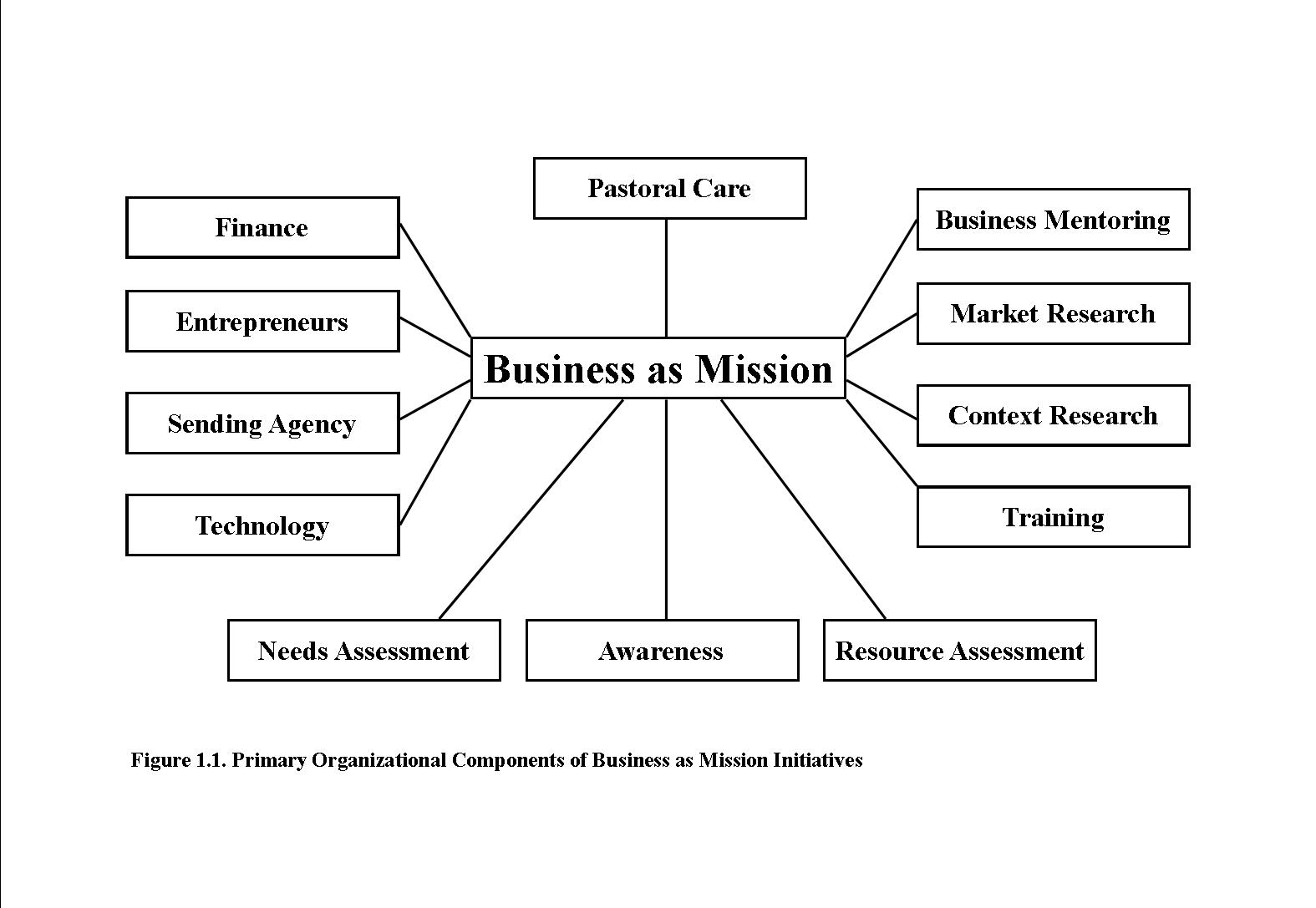
Figure 1.1. Primary Organizational Components of Business as Mission Initiatives shows twelve key elements connected with each business creation. There has been no intentional ordering of these key elements in the diagram other than that of placing Pastoral Care in a predominant position to indicate the vital importance that all BAM initiatives be carried out with spiritual and ethical accountability to the local church. The list of elements included is by no means exhaustive and considering the extent of issues subordinate to these twelve quickly reveals an intense complexity in the overall scheme of undertaking BAM initiatives. This complexity is compounded by viewing BAM as an interdisciplinary undertaking, the (re-)integration of business and ministry which have been falsely bifurcated historically as the doing of business as a Christian and the exercising of the practitioner’s Christian faith were compartmentalized both practically and philosophically.

The general lack of awareness of BAM can be easily documented anecdotally by speaking with a wide range of marketplace Christians, their pastors, and missionaries. This is likely due to BAM, as a formal proposition, having risen into the view of mission agencies and missiologists in just the past decade or two. Actual BAM work has been going on for centuries, as many cite the Apostle Paul, the tentmaker, as the first self-proclaimed bi-vocational (a misnomer) missions practitioner.

Domestic (U.S.) ignorance of other cultures around the world and the arrogance of U.S. exceptionalism often results in demeaning patronage, philosophic imperialism, and resentment among those in receiving locations. The cultural bent among U.S citizens toward addressing issues head-on and dictating solutions, too often like a bull in a glass factory, results unawares in insensitivity which renders “serving the poor” an awkward misstatement of the intended effort.

Marketplace Christians sent as BAM practitioners will require preparation and training, not the least for working cross-culturally but also in areas such as contextually appropriate business modeling and technologies. Indigenous BAM practitioners may require extensive education in business development and practices. Both groups need to be recruited as awareness of needs and opportunities for BAM are defined in a broad range of locations.

Each location targeted for BAM initiatives presents a unique set of circumstances involving local cultural, the needs and opportunities within the community, assessing available (and missing) resources, and understanding the local and national business climate, especially in relationship to local, regional, and national governance. This requires well planned and executed strategies to optimize the success of both the businesses created and the ministerial aims of the mission agency and the local church.

Deployment and coordination concerns not just to the effective ministry of particular marketplace expertise but also to the wide variety of BAM experiences and lessons learned. Sending marketplace Christians into the mission field, whether for short or long term assignments, should be well-documented such that a clearinghouse could provide vital data to enhance and expedite other BAM initiatives. Information and expertise could then be more effectively matched and deployed as the various assessments surrounding each new BAM initiative are completed. The church is a divine enterprise and its ministry outreach to the world requires organizational development and information management no less so than any other charitable or commercial endeavor.

Best practices in undertaking complex tasks are nowhere more critical than in the advancing God’s Kingdom on earth. Sadly, many church and mission agencies neglect understanding the finer points of organizational development. Lacking adequate knowledge leads to marginal success, especially when coupled with limited capacities to anticipate and handle those complexities. This is an area in particular the church can learn from the highly motivated business world to maximize the penetration and impact of BAM initiatives.

27 Comments

Filed under Faith in the Marketplace

On Calling and Works

(This essay is excerpted from my upcoming e-book, Christ in the Marketplace: A Business and Mission Primer.)

“The mind of man plans his way, But the LORD directs his steps” – Proverbs 16:9.

There is confusion surrounding the notion of Christian calling. Many believe they are called to a particular vocation or action, some even that they cannot please God until they find that one thing to do or be in their career. The problem arises in mistaking calling with works. Calling and works do overlap but they are distinct as to how they are understood and performed.

There is but one calling for Christians and that is to obey Jesus’ command, “Follow me.”  Much of the confusion of calling arises out of the inappropriate privatization of the Christian faith, an effect of Western individualism. The mission of God is personal only on the point that the body of Christ is comprised of many individuals. But the Kingdom is more aptly understood in the communal sense.

As we are called to follow Christ, we are called into the community of the Church. Vital relationships are formed within the Church for the purposes of helping all on the path of spiritual growth amidst the normal activities of life, whether in worship, at work or leisure, in serving others, or in times of fellowship. The importance of relationships is likely no more apparent than it is to marketplace Christians who interact daily with customers, employees and co-workers, superiors, vendors, business partners and investors, and the surrounding community.  Partnerships are important within the business as mission movement as it brings together ministry leaders, investors, business leaderships, and the constituencies they serve.

Jeremiah 29:11—‘For I know the plans I have for you,’ declares the LORD, ‘plans to prosper you and not to harm you, plans to give you hope and a future’” (NIV)— is often misappropriated to justifying calling as an individual issue. This highlights the bad practice of taking isolated verses or passages out of context, particularly as this instance reads the presuppositions of individualism (of privatized faith) into Scripture. Jeremiah’s statement was given to the elders of Israel in exile. It was spoken to the whole of Israel as a people, a community of faith, not to any one person.

The call to Christians, corporately and individually, is to becoming holy, taking on the character of God, to becoming “other” in the sense of being different from the world. Holiness cannot be exercised in isolation. It always functions within relationships. Sadly, privatized faith has been a powerful deterrent to the effectiveness of the Church in Western culture as many Christians have assumed a predominantly inward spiritual focus.

God is glorified not so much by the career choices we make but rather by the witness of His character manifest in us. Our “calling” is to be becoming different than we have been. It is a calling to make behavioral and systemic changes in every circumstance. We are “to act justly and to love mercy and to walk humbly with your God” (Micah 6:8). There is no indication that this pertains to certain occupations or is specific to charitable works. Rather, this is indicative of one living out transformed character.

Character is the issue, not any particular pursuit. Consider the “generic” sentiment of Psalm 37:3-5: Trust in the LORD, and do good; Dwell in the land and cultivate faithfulness. Delight yourself in the LORD; And He will give you the desires of your heart. Commit your way to the LORD, Trust also in Him, and He will do it.”

Paul exhorts the church in Thessalonica “to make it your ambition to lead a quiet life and attend to your own business and work with your hands” (1 Thessalonians 4:11). He charges the Corinthians and Colossians that in whatever they do, they should do all “to the glory of God” (1 Corinthians 10:31), “in the name of the Lord Jesus, giving thanks,” (Colossians 3:17), and heartily, as for the Lord” (Colossians 3:23).

There is nothing here about being “called” to particular vocations or even specific acts. Rather, as said, our calling is unto Christ. The “works” we perform within whatever circumstance we find ourselves will glorify God (Matthew 5:16). Simon Peter was still a fisherman after the first Easter (John 21).

The sentiment of Psalm 37:4-5—“Delight yourself in the LORD; And He will give you the desires of your heart. Commit your way to the LORD, Trust also in Him, and He will do it” (emphases mine)—offers insight as to how God views our vocational choices. First, we can see that perhaps God has not chosen specific plans for our lives. There may be specific works that present themselves amidst our journeys with God, but God is able to align our paths, whatever they may be, with specific needs or events.

That alignment is commonly called convergence, which combines our calling to follow Christ, our discipleship (especially through the ministry of the Word and Church), our experience in whatever profession or other interests we pursue, and our passion. There are far more marketplace Christians than any other occupational category (i.e., paid clergy, healthcare and social workers, government or academic employees, and so on). They are called where they are.

Many marketplace Christians are very good at what they do and enjoy their occupations thoroughly. It is in whatever circumstance, professional or volunteer, that they can serve God with the gifts and talents given to us or that we have developed. The heart of Psalm 37:3–5 is “Delight yourself in the LORD.” Knowing and communing with God is our highest passion. But He also knows our temporal interests and a multitude of ministries are birthed out of the intersections of our faith, relationships, occupations, and passions.

For business people this may mean using high incomes to bless the poor, or to bring their gifts to bear in outreach ministries, such as a fishing outfitter or guide service spending quality time with disadvantaged youth. It may mean business leaders mentoring start-up businesses that lack their particular expertise, such as in the disciplines of management practices, leadership development, logistics, technology, or strategic planning. It could be a web designer helping a not-for-profit organization get up to speed on the web and active in social media. Or it could be just being a good employee, looking out for the welfare of their employing company and co-workers. In all cases, God will be glorified as we live into the nature and character of God in our spheres of influence in humility, grace, gentleness, generosity, compassion, diligence and integrity.

Convergence is where God meets us in the details of our own lives to manifest His love for the world. By our works, He makes Himself known. Ultimately, our following Christ, living in the grace and truth of Christ, is our most powerful witness.

As an example of convergence, i.e., the discernment of the works appropriate to my ministry, I share my own experience:

My parents were avid readers and I grew up reading. I enjoy the arts because human stories are studies in psychology, anthropology, culture, sociology, history, and philosophy. My parents loved to travel, so I grew up traveling. I love adventure for the sake of discovering the previously unknown. Their curiosity rubbed off. I want to learn everything about everything so I am an avid researcher. I am a learner and I like to discover the connections (synthesis) between otherwise seemingly disparate topics or arenas of life. I enjoy “exploring” the world of ideas as much as the physical world.

I love reading and studying the Bible and theology, especially about the mission of God and economic concerns. I enjoy writing as it forces me to clarify what I think I have learned. I had a lot of research and writing practice in my undergraduate (English literature) and graduate (world mission and evangelism) studies. One of my top spiritual gifts is teaching.

I enjoy business. It is like a game with lots of rules, decision-making, and strategizing. I have thirty years’ experience in business and administrative management, including fourteen years as a three-time small business founder and owner. I have been “online” for twenty years, communicating professionally via dial-up bulletin boards before the world wide web was invented. I am very project oriented, preferring to undertake work that has closure where accomplishments can be evaluated for future reference.

So, “by coincidence,” I have had a book published (Eden’s Bridge: The Marketplace in Creation and Mission, Wipf & Stock Publishers) on the theology of the marketplace; I have received requests to create e-books on business and mission and on the integration of Christian faith and economics; I have a blog (www.edensbridge.org) on the integration of Christian faith and economics, which also includes devotional and meditation materials; and, I have started writing daily devotionals for mobile device apps.

Many have spoken no truer words than to say that God comes to meet us where we are. That is never more true than in our vocation. God does not necessarily care what occupation we pursue (unless it is something immoral). He does care that we would be salt and light wherever we work.

8 Comments

Filed under Discipleship, Faith in the Marketplace

A question for readers

I am in the process of assembling a business and mission primer for publication in the coming weeks (approximately 45-50 pages). My intent is to first publish it as an ebook but am curious to know what questions folk would like to have addressed. Also, is there any interest in a print version? Some material in this primer is adapted from my book, Eden’s Bridge: The Marketplace in Creation and Mission, but obviously in much less detail and at a much lower price. The aim is to make foundational information more accessible to foster more discussion on the role marketplace Christians have to play in God’s movement in and through the business world.

Let me know your thoughts.

3 Comments

Filed under Announcements, Faith in the Marketplace

After Easter

I think my greatest delight yesterday, amidst all the Easter celebrations, was simply in re-reading in Luke 24. Specifically, I was enthralled by those three little words that are, literally, the crux of our Christian faith: “He is risen” (v. 6).

But now comes Monday. Reminiscent of the time after Christmas when the torn wrapping paper is cleared away, the new toys, clothing, books, and accessories stowed appropriately, the tree and other decorations taken down and stored for another year, and, after all the festivities, the return to school or the workaday world for another year.

What comes after Easter Resurrection? We all, as Christians, have been resurrected in Christ but resurrection is not the end of the story. There is still much to be done. In our resurrection, we receive new life, and that empowered by the Holy Spirit for our transformation from the old, worldly self into the new Kingdom self.

Somehow, in the privatizing of our religion in the last century or so, we have lost sight of what comes after Easter. The Bible’s story of God’s redeeming work, as it extends to all creation, has been muted. Our focus has drawn back and the story seems to end on Easter morn. In the infamous Words of the Apostle Paul, “Heaven forbid!”

God has promised a future and a hope, not just for God-followers but also for the redemption of the earth as God’s Kingdom is already coming “on earth as it is in heaven.” Are you living into that prophetic expectation uttered by none other than our Lord and Savior, Jesus Christ?

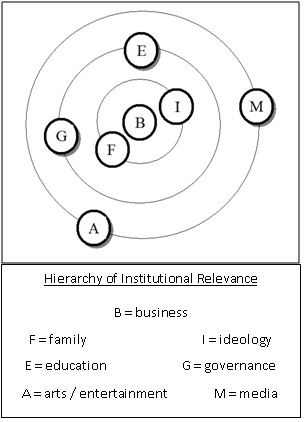
How do we live into the Kingdom now while waiting with expectant urgency for the culmination of the Kingdom as His return? The Church is culpable for where the world is headed. We have the power of heaven backing us to transform the meta-institutions of the world. There is coming a day when the theocracy of Jesus Christ will be fully established. Until that day, we are to be about changing the status quo.

“He is risen indeed.” What are we doing to explain and demonstrate His reign . . . here and now? There is a move of God taking place in the marketplace but thus far it is only a fledgling movement in most quarters. All of God’s people in the marketplace have the opportunity to reach their communities for the cause of Christ. But we have opportunities swelling to reach, and change, the world.

How does your faith translate into good news for the poor? As you read this, there are organizations and movements coalescing around the world, seeking to strategize how to be most effective in advancing God’s agenda in the world. Are you taking part?

As a researcher, I have the privilege of being perhaps more aware than most of some of what God is doing in and through the marketplace to alter the world’s political economy. I am pressing into more research and publishing that I hope will contribute to a growing awareness of that movement and how we each can take greater part. But know this, the Church, especially those Christians living in the luxury of developed economies, is being called out to engage beyond just doing good in their workplace or hometown. We are challenged to challenge our lifestyles, that we would find ways to invest in the poor, whether financially or by education or by prayer, such that the world will look on the Church as a “wise and understanding people” (Deuteronomy 4:6). But our financial culpability is perhaps the most dangerous aspect of our walk with the Lord.

What questions arise for those who hear the cry of the poor and recognize that God is moving in the realms of politics and economics? What information is critical to move us from where we are to where we should be?

This post is an open invitation for engagement. I am planning to publish two or three e-books in the coming weeks. One is on the movement in business and mission, a primer of sorts. A second will consider what Kingdom economics look like. Please join the conversation.

2 Comments

Filed under Discipleship, Faith, Faith in the Marketplace